Newly diagnosed or recurrent malignant brain tumor patients
Primary or metastatic malignant brain tumor patients
The Brain Tumor Team at Linkou Chang Gung Memorial Hospital is dedicated to precision medicine for malignant brain tumors, integrating advanced surgery, translational research, and clinical trials. The team has established a multidisciplinary care model and standardized awake craniotomy procedures to provide safe and effective treatment. Performing more than 120 brain tumor surgeries annually—the highest volume in Taiwan—the team achieves a resection rate exceeding 95%, while over 80% of low-grade glioma patients maintain or improve neurological function one year after surgery. In research, the team developed the NaviFUS focused ultrasound system for blood-brain barrier opening and drug delivery, and continues to advance multiple clinical trials. International collaborations have been established with National Taiwan University, University of California, San Francisco, University of Virginia, and Stanford University. Over the past decade, the team has published more than 130 SCI-indexed papers in molecular oncology, nanomedicine, and focused ultrasound. The team also leads Taiwan’s pioneering clinical trials of focused ultrasound for brain diseases, now advancing into Phase III studies, while leading over 80% of domestic trials involving novel therapies for malignant brain tumors. Through innovation, clinical excellence, and global collaboration, the team continues to improve patient outcomes and strengthen Taiwan’s leadership in brain tumor treatment.
Personalized Surgery for Malignant Brain Tumors: (1) Widely applied to newly diagnosed and recurrent gliomas, (2) Widely applied across gliomas of different malignancy grades, (3) Comprehensive surgical planning integrating cognitive function, tumor parameters, and patient characteristics.
Innovative Translational Research & Development: (1) Blood–brain barrier (BBB) opening, (2) Adjunct approaches to brain tumor radiotherapy, (3) Sonodynamic therapy for brain tumors, (4) BBB opening–assisted liquid biopsy for brain diseases.
Clinical Trials to Benefit Patients: (1) Focused ultrasound clinical trials, (2) Novel drug clinical trials, (3) Cell therapy clinical trials.
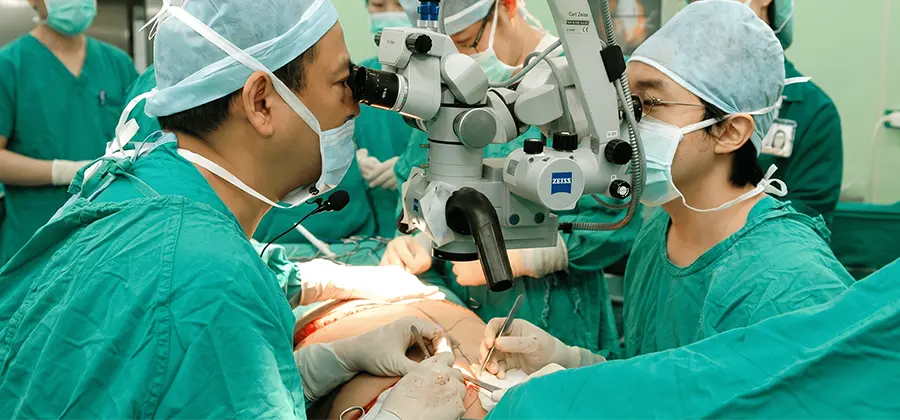
Personalized Surgery for Malignant Brain Tumors: (1) Over the past 10 years, an average of nearly 70 awake craniotomies with intraoperative brain function monitoring have been performed each year. (2) Surgical volumes for newly diagnosed and recurrent gliomas are approximately equal (~50%).
Translational Research: Innovation & Development: (1) Over the past 20 years, team members have secured a total of 98 brain tumor–related research projects, including international-level, national-level, and hospital/institutional grants. (2) In collaboration with Chang Gung University, the team has developed focused ultrasound–mediated blood–brain barrier opening as an internationally innovative drug-delivery platform.
Clinical Trial–Based Therapies: (1) Principal Investigator (PI) for 14 multinational and domestic brain tumor clinical trials. (2) Independently developed a Phase III clinical trial using focused ultrasound to open the blood–brain barrier.
Personalized Surgery for Malignant Brain Tumors: (1) Tumor resection rate > 95%., (2) After implementing function-preserving surgery, the median overall survival of patients with malignant glioma increased from 17.82 months to 26.22 months.
Translational Research: Independently developed a surgically navigated, focused ultrasound–guided blood–brain barrier opening technique, a world-first innovation.
Clinical Trials: (1) Clinical trials of the focused ultrasound system have completed Phase I and Phase II, with the Phase III trial currently ongoing., (2) Successfully mentored and supported a domestic pharmaceutical company to complete an early-stage clinical trial and progress to multinational trials.
Personalized Surgery for Malignant Brain Tumors: (1) Postoperative functional preservation rate: 95%. (2) At 12 months after surgery, nearly 80% of patients maintained or improved their functional status.
Translational Research: Independently developed a surgically navigated, focused ultrasound–guided system with side effects below 2%, enabling treatment to be completed in an outpatient setting.
Clinical Trials: Clinical trials of the focused ultrasound system are non-invasive, with high patient acceptance.
Patient satisfaction with the brain tumor surgical team is over 95%.
The treatment completion rate for focused ultrasound–mediated blood–brain barrier opening is over 98%.
Focused ultrasound clinical trial treatments have been delivered in more than 100 patient sessions.
Novel findings on how glioma invasion of the periventricular region affects patients’ cognitive function were selected for oral presentations at the world’s largest neuro-oncology meeting, the Society for Neuro-Oncology (SNO), for two consecutive years (2024, 2025), and were published in the leading neurosurgical journal Neurosurgery (2025).
The neuronavigation-guided focused ultrasound system was recognized by the top-tier journal Nature Reviews Neurology (2021) as one of the world’s three major systems.
Served as the lead investigator for applying the locally developed drug ADI in patients with malignant glioma, and led the multinational clinical trial as the overall Principal Investigator (PI) (Dr. Kuo-Chen Wei).
Led and promoted personalized awake glioma surgery with intraoperative brain function monitoring, both domestically and internationally.
Led and advanced clinical trials and innovative applications of focused ultrasound for patients with malignant brain tumors.
Directed more than 80% of the domestic clinical trials involving new drugs and novel therapies for malignant brain tumors, and further expanded locally developed new-drug trials into multinational studies, bringing Taiwan’s R&D achievements to global clinical application.