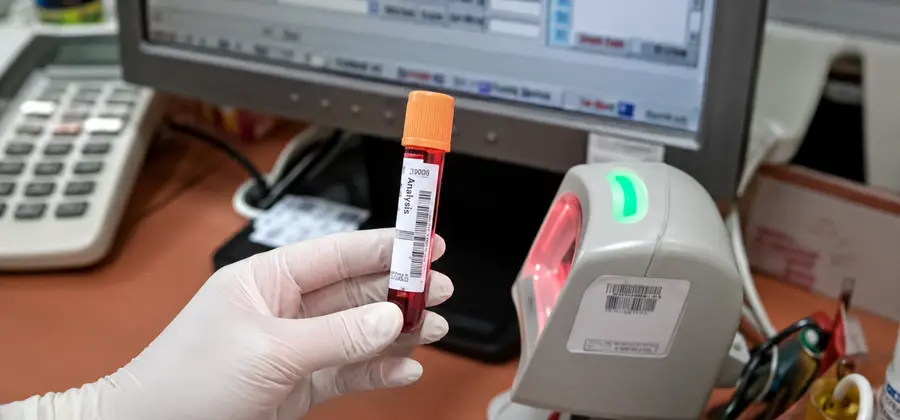
The entire hospital's clinical medical team and patients submit pathology specimens for testing.
The AI module is executed by the pathologist.
In order to promote patient safety, we have reformed the work flow of the specimens of Department of Pathology, examination rooms of various departments, and operating rooms. First of all, we adopted an automatic marking system to replace manual writing for eliminating errors caused by unclear marking on specimen bottles, tissue cassettes or slides. At the same time, a QR code system was employed as the basis for specimen identification, and a dynamic tracking system for tissue processing was built to reduce the risk of tissue loss, to improve the skills of medical technologists, to improve work quality and efficiency, and to innovate the warehousing management of tissue blocks. Then whole slide scanners were introduced. Based on this barcode system, we integrated a digital slide management/reading system and laboratory information system, and successfully launched digital pathology workflow, which allowed us to achieve remote pathology consultation, to establish online review mechanism, to apply precision measuring tools, to increase the efficiency of multidisciplinary team meetings, and to enrich pathology teaching database. We also successfully implemented the artificial intelligence-assisted mode in pathological interpretation. Our next-generation tissue diagnostics platform not only creates a seamless pathological quality system, but also accelerates the medical application of artificial intelligence.
First in Taiwan to digitalize all pathology slides: aetherSlide platform with high-throughput whole-slide scanners deployed in 2019 at 100% scanning rate.
QR code closed-loop workflow: unique identification across all 6 steps from extraction to interpretation.
Tissue block warehouse management: upgraded from serial-number archive to QR code system.
Five AI-assisted interpretation modules: nasopharyngeal cancer detection (AUC=0.99), gastric lymph node segmentation, glomerular lesion classification (AUC=0.982), colorectal cancer lymph node metastasis (AUC=0.999), breast HER2 FISH counting (99.173% sensitivity).
Remote review and team conferences: 689 new cancer cases/month moved online (>40 hours saved); 50 multi-disciplinary conferences/month saved >50 hours.
Number of surgical specimens per year: 120,687
Number of pathology slides: 1,250 slides/day
Surgical pathology report turnaround compliance (3-6 days by complexity) improved from 94.48% (2010) to 99.97% (2020).
frozen section 30-minute report compliance from 89.99% (2010) to 93.98% (2020);
aetherSlide digital pathology platform with high-throughput whole-slide scanners; daily scanning of 1,250 slides at 100% execution rate.
surgical pathology specimen anomaly rate from 0.05% to 0.01%
Pathologists generally expressed satisfaction or high satisfaction with the use of AI-assisted interpretation modules, with over half of them expressing high satisfaction with the gastric cancer lymph node image segmentation and cancer cell detection module.
Compared with domestic (NTUH, Taipei VGH, Taichung VGH, NCKU), Asian (Seoul Nat Univ, Kameda, Kyushu, Nagasaki), and Western (MSKCC, Mayo Clinic, Spain de la Salud) hospitals: leads globally in slide barcoding, warehouse informatization, comprehensive slide scanning, platform integration, AI applications, and digital pathology for routine and remote diagnosis.