Patients with attention-deficit/hyperactivity disorder
The diagnosis of attention-deficit/hyperactivity disorder (ADHD) is primarily based on the presence of core symptoms, supplemented by the use of rating scales. However, both approaches are highly subjective. As a result, overdiagnosis and underdiagnosis remain persistent challenges in clinical practice.
To achieve a comprehensive and objective assessment of motor activity and attention in patients with ADHD, our team has developed a simulated classroom system. This system consists of a desk-and-chair setup, a large display screen, three cameras, and four load cells installed under the legs of the chair. Load cells are force-sensitive components that undergo deformation in response to applied force, generating corresponding signal changes based on the magnitude of the force. These signals are used to detect activity patterns of patients with ADHD while watching videos.
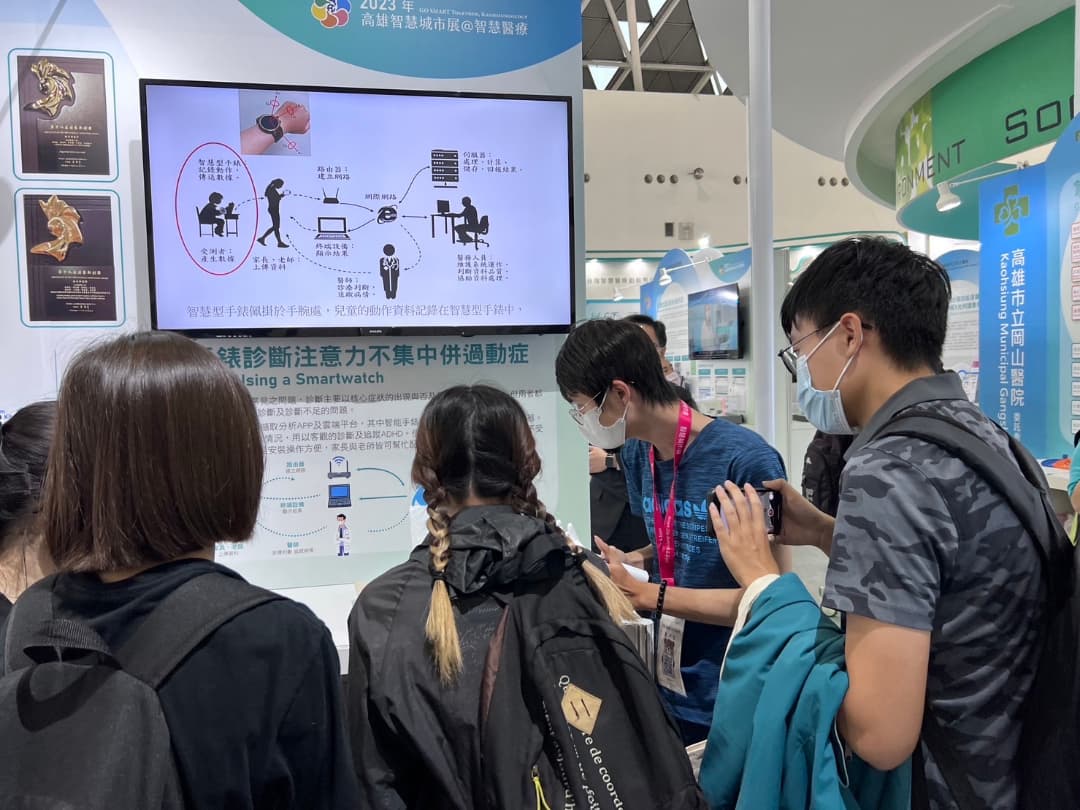
In addition to recording skeletal movements, the cameras are primarily used to detect eye movements, thereby providing an objective measure of inattention. Furthermore, children are equipped with a smartwatch capable of capturing motion-related data. Through this integrated approach, we aim to develop a comprehensive and objective diagnostic and assessment tool for ADHD and facilitate its application in clinical settings.
In addition to providing a more objective assessment than traditional rating scales, the key feature of the simulated classroom lies in the development of an integrated monitoring system that connects the child, parents, teachers, and physicians. This system enables the recording of children’s movements and attention levels without interfering with their daily routines, thereby providing objective data to relevant stakeholders. Activity details can be sensed and recorded within the simulated classroom, with the ultimate goal of extending such recordings to natural environments, including both classroom and home settings.
Since its implementation, the system has been used to assess more than 600 patients.
The diagnostic accuracy of this approach is nearly twice that of traditional rating-scale–based assessments.
All patients with ADHD undergoing clinical evaluation are assessed using the simulated classroom system.
The smartwatch, cameras, and chair developed by our team minimally interfere with children’s daily activities.
These devices are commonly used by children with ADHD in their daily lives and pose no safety concerns.
Parents of patients reported that the use of the simulated classroom for ADHD assessment was highly convenient and provided a more objective evaluation.
Representatives from the education industry union visited our hospital and expressed strong interest and high satisfaction with the simulatedclassroom system
Our team has published more than ten international peer-reviewed journal articles on automated detection and assessment of ADHD.
Our team received the National Innovation Award and the Excellence Advancement Award for the use of smartwatches in the diagnosis of ADHD.
Compared with the SNAP-IV scale commonly used in clinical practice, this approach achieves nearly twice the diagnostic accuracy of traditional rating-scale–based assessments.
The magnitude of a child’s movement while seated can reflect the degree of hyperactivity, enabling an automated and objective evaluation of treatment efficacy following medication.