FJCUH employs a top-down organizational management strategy to implement concrete policies. All staff members are encouraged to participate and uphold the spirit of sustainability.
1. Leadership Strategy
The Superintendent has led the Administrative Deputy Superintendent, Medical Humanities Office, Human Resource Office, Accounting Office, and General Affairs Office to establish the Sustainable Development Promotion Task Force. Plans devised by the task force focus on greening measures, site water retention, daily energy conservation, CO₂ reduction, indoor environment improvement, water resource management, waste reduction, and sewage and garbage treatment enhancements.
2. Sustainable Operations
The hospital infrastructure adheres to the certification standards of EEWH, which is Taiwan Green Building Label, by incorporating environmentally friendly, lightweight, and earthquake-resistant steel structures and maximizing the use of natural light to enhance energy efficiency. Extensive greenbelt areas and scenic landscapes are also integrated into the hospital venue. This approach emphasizes minimizing environmental and energy impacts throughout the building lifecycle from material production, architectural planning, and design to construction, operation, management, and eventual deconstruction. The hospital aims to embody a gold-level certified green building with minimal waste production and sustainable use of local materials.
A rolling mechanism is employed to periodically review implemented energy-saving measures, develop successive energy conservation plans, and conduct annual performance evaluations of equipment efficiency.
Performance over the previous three years (annual averages):
Overall energy savings rate: 3.64%.
Average energy savings equivalent: 78.8 Kl of oil.
Reduction in CO₂ emissions: 389.3 t.
Average electricity consumption reduction: 750.4 kWh.
The hospital energy use intensity value (e.g., the EUI value in 2023 was 157.9) indicates top-tier energy-saving performance among regional hospitals.
Average annual growth of 7.8% in outpatient and emergency visits over three years
Average annual growth of 9.1% in hospitalization days over three years
Total of 4,229 lighting fixtures in the hospital (551 for 15-hour lighting, 2,745 for 10-hour lighting, 933 for 8-hour lighting)
Total of 16 elevators equipped with energy recovery systems (6 visitor elevators, 9 patient bed elevators, 1 emergency fire elevator)
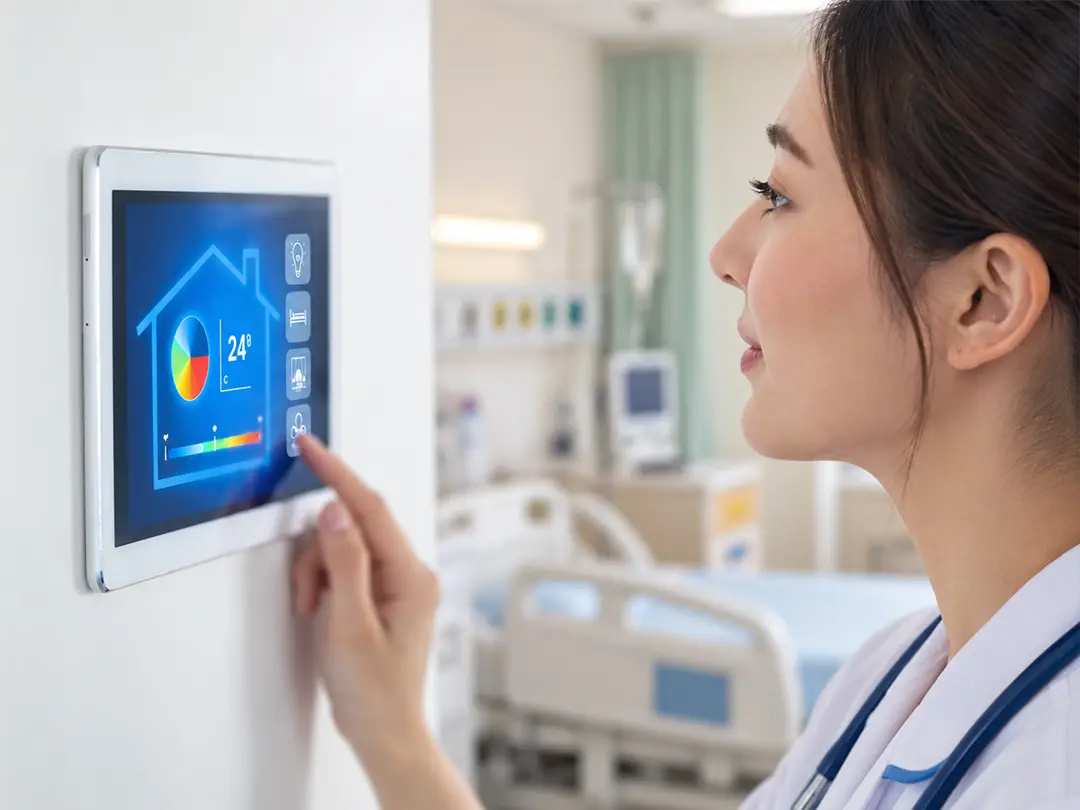
Hospital-wide space temperature management: 55.82 thousand kWh electricity saved/year, 5.33 barrels of oil equivalent/year energy benefit, 27.63 tons CO2 reduction/year, 187.6 thousand yuan cost savings/year
Hospital-wide lighting fixture replacement: 315.8 thousand kWh electricity saved/year, 30.2 barrels of oil equivalent/year energy benefit, 156.3 tons CO2 reduction/year, 1,061.2 thousand yuan cost savings/year
Infrared sensor addition to lighting fixtures: 7.4 thousand kWh electricity saved/year, 0.7 barrels of oil equivalent/year energy benefit, 3.7 tons CO2 reduction/year, 24.8 thousand yuan cost savings/year
Elevator energy recovery system: 166.94 thousand kWh electricity saved/year, 15.95 barrels of oil equivalent/year energy benefit, 82.5 tons CO2 reduction/year, 560.93 thousand yuan cost savings/year
Cooling tower wet bulb operation control: 135.77 thousand kWh electricity saved/year, 12.97 barrels of oil equivalent/year energy benefit, 67.07 tons CO2 reduction/year, 456.16 thousand yuan cost savings/year
Operating room nighttime energy-saving measures: 82,000 kWh electricity saved/year
Microwave oven timer safety device patent application, set 2-minute as optimal usage time to prevent food carbonization and fire alarm activation
Women's Center waiting area optimization on 3rd floor: restored automatic door sensors to reduce external heat infiltration
Hospital-wide temperature management standards: medical spaces (20~22°C), non-medical spaces (23~26°C), public areas (24~28°C)
Outpatient environmental safety satisfaction rate: 87.60% in 2021, 93.90% in 2022, 96.20% in 2023
Inpatient environmental safety satisfaction rate: 90.00% in 2021, 92.30% in 2022, 94.00% in 2023
Participated in 2024 Ministry of Economic Affairs Energy Conservation Excellence Award selection, advanced to final round in August 2024
Evaluating adoption of ISO-14064 and ISO-50001 certification systems
Total energy-saving and carbon reduction achievements in recent three years: 3.64% oil reduction, 78.8 barrels of oil equivalent saved, 389.3 tons CO2 reduction, 750.4 thousand kWh electricity saved (approximately 2.29 million yuan/year)
Outpatient and emergency per-capita electricity usage decreased by average 9% over three years, inpatient per-capita electricity usage decreased by average 10.2% over three years
2023 EUI value of 157.99, ranking within top 25 (ranked 85 in 2020, 86 in 2021, 38 in 2022, 38 in 2023, 21-23 in 2024)
Short-term target (2024~2025): 1% carbon reduction
Medium-term target (2025~2030): 2% carbon reduction
Long-term target (2030~2050): 5% carbon reduction and achieve net-zero emissions