Adult health screening population
Potential population with asymptomatic kidney stones
Hospital health examination and preventive medicine departments
Urology clinical healthcare professionals
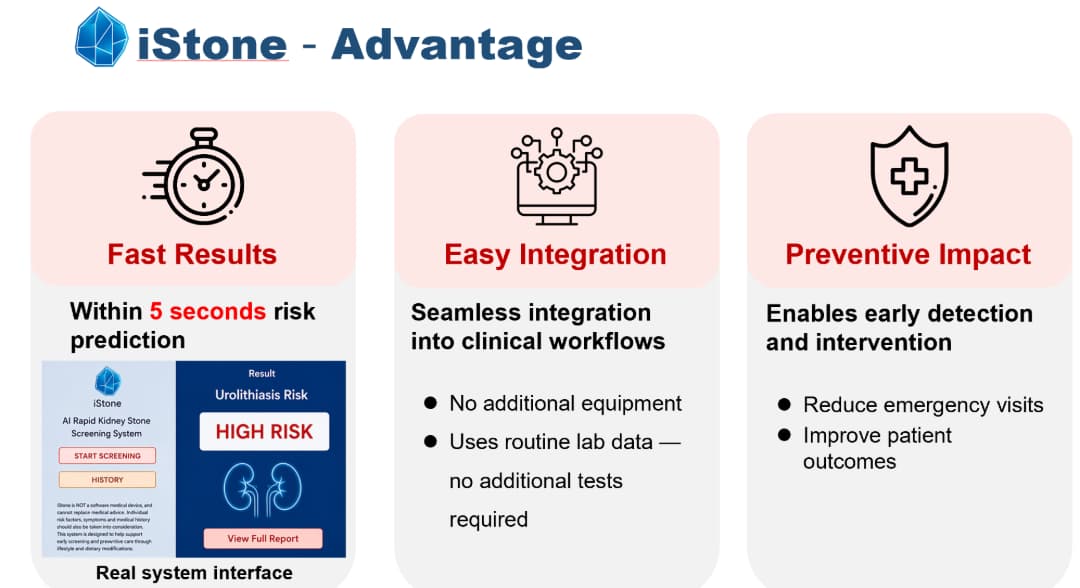
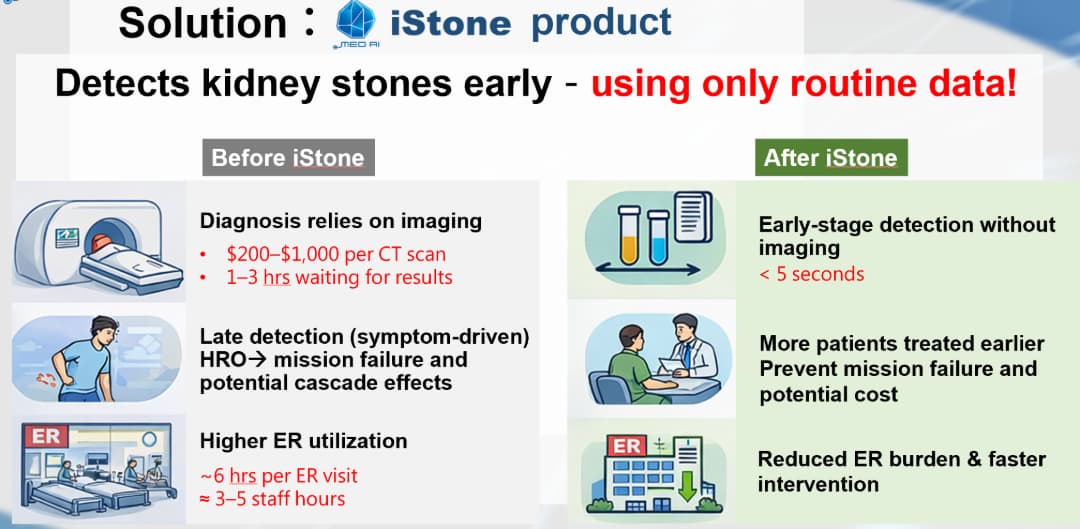
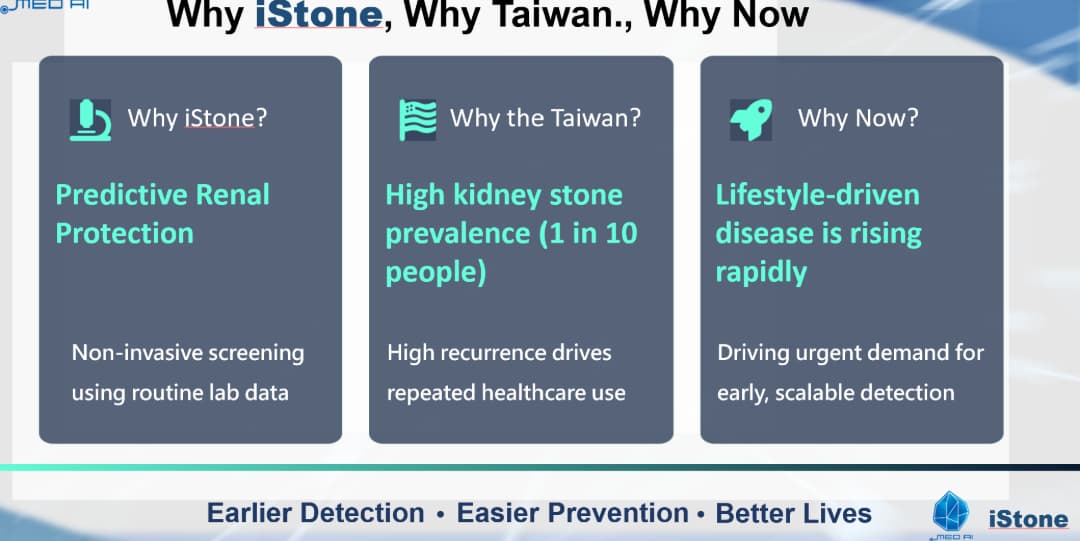
iStone is an artificial intelligence–based kidney stone risk screening system that analyzes existing urine and blood laboratory data to assist healthcare professionals in rapidly identifying individuals at high risk of kidney stones, without the need for imaging studies or additional invasive examinations.
The system focuses on the clinical needs of early detection and preventive intervention, particularly for individuals who have not yet developed symptoms but may already carry an elevated risk of kidney stone formation. By leveraging routine laboratory data, iStone provides a highly accessible and cost-effective screening support tool.
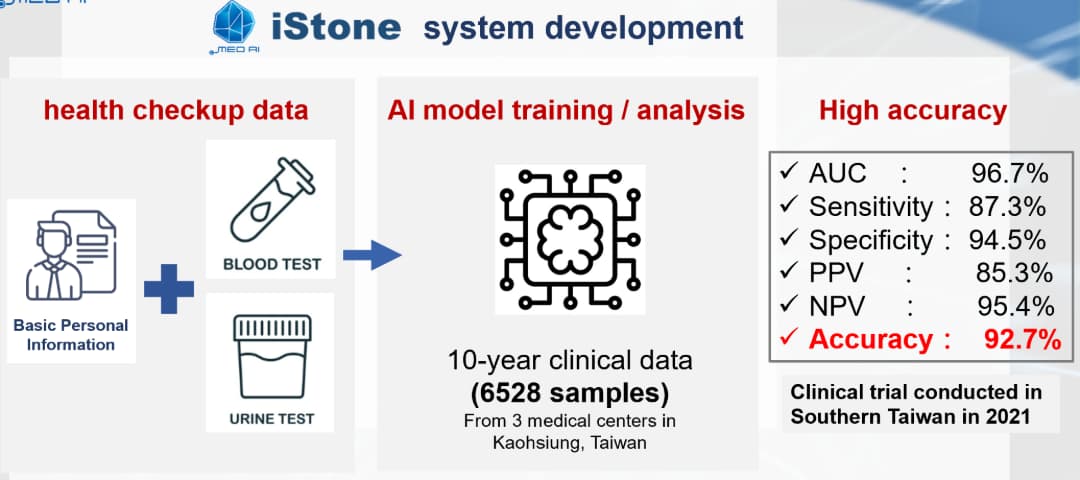
iStone has been validated using clinical data and demonstrates reliable predictive performance. It can be seamlessly integrated into existing hospital information systems, enabling frontline health check-up and clinical settings to access risk information in real time and support patient education, follow-up, and clinical decision-making.
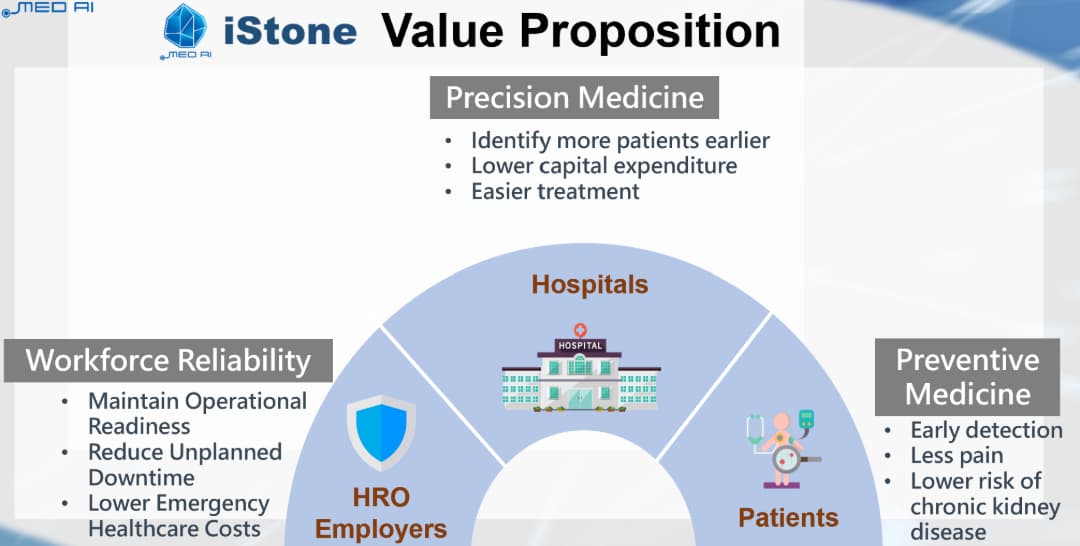
Through the implementation of AI-assisted screening, iStone aims to reduce the risk of acute stone episodes and related complications, alleviate the overall healthcare burden, and promote a shift in kidney disease management from treatment-oriented care toward preventive medicine.
Non-imaging, non-invasive AI-based kidney stone risk screening, using artificial intelligence models to support early identification of high-risk individuals.
Analysis based on existing urine and blood laboratory data, requiring no additional tests and reducing screening barriers and costs.
Seamless integration into existing health check-up and clinical workflows, with clinically validated performance to enhance healthcare efficiency and support preventive intervention.
About 20 health-check visits per week
500 individuals served to date
Early treatment stabilized renal function
The AI model demonstrates strong predictive accuracy, with an overall accuracy of 92.7%.
Non-invasive screening with no additional medical risk.
Does not interfere with existing clinical decision-making workflows.
Patient data are stored within the hospital to ensure data security.
Patient and physician satisfaction >95%
Early stone detection improves treatment efficiency
Reduced emergency visits and healthcare burden
Helmut Haas Award” at the 2024 European Association of Urology (EAU)
Chen HW, Lee JT, Wei PS, Chen YC, Wu JY, Lin CI, Chou YH, Juan YS, Wu WJ, Kao CY. Machine learning models for screening clinically significant nephrolithiasis in overweight and obese populations. World J Urol. 2024 Mar 9;42(1):128. doi: 10.1007/s00345-024-04826-4. PMID: 38460023.
Enhances the quality of early kidney stone screening domestically and internationally by leveraging AI-assisted risk identification to strengthen preventive medicine and consistency in clinical decision-making.
Facilitates the establishment of non-invasive kidney stone care standards through reproducible, data-driven screening and follow-up workflows.
Improves patient care outcomes and healthcare accessibility by enabling earlier intervention and reducing the risk of acute episodes and related complications.
Supports healthcare sustainability and resource efficiency by reducing unnecessary examinations and healthcare expenditures, thereby alleviating system burden.