Critically ill patients
Led by nursing professionals, our hospital integrates nursing practice, critical care medicine, information engineering, and artificial intelligence technologies to develop a Comprehensive Modular AI System for Critical Care Nursing.
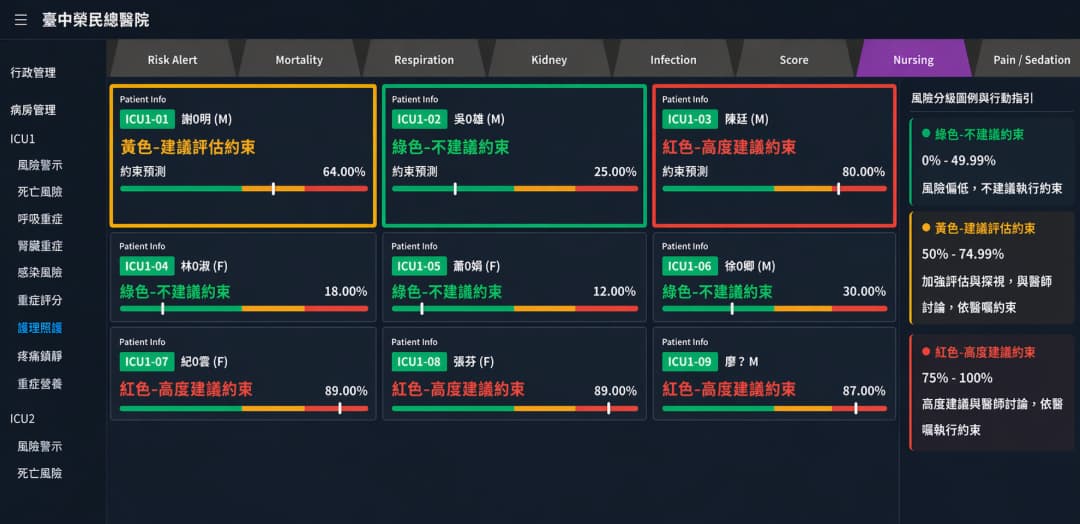
The system addresses three high-risk clinical care scenarios—agitation (RASS), physical restraint risk, and acute delirium—and incorporates IoT-based real-time urine output monitoring and alerting, as well as intravenous medication Y-site compatibility assessment, to support the establishment of a comprehensive critical care and patient safety management framework.
The system automatically retrieves patients’ clinical data from the preceding eight hours and performs continuous 24-hour real-time inference and risk stratification. Through real-time alerts for abnormal urine output and medication compatibility assessments, the system provides timely clinical decision-support information, enabling nursing staff to intervene at an early stage. All modules are delivered through visualized interfaces to support clinical nursing practice.
The system has been implemented in five adult intensive care units, generating an average of over 6,200 inferences per day with a 100% system operation rate. Following implementation, the physical restraint rate decreased from 5.62% to 4.89%, the incidence of delirium declined from 27.63% to 23.85%, and nursing task time was reduced from an average of 8 minutes to 2 minutes and 34 seconds, collectively contributing to enhanced patient safety and improved care efficiency.
First-of-its-kind integration of multi-dimensional clinical data and AI technologies to perform automated RASS classification and acute delirium risk prediction, combined with a clinical decision support platform to assist in sedation medication adjustment, establish preventive mechanisms, and enhance patient safety.
Integration of AIoT-based real-time urine output monitoring and analysis, providing immediate alerts for high-risk conditions such as oliguria and polyuria.
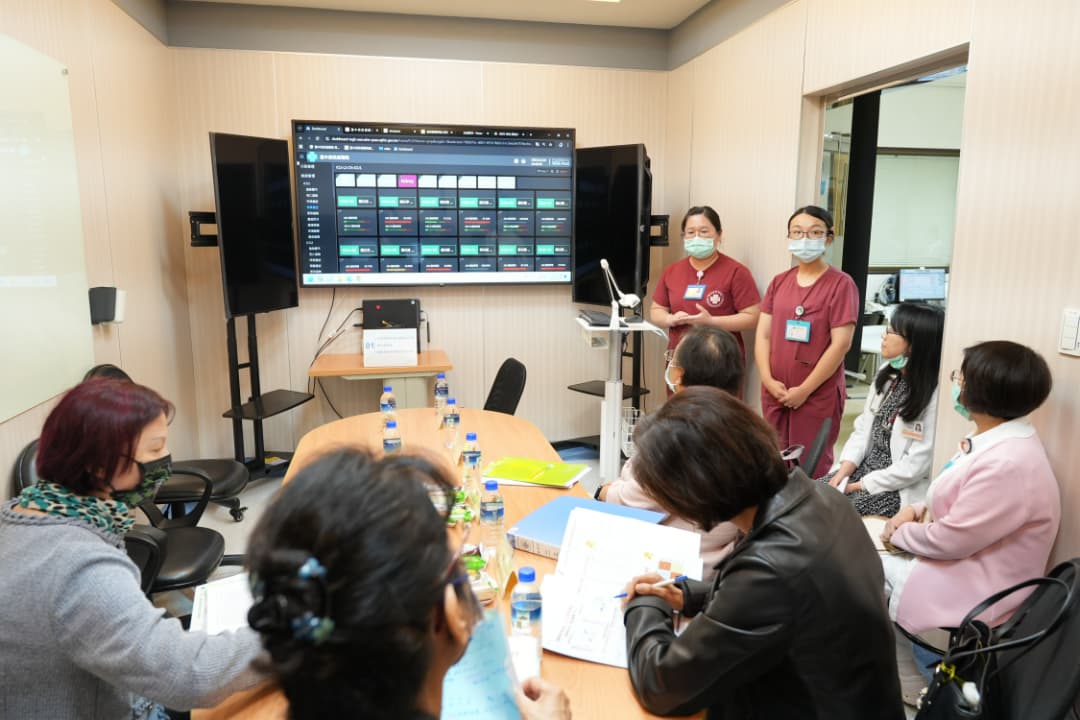
Visualization interfaces present risk assessment results, care recommendations, and intravenous medication compatibility evaluations, supporting routine clinical nursing workflows.
The intelligent critical care prediction modules have been implemented across five adult intensive care units, covering a total of 114 beds.
AI inference results are updated on an hourly basis, generating over 6,200 prediction outputs per day, with a 100% system operation rate.
The incidence of delirium decreased from 27.63% to 23.85%, representing an improvement of 13.68%.
The physical restraint utilization rate decreased from 5.62% to 4.89%, corresponding to an improvement of 12.99%.
Assessment task time was reduced from 8 minutes 0 seconds to 2 minutes 34 seconds, achieving a 68% reduction.
Manual urine emptying and documentation time decreased from 9 minutes 30 seconds to 5 minutes 05 seconds, resulting in a 46.5% time savings.
The RASS classification model achieved an overall AUROC exceeding 0.80, with prediction results showing a high level of agreement with manual clinical assessments.
The incidence of unplanned device self-removal decreased from 2.36% to 2.28%, representing an improvement of 3.39%.
The IoT-based patient output alert and monitoring system achieved urine output measurement accuracy with an error margin of ≤ 5 mL.
The incidence of intravenous medication incompatibility decreased from 20.2% prior to implementation to 0.06%, remaining below the international benchmark of 4.4%.
The ICU staff retention rate increased from 90.3% to 96%, while the turnover rate decreased from 9.7% to 4%.
Nursing staff satisfaction averaged 4.17 out of 5 points, with 82% of respondents reporting satisfaction scores of 4 points or higher..
Establishing a model for smart nursing: A total of 13 invention patents related to smart nursing have been granted.
Achievements in AI clinical applications: Over a five-year period (2020–2025), eight nursing-related AI research articles have been published in domestic and international journals.
Model with international dissemination potential: In 2024, domestic and international visits focusing on smart nursing and smart healthcare involved participants from more than 40 countries, totaling 377 visitors.
Provides timely and objective clinical risk assessments, enhancing the quality of critical care and patient safety.
Integrates AI-driven decision support into clinical workflows, establishing standardized and scalable care practices.
Implements preventive and restraint-free care models to improve patient care outcomes while preserving patient dignity.
Reduces repetitive nursing workload, improves care efficiency, and supports sustainable healthcare workforce development.