Nurse 2. Medical Team
Healthcare and IT experts have collaborated across domains to develop an "Assistive Nursing Record Processing Device" to address pain points such as time-consuming nursing records and the difficulty of recognizing mixed Chinese and English languages. This device utilizes Generative AI (GAI) to automate nursing records.
Core Technologies and Functions:
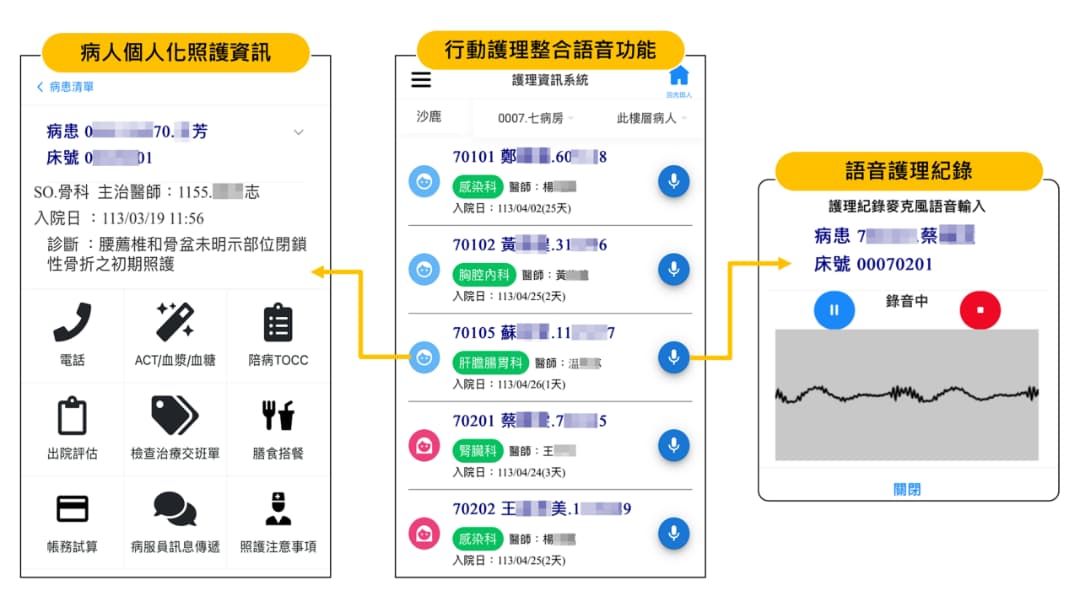
Efficient Automatic Speech Recognition (ASR): Overcomes recognition barriers presented by mixed Chinese and English medical terms and drug names. Nurses only need to narrate via mobile phone, and the system can accurately convert speech to text, eliminating the need for manual, repetitive corrections.
LLM Automatic Writing: Combines large language models to automatically generate descriptive nursing records that comply with medical standards from the spoken content.
Semantic Voice Command Integration:
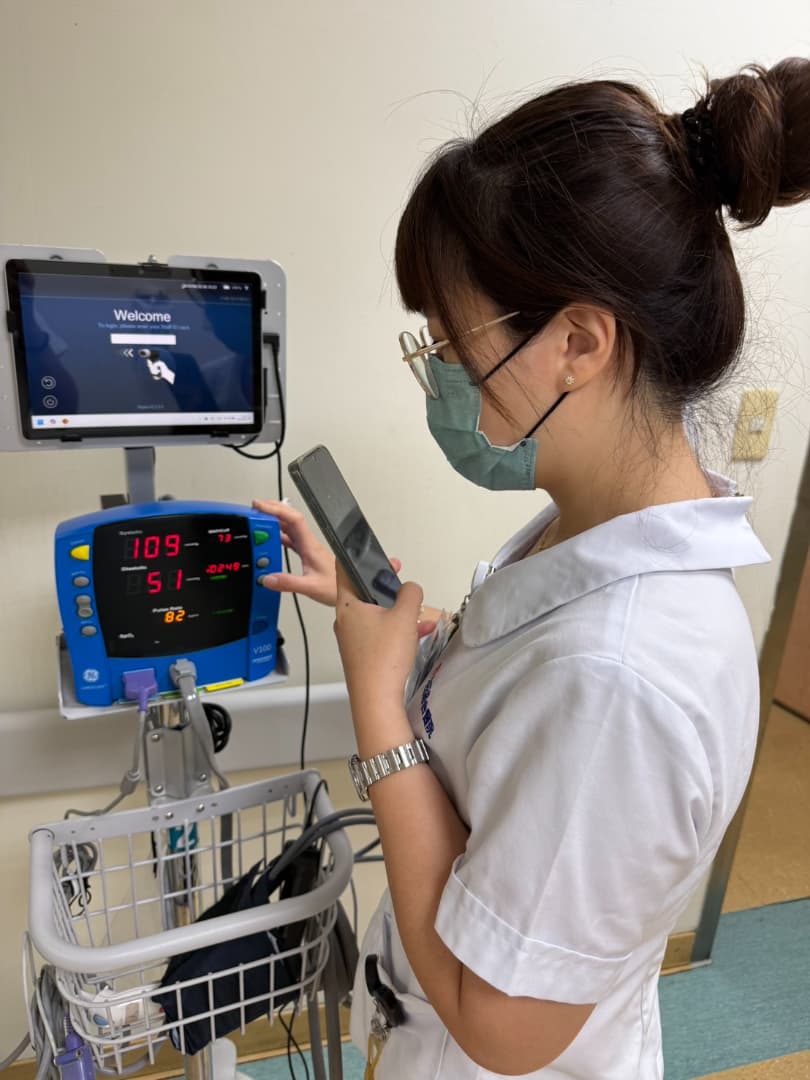
Supports real-time voice commands to interface with external data such as medication, lab results, and vital signs, achieving one-click integration. Through automated workflows, it reduces the documentation burden and enhances recording efficiency and accuracy, allowing nurses to dedicate more time to patient care.
The system is composed of three major modules: the "Nursing Record Generation Module," the "Retraining Module," and the "Backend Management Module." This project conducted a complete evaluation of information technology implementation from the perspectives of demand, technology, and cost, utilizing GAI to build an AI nurse.
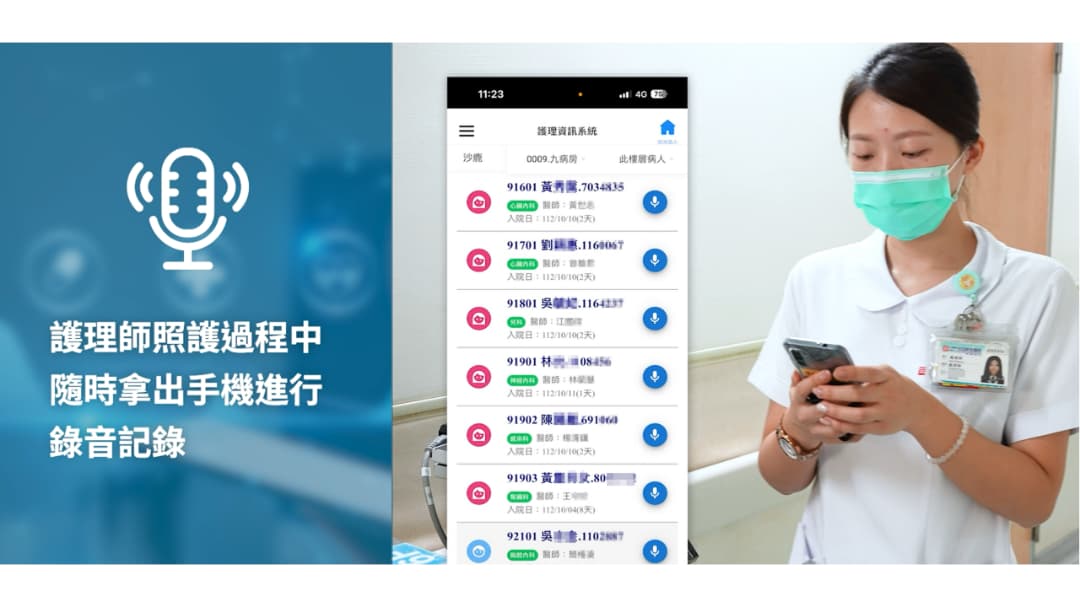
Nurses can use voice input to narrate care records. The content is converted to text via ASR, then corrected and standardized by the LLM to generate nursing records that meet internal hospital standards.
During the narration process, nurses can also simultaneously issue voice commands to execute corresponding tasks, assisting in the collation of nursing records. After the nurse edits and confirms the draft, it is converted into a formal nursing record, further saving the time nurses spend manually entering records.
Self-development cost savings: 67.6%
The process from recording → AI analysis to generating records takes an average of 28.2 seconds; one-click generation takes <6 seconds.
Nurse usage adoption rate: 94%
The operational effectiveness of implementing AI nurses: voice recognition accuracy rate 92.1%.
AI record generation accuracy rate: 95%.
Medical jargon accuracy rate: 98%.
The fall injury rate decreased by approximately 11.76% from year 112 to 113.
The absolute value of the fall injury rate decreased by 5.28 percentage points.
The infection density decreased by 0.24‰ (approximately 15.29%) between year 112 and 113.
Nurse usage satisfaction rate: 90%
Nurse satisfaction with AI-generated records: 8.4 (Note: the original number in the image is 8.4)
Average personnel cost savings per nursing record: 16 NTD
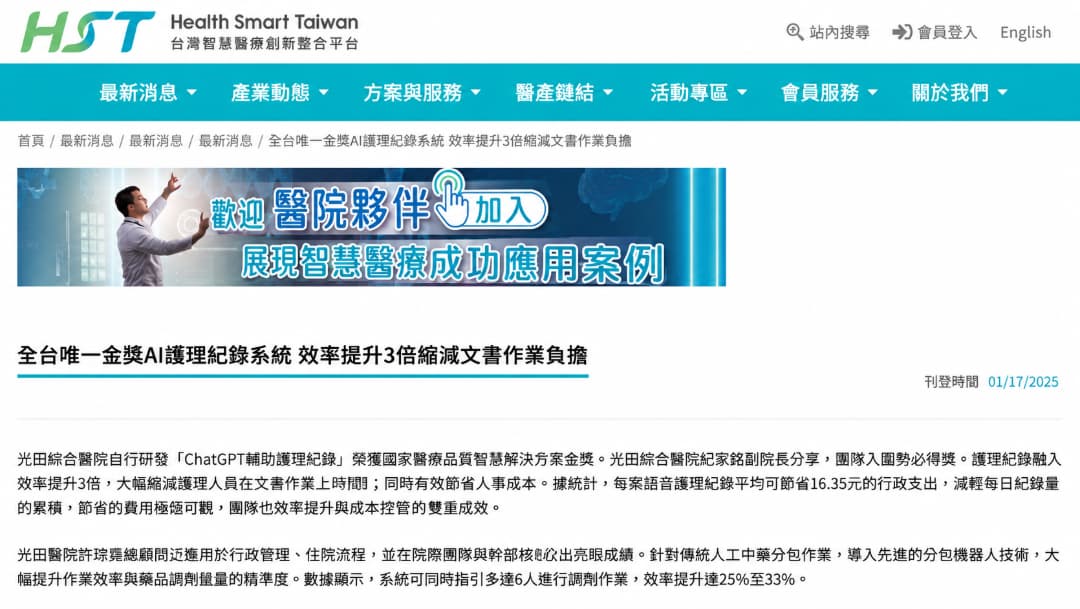
Received the Gold Award in Smart Care at the 2024 National Healthcare Quality Award (NHQA), presented by the Joint Commission of Taiwan (JCT).
Received the Medical Technology Team Award at the 2024 Medical Technology Awards, presented by the Healthcare Systems Consortium (HSC).
Participated in the 2023 Taiwan Healthcare+ Expo
1. Kuang Tien General Hospital Introduces AI Nurses with Remarkable Results
In-house development cost savings: 67.6%
Personnel cost savings per record: approximately NT$16
Nurse usage satisfaction rate: 90%
Nurse adoption rate: 94%
2. Improvements in Medical Quality
Both the fall injury rate and infection density were significantly reduced.
AI voice recognition and record generation accuracy rates both exceed 92%.
3. Overall Benefits
Overall benefits include improved operational efficiency and enhanced care quality