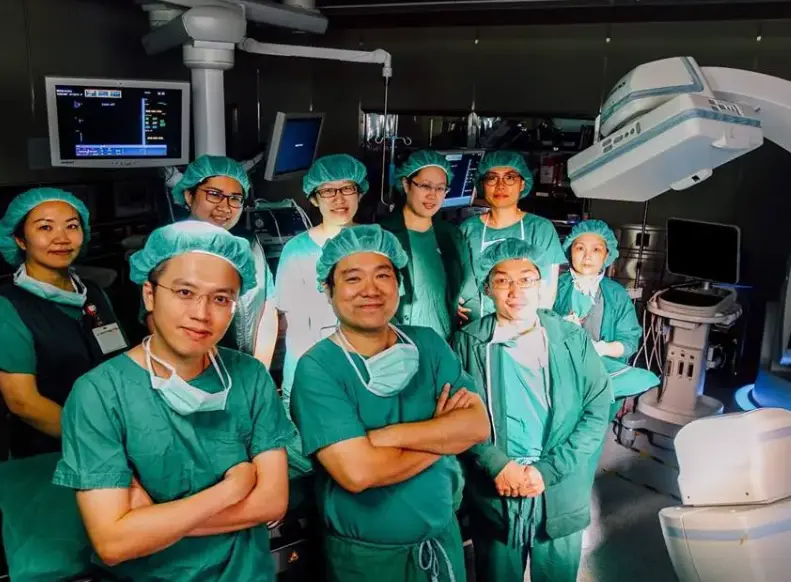
A leaders' dialogue at the second Asia-Pacific Healthcare Quality Forum: ICHOM, the European Union of Private Hospitals, Stanford University and three Taiwanese hospitals on measurement, clinical use, and the obstacles that remain.
AI has begun to take part in generating notes, predicting risk and managing care. But what do patients gain? Is the load on clinicians any lighter? And can one successful application keep running at another hospital?
On 6 December 2025, the second Asia-Pacific Healthcare Quality Forum held a leaders' dialogue on advancing healthcare quality through technology, smart innovation and data, chaired by Yu Chong-jen, superintendent of National Taiwan University Hospital. International quality experts and representatives of Taiwanese hospitals discussed how technology can improve care - from quality measurement to clinical application to international collaboration - and the difficulties that remain in practice.
Opening the session, Yu said hospitals need to integrate data and connect it to care outcomes. What outcome you want to improve should be the starting point for choosing both measures and technology.
Jennifer L. Bright, president and chief executive of the International Consortium for Health Outcomes Measurement (ICHOM), said digital tools and AI make it far more feasible to collect, analyse and feed back data in real time - but the first question is which information genuinely reflects a patient's experience and needs.
She used pain as an example: even if technology can read the degree of pain from an image, the care team has to regard pain as an important outcome before it will be measured at all. Questionnaires, sensors and digital platforms will keep evolving; what the patient is going through, and which changes are worth attention, remain the basis for choosing what data to collect.
Cases from Taiwanese hospitals brought the discussion back to the clinical floor.
Chang Shih-sheng, director of the AI and robotics innovation centre at China Medical University Hospital, described an ECG application for acute myocardial infarction that cut door-to-balloon time by about 16 minutes, and brain CT analysis that helps identify large vessel occlusion so teams can assess further treatment earlier.
Chen Liang-kung, superintendent of Taipei City Hospital Guandu Branch, explained that confirming whether staff had repositioned patients on schedule used to rely mainly on care records. With pressure sensing in place, the team can observe actual repositioning, bed exits and activity, and adjust care accordingly.
Since the system came into use, he said, falls at the bedside have become rare and no new pressure injuries have been observed - though patients may still fall elsewhere. Sensor data lets the team track how care is delivered alongside patient outcomes, and see more clearly where the improvement occurred.
How quality data is used matters as much as collecting it. Wang Chih-hung, director of the Center for Policy, Outcomes and Prevention at Stanford University, said digital technology can lower the sampling and collection costs of quality measurement, but that once a gap is found, cross-disciplinary coordination and behaviour change are still what improve care.
He added that quality reporting has to balance acceptability to hospitals against usefulness to patients choosing care. If results are linked to payment, representativeness, sampling bias and analytical method matter all the more; cross-country comparison also has to account for local conditions.
Bright stressed that information should be fed back transparently to patients and families. When patients take part in designing the tools and understand how the data is used in their own care, there is a better chance of building trust and shared decision-making.
Lee Wei-chiang, deputy superintendent of Taipei Veterans General Hospital, described how the hospital obtains the data and engineering resources AI development needs through cross-hospital and technology industry collaboration. A single hospital's data has limits, which is why cross-hospital collaboration and federated learning are priorities.
In daily operations, the hospital uses automatic summarisation of nursing records and integration of care information to answer clinical needs, and uses robots and digital tools to reduce some manual work and staff exposure to chemotherapy drugs.
China Medical University Hospital takes an in-house development approach. Chang said the hospital has around 50 AI engineers, and places engineers or product managers inside departments to understand directly what users want solved and where in the workflow a tool should help.
Once a note is generated automatically, clinicians still have to check it, and the time spent reviewing should be counted.
Wang Chih-hung - director, Center for Policy, Outcomes and Prevention, Stanford University
Once a tool is in use, time saved still has to be assessed across the whole process. Fast generation, Chang noted, does not mean a physician's working day shortens by the same amount.
Oscar Gaspar, president of the European Union of Private Hospitals, offered a similar observation: Europe has excellent digital health cases, yet some hospitals feel costs rising without seeing enough overall benefit. One reason, he suggested, is that tools have not yet been applied systematically or changed daily work sufficiently.
From developing around user needs to the checking and operation that follow, all of it falls within what a hospital has to examine when judging whether workload has actually eased.
Chang described helping develop a tool to screen patients for clinical trials, intended to spare physicians and nurses from reading through records one by one. But the AI needed access to multiple clinical systems, and the IT department was concerned about the load of frequent access and the associated security issues - which became a barrier to deployment.
Problems like this directly determine whether a tool can be used at all. Data access, system integration and security requirements all have to be handled during development and rollout.
Funding then shapes what happens next. The engineering staff and computing resources that quality improvement needs, Chang noted, still rely on research grants when there is no corresponding payment mechanism. Once a tool becomes part of routine care, how the ongoing costs are met requires policy and financial arrangements.
Taking a tool abroad brings different contexts again. Wang cautioned that however good the technology, you have to understand local ways of living and local care processes, and establish who is willing to pay and through what route, before you can judge how it enters a health service.
On collaboration between Taiwan and the international community, Bright proposed that SNQ and ICHOM work together to share clinical change, technology application and payment models built around patient outcomes, as a reference for other regions.
Gaspar suggested reciprocal visits by physicians and nurses into each other's workplaces to see how care is actually delivered. He also saw potential in SNQ's quality certification experience for joint projects. Such exchange would let health professionals in different places discuss directly what has improved, what obstacles they met, and how the work is sustained under different systems.