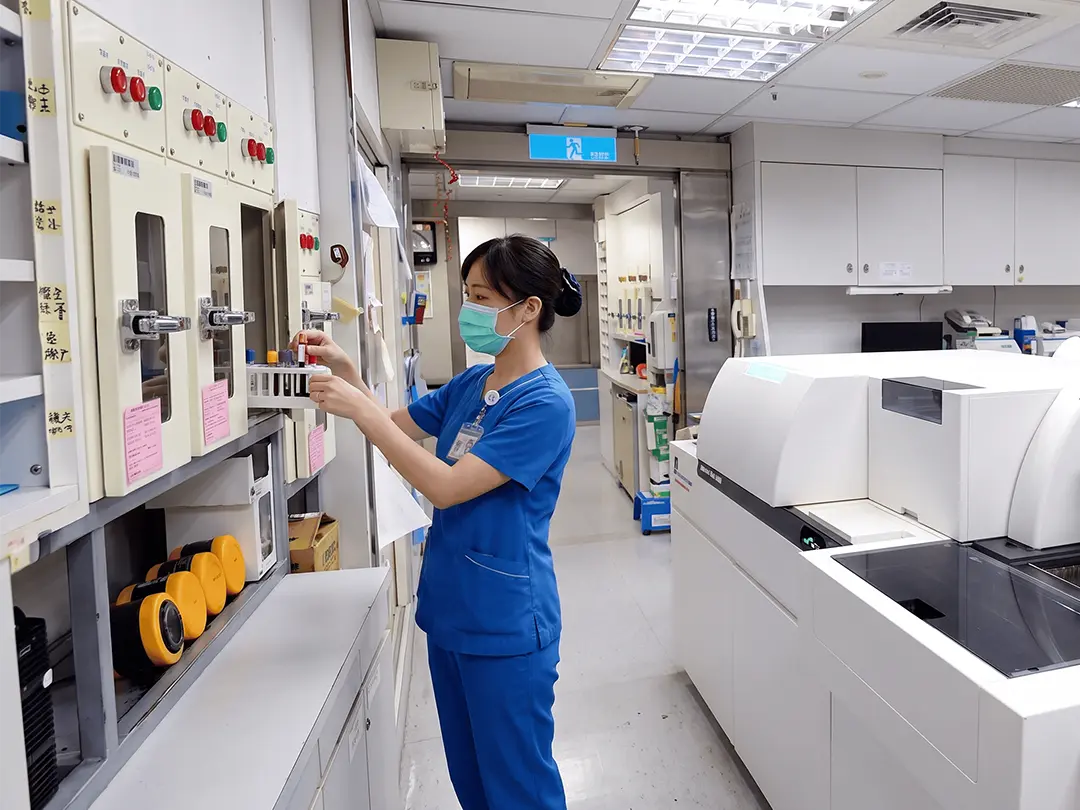
Emergency & inpatient: 24/7 lab services.
External units: Emergency & special testing.
Clinical teams: Consultation, reporting & training.
We committed to improving the efficiency and quality of emergency laboratory testing, ensuring patient safety and providing timely testing services. By implementing a pneumatic sample delivery system, automated dilution functions, adjust instrument maintenance content, reagent packaging and calibration cycle, optimize specimen transportation, processing, and reporting processes, and establish a critical value reporting mechanism. Innovative measures such as priority channels for emergency specimens, data flow management, and multiple cross-departmental collaboration have significantly improved the efficiency of emergency testing. Emergency reporting time has been reduced from 20.9 minutes to 14.8 minutes, the error rate for specimens submissions has dropped from 0.648% to 0.382%, the critical value overdue rate has dropped from 40% to 20%, and the emergency team's quality control exception rate has dropped from 0.432% to 0.295%. The results of these process improvements are reflected in both internal and external quality control performance. Precision: The proportion of test items with internal quality control CV values exceeding target values has dropped from 0.7% to 0.2%, outstanding of regional hospitals by 2.7%. Accuracy: External proficiency testing results averaged 99.8%, exceeding the target of 95%. These achievements provide patients with more accurate and faster test reports and set a benchmark for the domestic medical examination industry.
Rapid response: Establish an emergency VIP testing channel and air delivery equipment to shorten specimen turnaround time.
Robust Processes: Utilizing information flow management and cross-departmental collaboration reduces sampling errors and resampling rates.
Certified Quality: ISO15189 certified, employing automated dilution and validation instruments to ensure accurate results.
Average annual number of samples collected by the laboratory was 934,916.
67 field screenings were conducted during the COVID-19 pandemic, serving a total of 30,074 people.
During the COVID-19 pandemic, the three screening stations conducted a total of 22,788 rapid screenings.
An average turnaround time of 14.8 minutes for STAT test reports was achieved.
A compliance rate of 99.4% for emergency department test reporting within 60 minutes was achieved.
An external proficiency testing accuracy rate of 99.8% was achieved.
The specimen collection and submission error rate was 0.382%.
The critical value notification rate was 100.0%.
The laboratory report revision rate was 0.008%.
The achievement rate of emergency department patient satisfaction regarding waiting time for laboratory testing was 84.1%.
The achievement rate of internal customer (physician) satisfaction was 94.38%.
The achievement rate of satisfaction with the critical value notification procedure was 96%.
The Department of Medical Laboratory Science obtained ISO 15189 international certification.
Three Poster paper were published at the Asia-Pacific International Symposium on Medical Laboratory Science
Research findings were published 12 times.
Improve patient safety and reduce the risk of duplicate testing and treatment delays.
Enhance the timeliness of emergency room reports and rapidly support clinical decision-making.
Drive quality improvement across the regional healthcare system through cross-hospital benchmarking.
Financial benefits: Emergency room revenue has seen steady year-on-year growth.