Nursing staff
Taipei City Hospital comprises five general hospitals and two specialized campuses, forming a comprehensive healthcare network that encompasses emergency and critical care, maternal and child health, infectious disease management, psychiatric services, and integrated care. Through this structure, a “Seven-Star” collaborative system has been established across the Greater Taipei area, creating a mutually supportive and interconnected healthcare ecosystem.
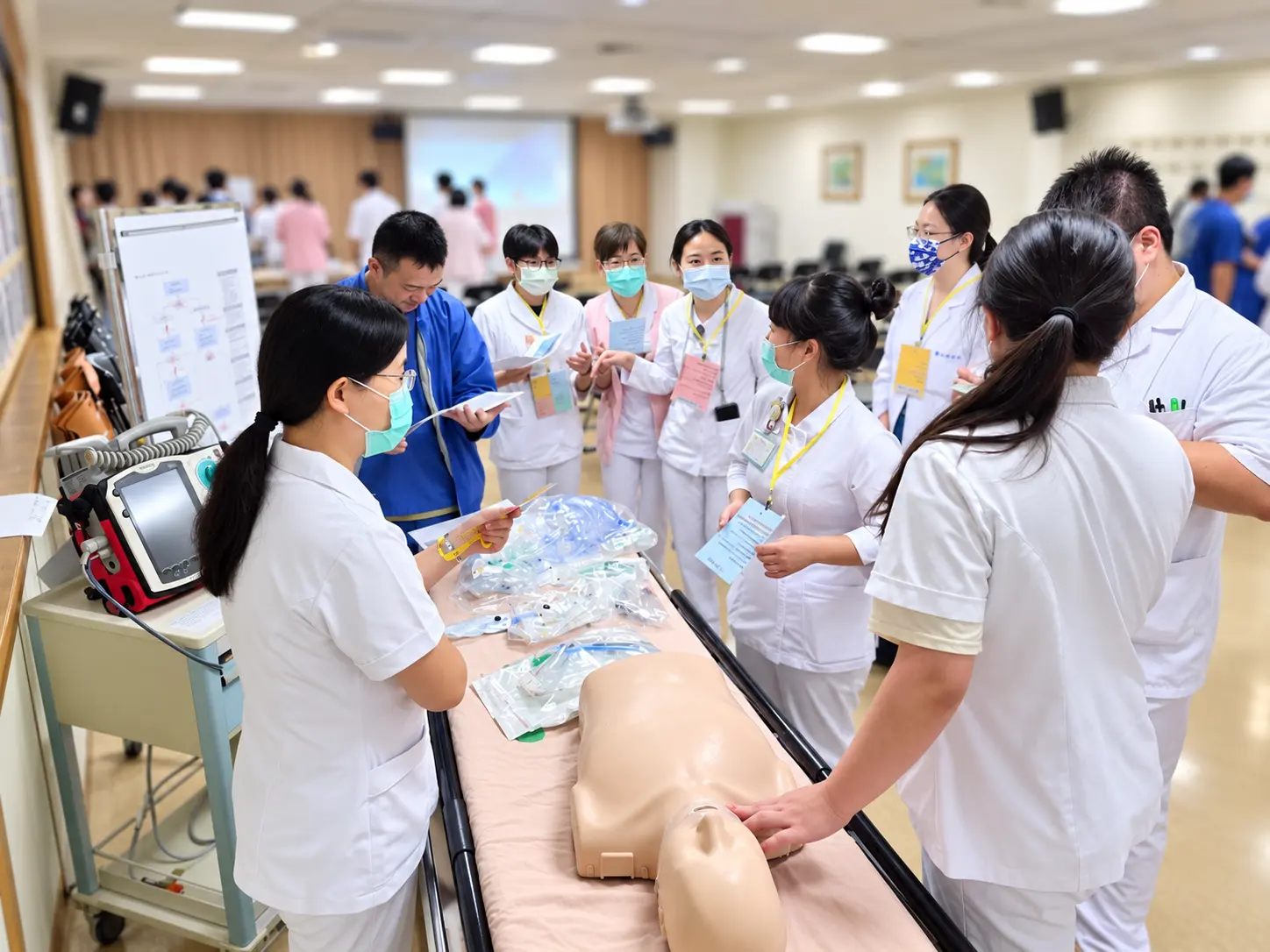
In response to the clinical challenges arising from cross-campus, cross-specialty, and cross-setting practice, the Nursing Education and Research Development Committee upholds the philosophy of “co-learning, co-development, and co-creation” and promotes the clinical education strategy of “Seven-Star Leadership: Collaboratively Cultivating Nursing Talent.” This initiative integrates core nursing competencies across the seven campuses to ensure consistency in care quality. By linking academic institutions, clinical practice, and policy resources, the program transcends institutional boundaries and establishes a unified yet flexible talent development system. Guided by the principle that “integration is strength,” this approach fulfills the mission of resource integration, collaborative talent cultivation, and healthcare excellence, ensuring a stable, high-quality, and sustainable nursing workforce while continuously delivering diverse, continuous, and high-quality nursing services to the residents of the Greater Taipei area.
The Nursing Education and Research Development Committee upholds the spirit of “co-learning, co-development, and co-creation” and promotes a clinical education advancement strategy centered on the theme of “Seven-Star Leadership: Collaboratively Cultivating Nursing Talent.” By integrating resources across the seven hospital campuses and working in partnership with academic institutions, clinical settings, and policy stakeholders, the Committee implements a systematic approach to the development of professional nursing talent. This approach encompasses the establishment of cross-campus collaborative platforms, the strengthening of academia–industry collaboration mechanisms, the integration of digital teaching technologies, the advancement of evidence-based teaching and research culture, and the enhancement of teaching quality and consistency in evaluation.
On average, approximately 2,500 nurses participate in educational and training programs each year.
Across all hospital campuses, nursing staff complete an average of 65,000 total hours of in-house training annually, including both face-to-face and digital learning.
Approximately 1,500 nursing interns are hosted each year
A total of 55 members serve as board directors, supervisors, and committee members of professional nursing associations.
There are 2 Ministry-approved Assistant Professors and 55 Ministry-approved Lecturers.
The number of nursing clinical instructors totals 697.
The five-year pass rate for case reports is approximately 60%, which is higher than the rate announced by the professional association.
The five-year pass rate for project reports is approximately 70%, which is higher than the rate announced by the professional association.
Sixteen projects have been awarded the National Biotechnology and Medical Quality Award (SNQ) Quality Label.
Internship agreements have been signed with 61 academic institutions.
Over the past six years, a total of 35 outstanding nursing interns have received annual recognition awards.
The execution rate of the education budget is monitored on a quarterly basis.
Meetings of the Education and Research Development Committee are held every two months.
Annual performance indicators are compiled and reviewed quarterly or semiannually.
A satisfaction survey is conducted at the conclusion of each course.
The average satisfaction rate of healthcare professional training programs is 93.4%.
The average satisfaction rate of nursing interns reaches 98.7%.
Over the past six years, a total of 8,421 letters of appreciation from the public have been received in recognition of nursing staff across all hospital campuses
Since 2019 (ROC Year 109), a total of 846 papers have been presented at domestic and international academic conferences, of which 167 papers focused on clinical practice outcomes.
The publications comprised 131 journal articles, 71 oral presentations, and 644 poster presentations.
Over the past six years, a total of 18 patents have been granted for nursing innovation projects.
Over the past six years, 39 nursing professionals have served as evaluation committee members, supervisory inspectors, or expert reviewers for organizations including the Ministry of Health and Welfare, the Ministry of Examination, local health bureaus, and professional associations.
Over the past six years, a total of 147 individuals have received major awards for outstanding nursing professionals.
On March 17, 2025, Ms. Chi-Fang Pan, a nurse at our hospital, demonstrated exceptional composure during an emergency encountered while commuting to work. She provided timely life-saving assistance to a patient and successfully saved the patient’s life. In recognition of her heroic actions, she was awarded the “Nursing Light of the Year Award” by the National Union of Nurses’ Associations.