In Taiwan, medical coders primarily handle health insurance claims and medical record coding in hospitals. Medical record coding is particularly time-consuming and labor-intensive due to the complexity of the information in medical records and the extensive range of disease classification codes. This machine-learning model was developed to alleviate the workload of medical coders and other personnel involved in coding tasks.
Since coding and claims often consume significant time and effort from medical coders, the goal is to develop and integrate various auxiliary tools to help hospital medical coders complete coding and claims tasks more efficiently. The hospital’s discharge medical record claims process can be divided into four stages:
Inpatient Stage: Physicians input medical records and related diagnostic content into the hospital information system based on the patient’s condition and treatment.
Discharge Stage: Physicians sign off on the medical records and confirm that the database has recorded the medical expenses incurred from the patient’s examinations and treatments.
Coding Stage: Medical coders edit and review ICD codes for each medical record based on the content of the records.
Claims Stage: Medical coders simulate the diagnosis-related groups (DRG) based on the information in the medical record system, ensure the accuracy of the information, and proceed to submit health insurance claims only after verifying the calculations.
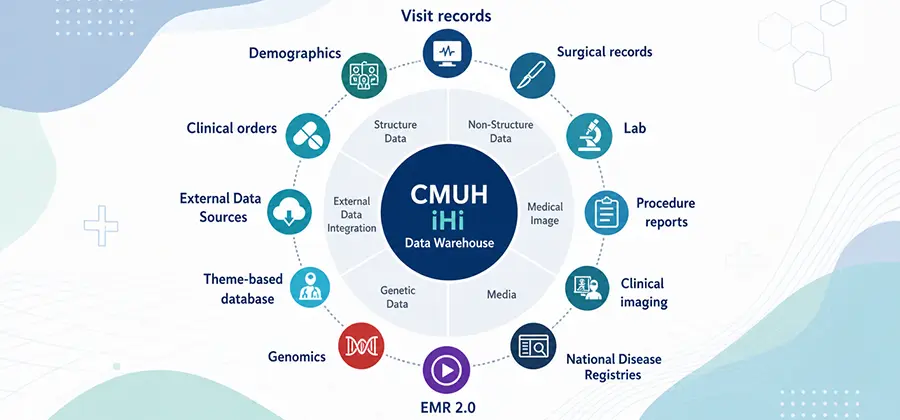
This project uses recent years' hospital medical record data to build a dataset. Using ICD-10 coding, natural language processing (NLP), and deep learning technologies, the platform implements a classification model capable of automatically predicting codes, effectively improving the efficiency of coding staff. The innovative and distinctive functionalities of the platform include:
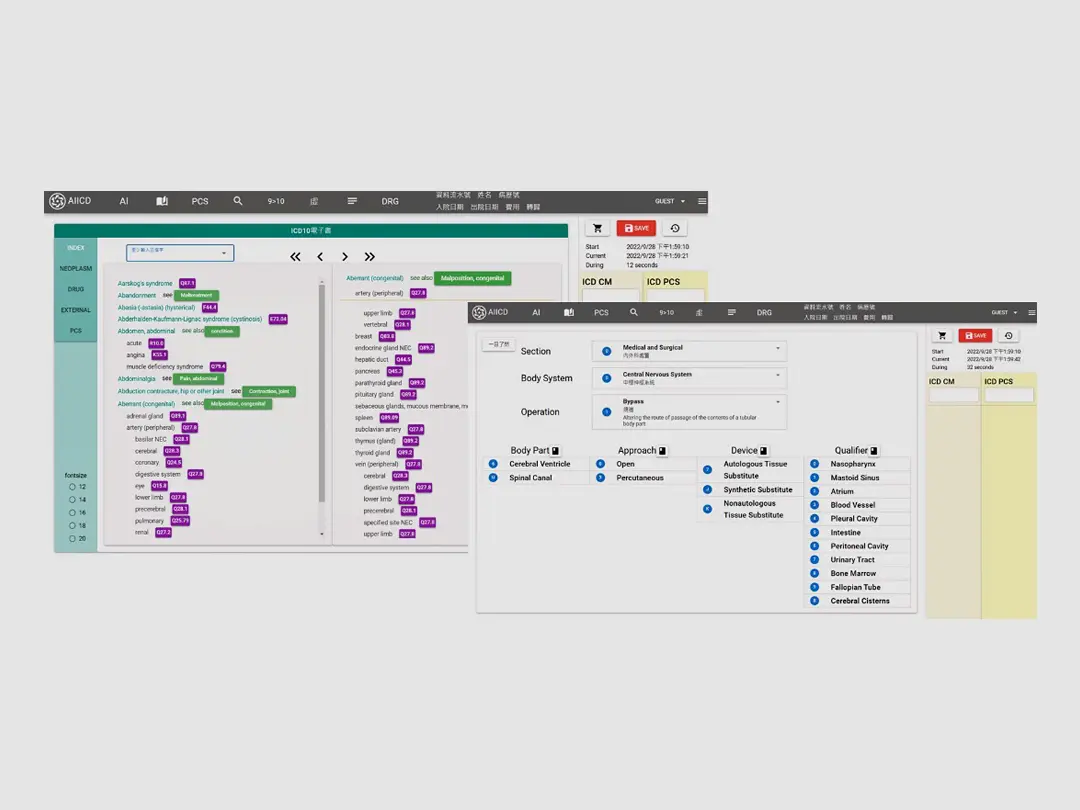
Full-text Code Prediction: Integrated with the hospital's existing information system, the AI-ICD service allows medical coders to quickly access it with a single click and trigger full-text code predictions automatically.
Keyword Code Search: The code search tool, accessible through the top shortcut toolbar, allows users to quickly find relevant codes by keyword.
ICD-10-CM and ICD-10-PCS Electronic Indexing: This feature provides a structured understanding of information related to various disease codes.
ICD-9 to ICD-10 Conversion Service
Virtual Code Lookup for Taiwan's National Health Insurance
Weight and Diagnosis-Related Group (DRG) Simulation: This function calculates the possible relative weight corresponding to the current code combination, helping users perform cost-benefit analyses and select the most appropriate primary diagnosis within reasonable limits. In the future, after integrating patient cost data on the backend, the DRG case cost scale for each medical record will be displayed on the front end, enabling users to reference and query the medical costs and utilization for inpatients under the National Health Insurance, ensuring accurate medical expense claims.
The primary operational safety concern of the AI system lies in protecting patient data. Before obtaining data and initiating development, the AI Center submitted an IRB application, and all relevant personnel signed confidentiality agreements. The hospital's data usage application procedures and review mechanisms are as follows:
Applicants must be official hospital employees. Data users and analysts are registered and must sign confidentiality agreements.
Data applications must follow formal procedures. Applicants submit requests (e.g., "O01-Research Data Usage Application Form" for patient records). Requests involving patient data or large datasets require IRB approval. Data management departments conduct initial reviews, which are subsequently reviewed by the "Medical Data Application Management Committee." Approved data is limited to in-hospital analysis.
For special cases aligned with hospital development needs, external use of medical data must be approved by the committee and managed as a case file.
When the purpose of data usage changes, previous datasets must be destroyed, and a new application must be submitted.
Violations of these policies by data management departments may result in the revocation of data management rights.
The project’s outcomes were exhibited at the 2022 Taiwan Healthcare+ Expo and the 2024 BIO Asia-Taiwan Exhibition, receiving positive feedback from healthcare professionals across various hospitals. As the largest healthcare system in central Taiwan, China Medical University Hospital handles a large volume of patients, highlighting the significant demand for efficient coding. This project aims to inspire more hospitals and vendors to invest in developing related technologies and productivity tools, driving positive societal impacts.