Head & neck cancer ranks 7th in world's incidence. Post-1st-line treatment, 40% relapse. Of those with re-irradiation, 17% face a life-threatening side effect: Carotid Artery Blowout Syndrome.
Carotid Artery Blowout Syndrome (CBS) refers to the rupture and hemorrhaging of the carotid artery or its branches. It occurs in 4.3% of all head and neck cancer patients, and can soar to 6–10% in advanced cases, serving as the most critical factor that drastically reduces post-treatment survival time.
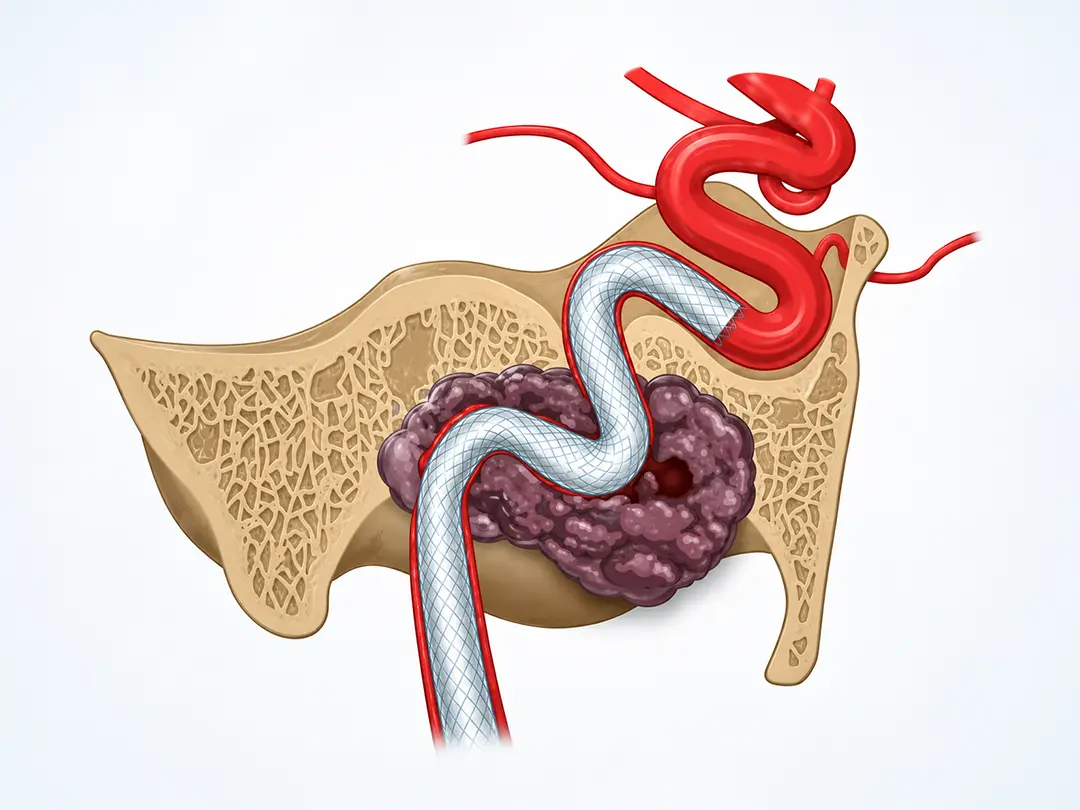
Over the past 20 years, our team has continuously refined and innovated endovascular techniques, successfully neutralizing the acute stroke risks historically associated with minimally invasive interventions. By establishing covered stent graft placement as a standard, routine therapeutic modality, we enable patients to achieve immediate, effective hemostasis while significantly minimizing stroke complications. This breakthrough fundamentally enhances the overall therapeutic efficacy and long-term prognosis for the entire multidisciplinary head and neck oncology team.
Pioneering Prognostic Proof: Our team was the first globally to prove that earlier initiation of minimally invasive endovascular interventions significantly improves patient prognoses.
First Comparative Literature: We published the first study comparing carotid artery embolization versus covered stent placement. The research revealed that while technical success rates are similar, clinical severity correlates most with outcomes. Crucially, we demonstrated that earlier intervention for Carotid Artery Blowout Syndrome (CBS) substantially reduces the risk of future re-bleeding.
Innovative Classification & Protocols: We developed a modified clinical classification and established a standardized diagnostic and therapeutic workflow for CBS.
Carotid Preservation-First Approach: We spearheaded advanced interventional techniques that prioritize preserving the patency of the parent carotid artery to prevent stroke and enhance quality of life.
Routine Implementation of Covered Stents: We successfully established covered stent graft placement as the standard, routine treatment for CBS in patients with nasopharyngeal carcinoma and lower neck cancers.
Synergy with Advanced Oncology: We continuously refine our minimally invasive interventions to complement next-generation oncological therapies (e.g., BNCT, heavy ion therapy, and immunotherapy), mitigating the rising risks of CBS as patient survival extends.
Incidence: 4.3% of all head and neck cancer patients (surging up to 6–10% in advanced cases)
High Academic Impact: This study has been cited 132 times in the field of Carotid Artery Blowout Syndrome (CBS), serving as a foundational reference for nearly most subsequent CBS-related interventional therapy research since 2009.
Evidence-Based Standard Protocol: In 2015, based on a series of literature-backed evidence, our team established a standardized diagnostic and therapeutic workflow centered on CT/CTA, successfully improving the quality of life for these patients.
Pioneering Global Literature: We published the world's first literature investigating the prevention and management of Carotid Artery Blowout Syndrome following salvage Boron Neutron Capture Therapy (BNCT).
Embolization therapy carries a 15–20% risk of stroke.
Surgical treatment: 60% morbidity & 40% mortality.
Covered stent graft placement combined with external carotid artery embolization is safer than embolization alone.
Clinical evidence demonstrates that this new technique features three major advantages: time-saving efficiency, excellent prognosis, and significantly improved quality of life.
Through this relatively safe procedure, the management has been successfully transformed from an emergency operation into a routine treatment.
This study received commentary from European neurointerventional masters Dr. Pirkka Vikatmaa and Dr. Manuela Pilz: Our covered stent graft placement combined with external carotid artery embolization is expected to become the routine treatment modality for main carotid artery lesions, offering a safer alternative to embolization alone and bringing hope to patients in hopeless situations.
International Visiting Fellows: Dr. Quadri (Pakistan, 2000–2001), Dr. Cindy (Indonesia, 2005–2006), Dr. Harsan (Indonesia, 2008–2009), Dr. Isabella Gem (Philippines, 2024), Dr. Gregoria Ysabel (Philippines, 2024), Dr. Marc Justin (Philippines, 2024), Dr. John Denver (Philippines, 2024), and Dr. Charlyn Khrvsse (Philippines, 2024).
This established covered stent graft placement as a routine treatment for carotid blowout, achieving effective hemostasis while minimizing stroke risks, thereby enhancing the overall therapeutic efficacy of the head and neck oncology team.
Integrated with the oncological management plan, proactive or prophylactic interventions for high-risk patients successfully reduced subsequent bleeding risks, allowing next-generation tumor treatment technologies to achieve their optimal long-term efficacy.