Targeting hospital staff, patients, families, the community, and the public, it aims to provide a low-carbon, energy-saving green medical environment while enhancing societal well-being.
FEMH Green Healthcare Initiative
FEMH aligns with national policies, aiming to reduce carbon emissions by 40% by 2030. Jointly led by General Affairs & Logistics and Strategy Planning, this project integrates smart tech to build a low-carbon hospital.
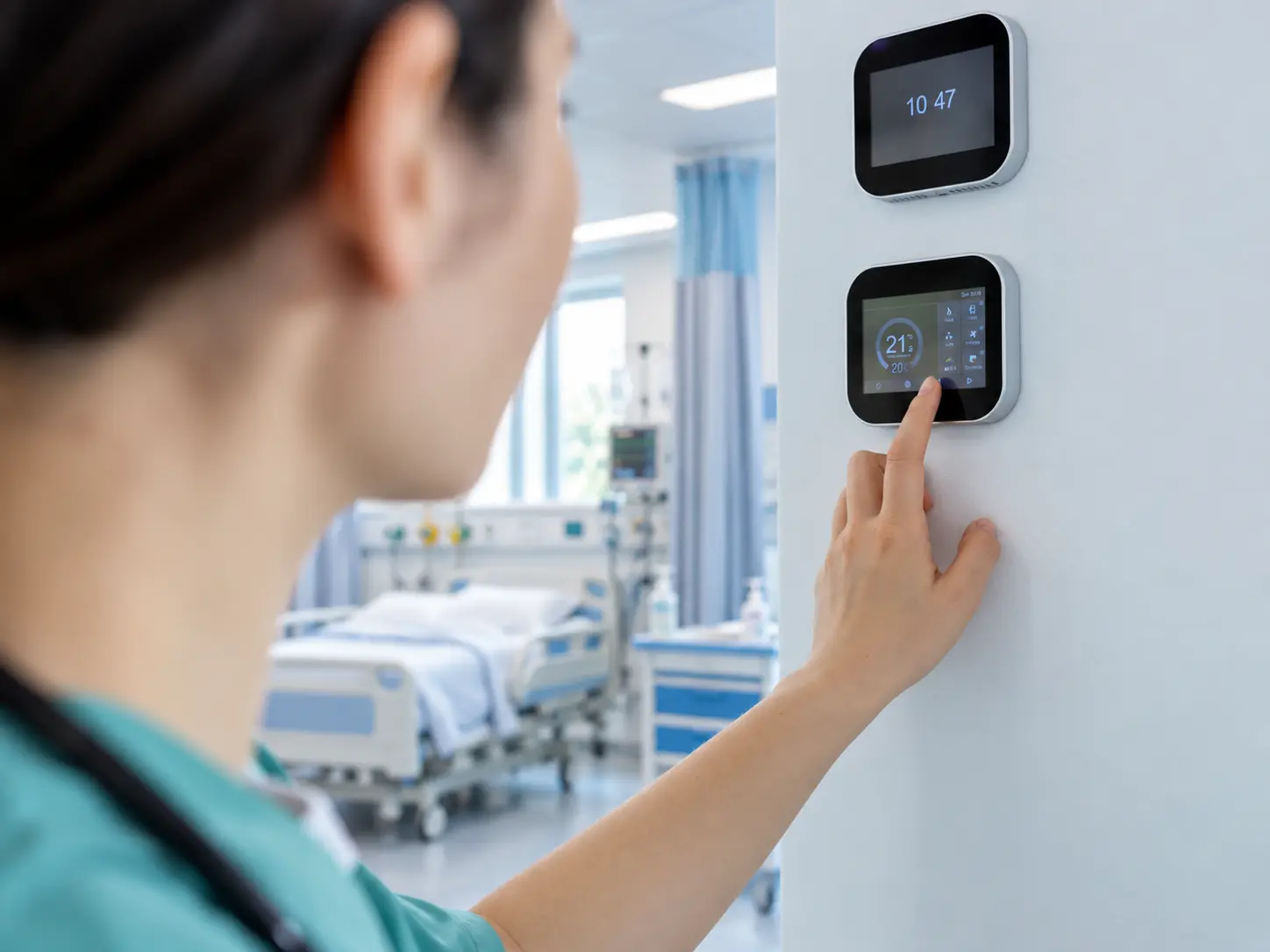
Smart Energy & Cloud Optimization HVAC Upgrades: Guided by GHG inventories, FEMH implemented six major HVAC upgrades, using variable-frequency chillers and ice storage. Cloud BAS: The Building Automation System was migrated to the cloud, using a proprietary "Smart HVAC Control APP" for remote temperature control and peak-shaving. Thermal Efficiency: Deploying water-source heat pumps and steam condensate recovery decreased natural gas reliance.
Innovation & Circular Economy Water Management: FEMH recovers RO wastewater and HVAC condensate, pioneering "Ozone Nanobubble Technology" for wastewater treatment. Recycling: Medical waste like diapers, PET bottles, and plastics are recycled into industrial raw materials.
Impact & Recognition Ensuring air quality and patient safety, this project won the Taiwan Health Sustainability Award and New Taipei City Medical Green Action Awards, serving as a blueprint for green healthcare.
Smart Energy Data Integration: Upgrading the BAS central monitoring system to the cloud, combined with integrating the greenhouse gas tracking platform and business travel APP to boost carbon footprint management.
Self-Developed Intelligent Control: Successfully launching the "Smart HVAC Control APP Platform" to combine multi-source data for cross-district remote real-time monitoring, automated temperature adjustment, and optimal scheduling.High-Efficiency
Hardware Retrofits: Executing comprehensive chiller optimization coupled with water-source heat pumps, ice storage systems, and boiler steam recovery setups to maximize thermal and electrical efficiency.
Innovative Eco-Friendly Water Treatment: Pioneering the use of "Ozone Nanobubble Technology" for premium wastewater management, along with building an extensive loop for RO rejected water and HVAC condensate reuse.
Green Circular Economy Practice: Establishing prominent medical waste recycling initiatives that effectively convert diapers, PET bottles, and medical plastics into high-value industrial and lifestyle commodities.
Healthcare Operations Data
Outpatient Visits: 1,768,805 visits in 2023; H1 2024 (Jan–Jun) served 896,021 visits.
ED Visits: 119,539 visits in 2023; H1 2024 served 60,446 visits.
Inpatient Admissions: 49,416 admissions in 2023; H1 2024 reached 24,732 admissions.
Total Inpatient Days: 349,016 patient-days in 2023; H1 2024 reached 175,023 patient-days.
Bed Capacity: As of July 2024, approved operational beds total 1,410 (876 general and 534 specialized beds).
Healthy Green Life Data & Carbon Reduction Outcomes:
From March to August 2024, the "FEMH Healthy Green Life Campaign" accumulated 619 participants and 4,146 logs, reducing 8,825.64 kg of carbon.
Pollution Prevention Seminars: In January 2024, three seminars held across Taiwan successfully promoted ozone microbubble wastewater technology to approx. 600 healthcare facilities nationwide. Energy & Environmental Management Data
Power Consumption: Total electricity dropped to 46,446,400 kWh in 2023, a -5.26% growth rate, saving 4.40% in annual power costs.
Carbon Management: Total GHG emissions decreased to 28,472 metric tons in 2023, or an intensity of 0.485 metric tons/ping.
Water Recycling: Estimated annual recovery includes 14,490.5 tons of boiler steam condensate, 17,520 tons of HVAC condensate, 8,000 tons of hemodialysis RO water, and 4,015 tons of rainwater.
HVAC & Power System Optimization
Chiller Optimization: Adding a 500RT chiller saves approx. NT$2.19 million in electricity costs annually.
Summer Adjustments: Seasonal chiller regulation measures save 2.57 million kWh of electricity per year.
Hardware Retrofits: General equipment upgrades and efficiency improvements have reduced overall power consumption by over 10%. Thermal Energy & Heat Pump Efficiency
Boiler Heat Recovery: The steam condensate recovery device for natural gas boilers reduces expenses by approx. NT$3 million annually.
Heat Pump Integration: Deploying 10 heat pumps hospital-wide cuts carbon emissions by approx. 7,850,290 kg per year.
Smart Controls & Operating Room Optimization
Operating Rooms: Energy-saving dehumidification controls achieve over 10% in energy savings.
FCU Smart Control: Implementing the "Go Mobile" temperature control app for fan coil units (FCUs) reduces AC energy use by over 6%.
Energy Recovery Ventilation: Smart controls on AC total heat exchangers deliver over 6% in energy savings.
Waste Management & Resource Recycling
General Waste: Resource recovery increased by 24,857 kg over 3 years (+7.1%), reducing annual carbon emissions by 182,532 kg.
Biomedical Waste: Resource recovery increased by 18,549 kg over 3 years (+29.6%), cutting annual carbon emissions by 396,288 kg.
Diaper Recycling: Managing ~3,600 kg of discarded diapers per month yields a 10.6% reduction in biomedical waste and saves NT$1.16 million in annual disposal fees.
Between 2022 and 2025, despite facing operational pressures from a 14% growth in dialysis visits and a 3.8% increase in total service volume, the hospital successfully reduced its water consumption intensity from 50.91 to 41.24 L/PE-Day through water-saving equipment upgrades and management optimization, achieving a 19% improvement in overall water efficiency.
The hospital continuously monitors power consumption across all facilities, leading to a steady downward trend in recent years. Despite consecutive annual growth in both medical service volume and revenue, total electricity consumption decreased from 46.446 million kWh in 2023 to 45.202 million kWh in 2025, representing an electricity savings rate of 2.68%.
In 2025, the total volume of recycled resources reached 403,665 kg, marking an increase of 12,166 kg compared to 2024 (a 3.1% increase in the overall recycling rate).
In 2025, the hospital's hospital-wide carbon reduction achieved a 2.09% decrease compared to 2024.
Far Eastern Memorial Hospital highly values patient experience. To this end, the Audit Department conducts semi-annual satisfaction surveys covering outpatient, inpatient, and emergency department patients. These surveys include evaluations of the physical environment throughout the healthcare process. Responses are measured on a 6-point scale: Strongly Agree, Agree, Neutral, Disagree, Strongly Disagree, and Not Applicable. The satisfaction rate is determined by calculating the percentage of patients who responded with "Agree" or "Strongly Agree." Notably, over 90% of outpatient and ED patients, alongside more than 80% of inpatient respondents, agreed that the hospital environment is safe and clean.
Employee Satisfaction Survey Dedicated to fostering a friendly workplace, FEMH conducts an annual employee satisfaction survey every third quarter to better understand staff insights and needs. Based on the feedback, the hospital optimizes working environments and benefit systems. This initiative aims to boost employee engagement and willingness to deliver high-quality clinical and administrative services, ultimately driving continuous improvement in healthcare quality.
The survey uses a 5-point scale: Strongly Agree, Agree, Neutral, Disagree, and Strongly Disagree. The score is calculated based on the percentage of employees choosing "Agree" or above. Annually, over 70% of staff express satisfaction with workplace elements such as the environment, lighting, and air conditioning.
Earned the Excellent Air Quality Label and achieved ISO 50001 Energy Management Systems certification.
Successfully verified under ISO 14064-1 for Organizational Greenhouse Gas Emissions.
Selected to present at the IHF World Hospital Congress with the submissions titled "The Path to Hospital Sustainability: Smart Energy Saving and Environmental Innovation" and "Far Eastern Green Living Initiative—Employee Energy Conservation and Carbon Reduction Promotion.
Sustainability Model: Saved 2.57M kWh and targeted 40% carbon reduction, leading green healthcare transformation.
Care Standards Established: Combined LOW-E glass and BAS to maintain a constant, stable, and comfortable healing environment.
Eco-Innovation Technology: Pioneered ozone nanobubble application in Taiwan to degrade antibiotic resistance genes in wastewater.
Circular Economy Drive: Initiated cross-industry loops to recycle medical diapers and plastic materials into reusable assets.
Positive Societal Impact: Won Taiwan Health Sustainability Awards, expanding the profound influence of green medical care.