Out-of-Hospital Cardiac Arrest (OHCA) patients
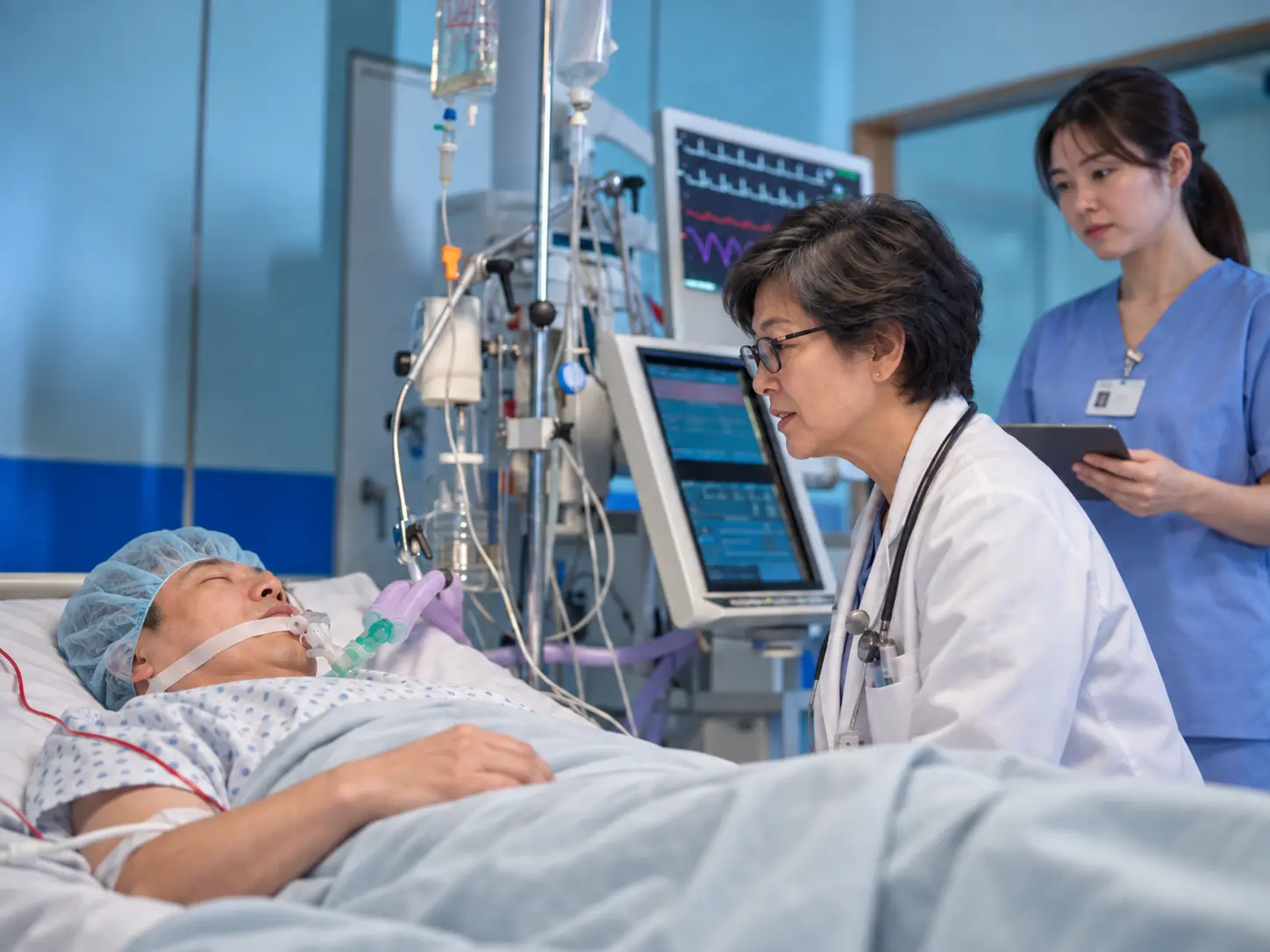
Patients requiring ECMO-assisted cardiopulmonary resuscitation
Critical patients requiring hypothermia therapy and EEG monitoring
Shuang Ho Hospital's Emergency and Critical Care Medicine Department integrates emergency medicine, critical care, and specialty care teams to establish a cross-disciplinary OHCA team. The team implements ECPR interventions and hypothermia therapy protocols, utilizing innovative treatments such as ECMO CPR, LAVA ECMO, immediate temperature management, and EEG monitoring to significantly improve OHCA patient survival rates and neurological recovery.
Rapid ECMO CPR (ECPR) activation protocol with installation within 28 minutes
Only hospital in Taiwan using single-cannula LAVA-ECMO for primary unloading
First global publication of VA-ECMO conversion to single-cannula LAVA-ECMO
Immediate hypothermia therapy and EEG monitoring in emergency department
2021-2023 ECPR survival rate of 27%, exceeding international 23-27% standard
LAVA-ECMO patient survival rate of 50%, three-fold improvement over traditional VA-ECMO at 16%
ICU mortality rate of 10.1%, below Taiwan medical center average of 10%
Established cross-departmental coordination mechanism and comprehensive critical care bundle care
Promotion of DCD (Donation after Circulatory Death) with approximately 7-9 organ donations annually
2022-2023 ECMO procedures: 44 patients
2021-2023 OHCA patients: 484 (262 in 2022, 268 in 2023)
ROSC cases increasing annually: 78 (year 108), 59 (year 109), 60 (year 110), 71 (year 111)
Hypothermia therapy execution rate: 19.2% (year 108), 50.8% (year 109), 61.7% (year 110), 73.2% (year 111)
Organ donation: 11 recruitment cases in 2023, 3 completed donations, 7 organ donations
2021-2023 ECPR survival rate: 27% (23/84 patients), exceeding international average of 23-27%
LAVA-ECMO group:
Survival rate 50% (20/40 patients)
ECMO duration 6.33 days
Pulmonary edema rate 5%
LVEF after ECMO weaning: 53%
Traditional VA-ECMO group:
Survival rate 16% (4/24 patients)
ECMO duration 11.25 days
Pulmonary edema rate 75%
LVEF after ECMO weaning: 32%
Annual survival rate trend: 12.5% (year 108) → 15.4% (year 109) → 6.3% (year 110) → 21.4% (year 111) → 42.9% (year 112)
ROSC recovery rate improved from 25% to 50%
CPC1 (complete neurological recovery) rate exceeding international 5-10% standard
ICU infection rate: 1% (superior to international peer value of 8-12%)
ICU mortality rate: 10.1% (below Taiwan medical center average of 10%)
Average OHCA patient ICU admission time: 114.4 minutes (year 112)
Overall average ICU admission time: 147.6 minutes (year 112)
Medical staff training: 60 medical personnel trained in 2024
Multiple awards for emergency care excellence in New Taipei City
20th SNQ Silver Award for "Emergency Air Medical Transport Services for Critical Patients in Remote Areas"
Publication in European Heart Journal (Eur Heart J Case Rep. 2024 Aug; 8(8): 362)
Publication in Neurocritical Care Journal (Neurocrit Care. 2024;41(1):109-118)
International conference presentations: 2023 APAC GAMI TAMI Conference, 2023 Kobe CCT Conference, 2024 APAC GAMI TAMI Conference, 2024 Korean Gwangju GICS Conference
Domestic conference speakers: Taiwan Acute Myocardial Infarction Autumn Symposium (2022, 2023, 2024), Critical Care Medicine Society Annual Conference (2024)
Contributed to authoring "Clinical Manual for Hypothermia Therapy and Post-Resuscitation Care: Neurological Prognosis Assessment and Treatment"
Established rapid ECPR response protocol to reduce treatment time
LAVA-ECMO technology innovation significantly improving patient survival and cardiac function recovery
Comprehensive hypothermia therapy and EEG monitoring enhancing neurological outcomes
Promotion of organ donation, enabling legacy of generosity
Training medical personnel to disseminate best practices
International academic publications and presentations enhancing hospital reputation
Established critical care bundle care standard protocols reducing infection and mortality rates