Normal Systolic Function Heart Failure patients
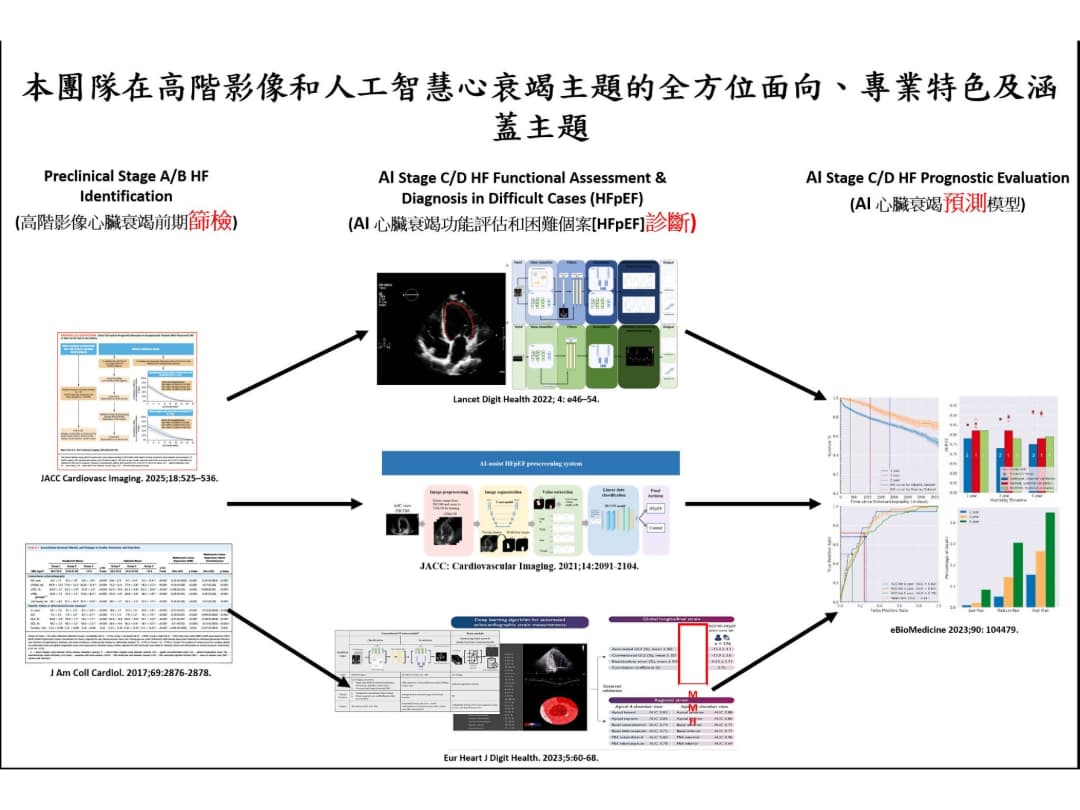
For individuals at Stage A and B heart failure risk, including subhealth populations and patients with chronic diseases, the Mackay Heart Failure Team aims to detect early myocardial dysfunction using novel functional myocardial imaging and speckle-tracking echocardiography techniques. Based on this technology, our team is particularly interested in its application for diagnosing heart failure with preserved ejection fraction (HFpEF). This technique is applied to post-myocardial infarction heart failure, early risk assessment of Stage A/B heart failure, and clinical risk stratification for complications such as atrial fibrillation.
Through advanced two-dimensional speckle-tracking echocardiography, we are able to apply these techniques broadly across large imaging databases spanning diverse patient populations and clinical conditions. This allows objective quantification of preclinical myocardial functional changes, enabling the characterization of subclinical functional imaging alterations, which can then serve as predictors of related clinical events.
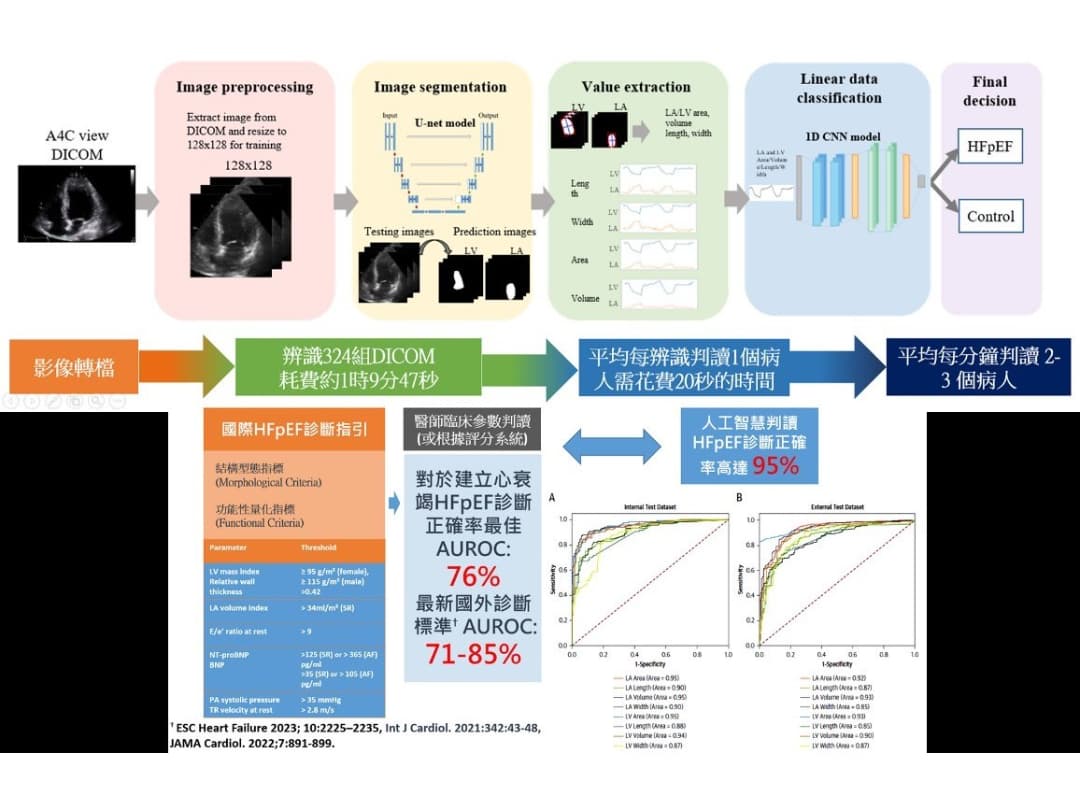
A CNN-based model was developed for clinical prediction of heart failure with preserved ejection fraction (HFpEF), achieving world-leading performance (AUROC: 95%).The model incorporates advanced and AI-driven risk stratification for both primary and secondary prevention in chronic heart failure, including pharmacological treatment strategies.
Multiple platforms, including the MacKay HFpEF Platform and US2.ai, were implemented to support clinical diagnosis, prognosis, and risk-based decision-making in heart failure care.
A breakthrough in artificial intelligence–based diagnosis of heart failure with preserved ejection fraction (HFpEF) (N = 1,401).
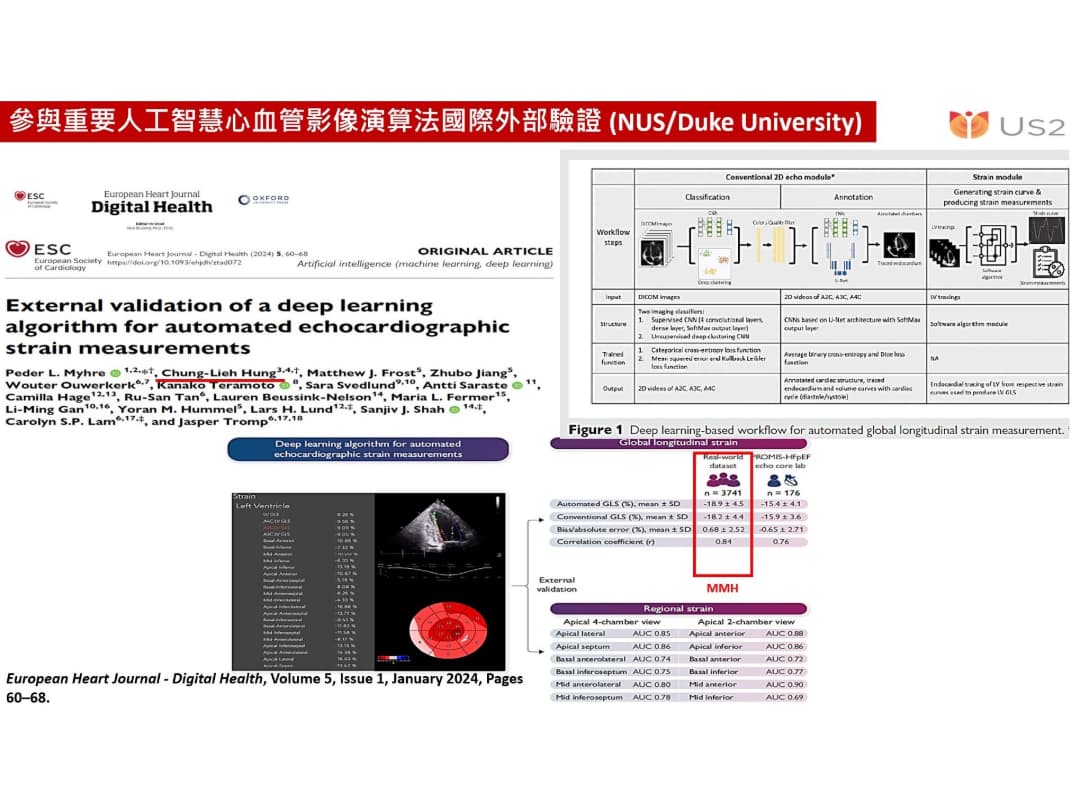
Advanced AI-driven automatic quantification of cardiac function using functional deformation imaging (N = 3,741).
MacKay achieved the highest accuracy in advanced AI-based cardiac functional imaging algorithms.
MacKay has the largest patient cohort in international comparisons of AI-based prognostic models for heart failure.
Advanced precision imaging techniques were used to predict the risk of heart failure occurrence in this population over the next six years.
AI-assisted interpretation achieved a 95% diagnostic accuracy for HFpEF.
Overall patient satisfaction rates were above 90%.
Led the development of THRS clinical cardiovascular imaging guidelines for arrhythmia and heart failure in Taiwan.
Two international expert fellows have completed training at MacKay.
MacKay Heart Failure Center has the highest level of global participation and contribution, playing a leading and pivotal role internationally.
Actively participated in national quality certification programs, including the National Quality Label, the NHQA National Healthcare Quality Award, heart failure accreditation, and innovation awards, with a focus on heart failure and AI-based healthcare.
This study is the world’s first clinical investigation to evaluate the clinical benefits of high-cost therapies (ARNi, sacubitril/valsartan) using machine clustering techniques.
Advanced deformation imaging significantly increased the proportion of patients deriving clinical benefit by approximately 40% compared with the conventional LVEF parameter.