Patients with small intestinal disease
Optimizing the diagnosis and management of patients with small intestinal disorders involves a multifaceted approach.
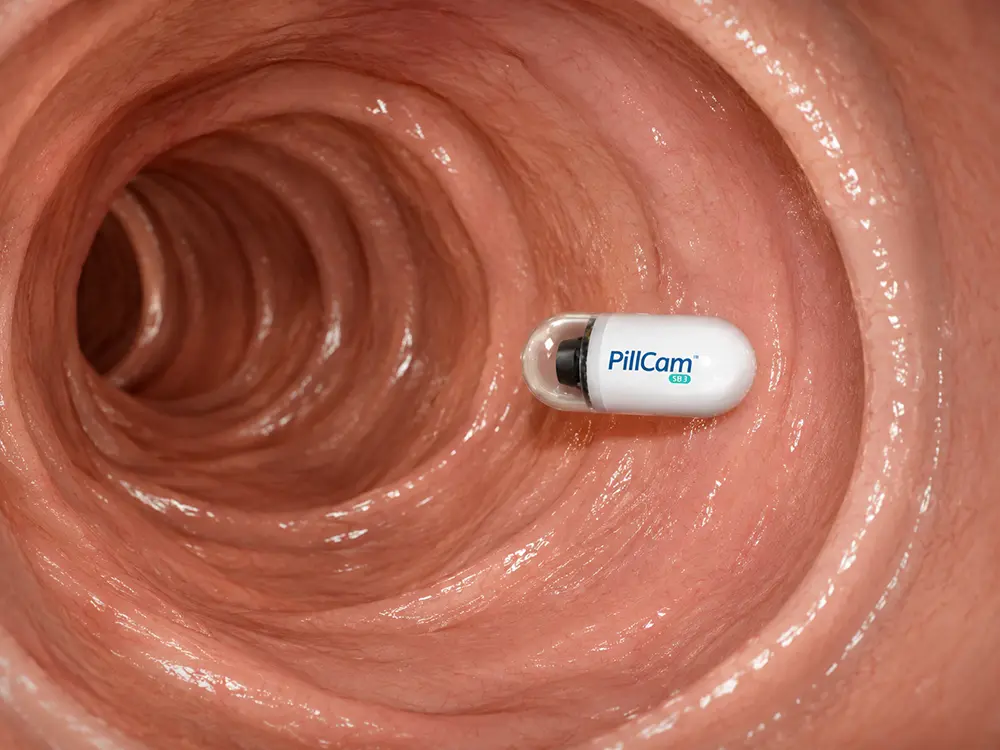
First, advanced diagnostic techniques are crucial, including capsule endoscopy, deep enteroscopy, and other imaging studies.
Second, a multidisciplinary approach is essential, involving gastroenterologists, radiologists, surgeons, and nutritionists.
Third, personalized treatment plans are vital for each patient.
Finally, further research into small intestinal diseases is necessary.
Capsule endoscopy and single-balloon enteroscopy
As the pioneer medical center in Taiwan to introduce capsule endoscopy in 2004, our institution completed 512 capsule endoscopy procedures as of June 2022, ranking first nationwide in total volume. Our exam completion rate reached an outstanding 98.7%, surpassing the international average.
Furthermore, from October 2008 to April 2023, a total of 440 patients successfully underwent 621 deep enteroscopy procedures.
Total small bowel evaluation rate: 72% (highest in Taiwan)
Capsule retention complications: 2/298 (0.67%), superior to international average of 1.0-1.7%
Single-balloon enteroscopy complication rate: 6/401 (1.5%), comparable to domestic medical centers at 1.5%
Elderly patients (≥65 years) single-balloon enteroscopy complication rate (5%) with no significant difference from younger patients (2.7%)
All patients with complications improved with conservative treatment, with no mortality events
Patient Satisfaction with Single-Balloon Enteroscopy: 100%
Our institution's multicenter study on endoscopic balloon dilation for Crohn's disease strictures was cited by the Japanese clinical practice guidelines (Guidelines for endoscopic balloon dilation in treating Crohn's disease-associated small intestinal strictures).
Engaged in academic exchange at the 2024 Annual Congress of the Korean Association for the Study of Intestinal Diseases (KASID).
Assisted in developing the Taiwan Guidelines for the Management of Small Bowel Bleeding (J Chin Med Assoc. 2026 Mar 1;89(3):204-211).
Assisted in developing the Taiwan Guidelines for the Management of Crohn's Disease (Intest Res. 2024 Jul;22(3):250-285).