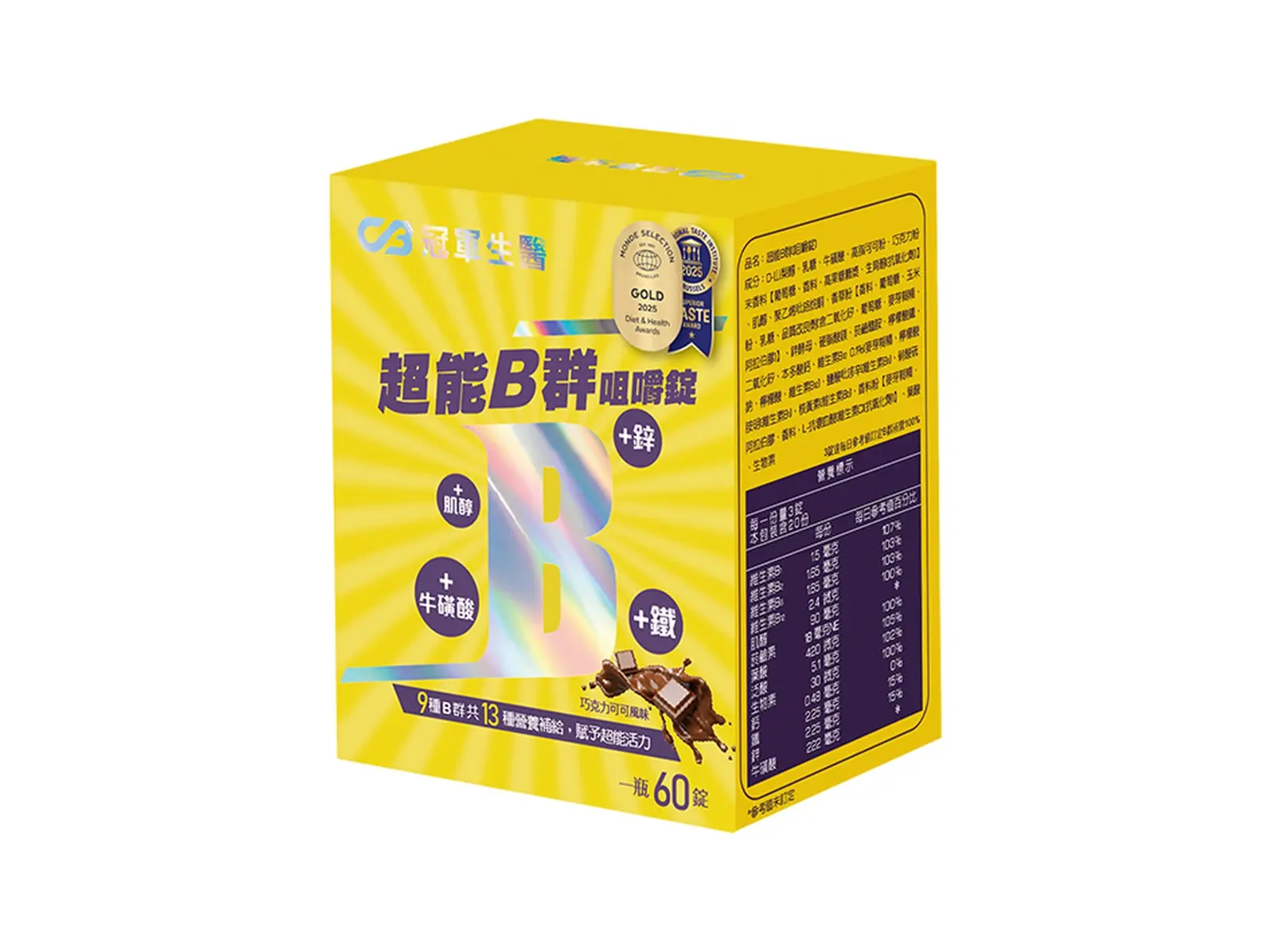
Vitamin B Complex Chewables is a cocoa-flavored chewable B-complex nutritional supplement, designed for people who eat out often, follow a vegetarian diet, dislike swallowing tablets, or are put off by the medicinal taste of typical B-complex products. Naturally cocoa-flavored and chewable with no water needed, it lets the whole family top up their daily needs easily and enjoyably.
Vitamin B Complex Chewables is a cocoa-flavored chewable B-complex nutritional supplement, designed for people who eat out often, follow a vegetarian diet, dislike swallowing tablets, or are put off by the medicinal taste of typical B-complex products. Naturally cocoa-flavored and chewable with no water needed, it lets the whole family top up their daily needs easily and enjoyably.
The product's health appeal is everyday nutritional supplementation and the maintenance of normal energy metabolism. [Nutrition Facts (per 3-tablet serving; 20 servings per pack; figures in parentheses are % of daily reference value)] Vitamin B1 1.5 mg (107%), vitamin B2 1.65 mg (103%), vitamin B6 1.65 mg (103%), vitamin B12 2.4 µg (100%), inositol 90 mg (), niacin 18 mg NE (100%), folate 420 µg (105%), pantothenic acid 5.1 mg (102%), biotin 30 µg (100%), calcium 0.48 mg, iron 2.25 mg (15%), zinc 2.25 mg (15%), taurine 222 mg (); 13 kcal per serving. (* No daily reference value has been established.) [Indicator Ingredients] 9 B-group nutrients (B1, B2, B6, B12, inositol, niacin, folate, pantothenic acid, biotin), reaching 100% of the daily reference value for B vitamins in 3 tablets; further enriched with iron, zinc, calcium and taurine.
Vitamin B Complex Chewables (cocoa flavor; 3 tablets/serving, 20 servings/pack) is made at a plant certified to FSSC 22000, ISO 22000, HACCP and GMP, with tableting in a positive-pressure, low-humidity (<30% RH) cleanroom. From incoming materials to shipment, it is managed batch by batch with full documentation and quantified indicators. 1. Incoming inspection: All nutrient materials and additives carry COAs and are checked for appearance, characteristics, moisture/water activity, content and microbiology; only conforming lots enter stock, others handled per procedure. Materials hold food-registration/traceability evidence.
Third-party testing is commissioned to an MOHW-accredited food laboratory (TAF/ISO 17025) and to independent bodies such as SGS, using the most recent production lot (submitted lot LOT6U254; expiry 2026.06.23). 1. Items and results - Microbiology: not detected. - Heavy metals: not detected. - Pesticide residues: not detected. - Veterinary/illegal drugs: not detected. - Active-content tests: folate (+16%), vitamin B12 (+9%), and vitamins B1 and B6 all conform to label. 2. In-house tests: each batch is checked for microbiology, water activity and appearance. 3. Basis: microbiology follows the Sanitation Standard for Microorganisms in Food; contaminants and heavy metals follow the Sanitation Standard for Contaminants and Toxins in Food.
The product applies a full-chain risk-control mechanism across incoming, process, finished-goods and post-market stages, via task-force assignment, self-inspection and QA patrol. 1. Incoming stage: Supplier qualification and tiered management require COAs and food-registration/traceability evidence; each lot is self-inspected for appearance, moisture/water activity, content and microbiology, with non-conforming materials isolated, returned and traced. 2. Process stage: Critical control points (blending, granulation, compression, packing) are identified per HACCP, with limits set and monitored. A low-humidity environment is kept; BOM control, calibration and hygiene checks are enforced, and QA patrols correct and record deviations. 3. Finished-goods stage: Each lot is inspected before release and out-of-spec lots are not shipped. Retained samples and periodic checks ensure traceability, linking each lot to material lots and process records. 4. Post-market stage: A customer-relations unit and service line handle complaints by phone, fax, email, LINE@ and social media; for quality concerns, customers send photos and same-lot retained samples are compared, with replacement and traceback as needed, plus dietitian advice. Counterfeits are identified via SGS testing and pursued legally.