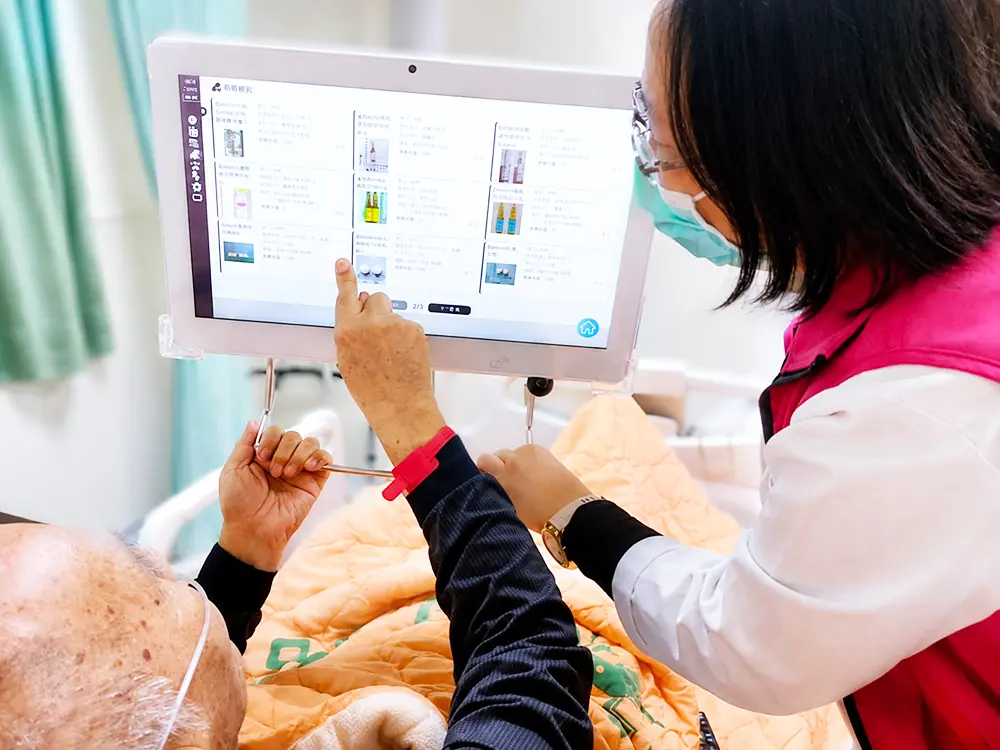
The instant satisfaction survey targets patients, while the occupational safety management system targets workers.
Through innovative thinking, satisfaction survey items are deconstructed by department locations. By classifying location attributes, the unique characteristics of each department are mapped to specific survey items, enhancing the survey's distinctiveness. Across the hospital, all 857 QR codes are composed of different parameters—such as location, item category, and staff profession—making each QR code a uniquely coded entity. Consequently, the open-text notification module can identify the heads of each operational unit, rendering real-time notifications more comprehensive and precise, and allowing public feedback to be resolved swiftly. Following the successful implementation of the QR code-based satisfaction survey, the same module was utilized to establish an occupational safety and health management system. This system includes eight sub-functions: unit self-inspections, daytime environmental patrols, nighttime safety patrols, dormitory repair reporting, accommodation satisfaction, working environment monitoring, security guard inspections, and earthquake reporting, covering a total of 619 scanning points. The earthquake reporting feature can also share the satisfaction QR codes. In earthquake-prone Hualien, this effectively improves reporting efficiency and environmental safety, serving as a highly valuable and forward-looking approach.
Deconstruction of Survey Items: Simplify to 10–12 questions to reduce the response burden; increase the volume and diversity of survey responses; and make the survey results more precise and valuable for reference.
Real-Time and Accurate Feedback Delivery: Forward feedback instantly to the head of the corresponding localized unit; effectively maintain patient-provider relationships and identify risks early; and reduce potential medical disputes involving patients.
Integration of the Safety and Health Management System: Cross-utilize QR codes to reduce staff workload; increase user convenience to ensure faster overall processing efficiency.
Real-time Satisfaction Survey: Establish 850 QR Code scanning points
Environmental Inspection: Establish 558 QR Code scanning points
Environmental Inspection Subfunctions (8 items):
Department Self-Inspection
Daytime Environmental Patrol
Nighttime Safety Patrol
Dormitory Repair Reporting
Accommodation Satisfaction Survey
Work Environment Monitoring
Security Patrol Inspection
Earthquake Reporting
Survey Scope: Institutions affiliated with the corporation (main hospital, branch hospitals, and postpartum care centers)
Real-time Satisfaction Survey: Processing time was reduced by 232 hours per year; paper consumption was reduced by 2,500 sheets; and accuracy improved from 93.5% to 100%. Safety Management Inspections: Processing time was reduced by 1,152 hours per year; paper consumption was reduced by 1,500 sheets; and accuracy improved from 86% to 99%.
The hospital integrated its patient satisfaction survey system with the President's Mailbox to establish an effective communication channel. The Executive Assistant to the Hospital Superintendent and the Director of the Public Affairs Department are responsible for receiving, coordinating, and addressing feedback, complaints, and concerns raised by patients or their family members. Through prompt handling and timely responses to complaints and suggestions, effective communication helps resolve misunderstandings and differences, thereby strengthening public trust in the healthcare institution.
Since the integration of the patient satisfaction survey and the President's Mailbox, the number of commendations from the public has increased year by year. Meanwhile, the number of medical dispute cases decreased from 15 cases in 2021 to 7 cases in 2023, representing a 53% reduction. These results demonstrate that timely management of patient complaints can prevent issues from escalating. Furthermore, internal reviews help identify the root causes of disputes, clarify differences in perception between both parties, effectively reduce the number of disputes, and lower the likelihood of legal actions being taken against the healthcare institution.
Patient Satisfaction Survey: The overall average satisfaction score was 92.7 in 2022 and increased to 93.4 in 2023. Employee Work Environment Satisfaction: The employee work environment satisfaction score was 3.76 in 2022 and increased to 3.79 in 2023.
Improve Efficiency: Through automation, hospitals can save manpower resources, reduce working hours, and enhance operational efficiency, enabling healthcare professionals to focus more on patient care. Ensure Regulatory Compliance: Intelligent systems can help hospitals promptly inspect and document environmental conditions, ensuring compliance with relevant regulations and standards. Enhance Safety: Potential safety issues can be identified and addressed in a timely manner, reducing the likelihood of accidents and safeguarding both patients and staff. Support Data-Driven Decision Making: Data collection and analysis provide hospital management with valuable insights for making more informed decisions and optimizing resource allocation. Reduce Operating Costs: Intelligent systems can lower long-term operational expenses and minimize losses resulting from accidents or environmental issues.