We primarily serve female breast cancer patients who have had a total mastectomy and require breast reconstruction. We welcome both internal patients and referrals from other medical facilities.
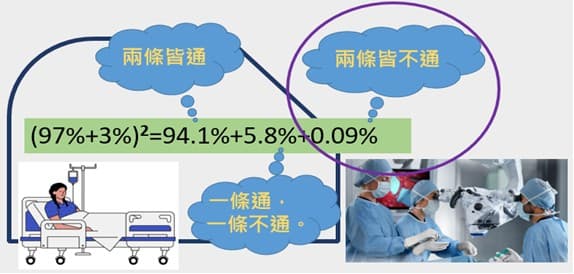
Autologous breast reconstruction offers higher long-term satisfaction and fewer reoperations compared to other methods. In 2012, our team took the lead in introducing the bi-pedicled DIEP flap, raising success rates to over 99% and lowering reoperation rates to below 2%. This has transformed breast reconstruction in Taiwan, moving away from the conventional TRAM flap. Beyond clinical excellence, our ongoing research in wound care and surgical techniques is widely published in international journals. We provide 'Holistic Reconstruction' by coordinating a multi-specialty team—including plastic surgery, oncology, and ERAS protocols—to ensure comprehensive care for every patient.
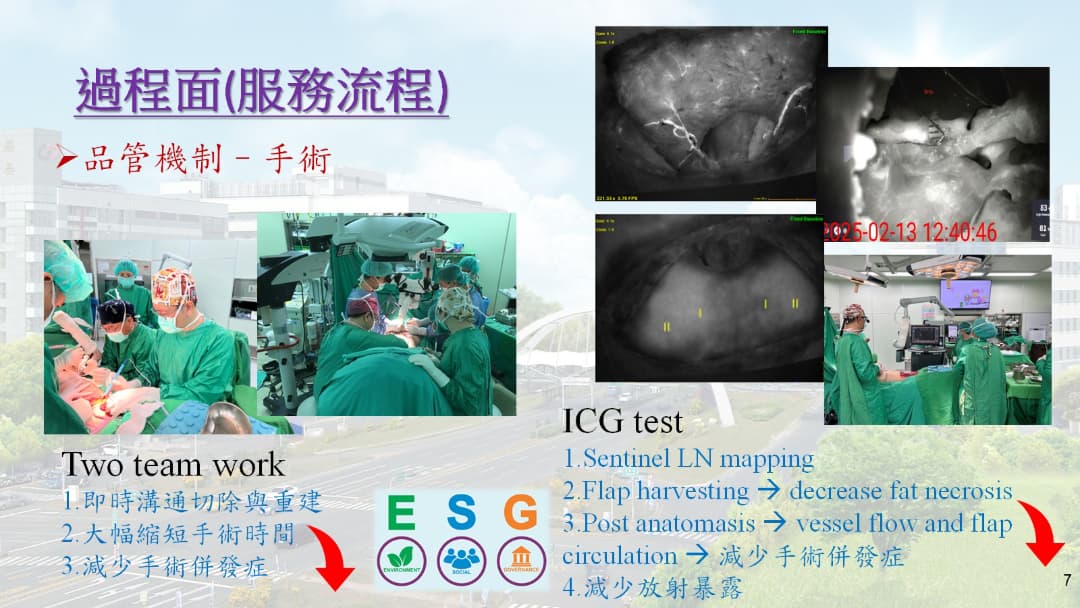
Our team performs preoperative anatomical assessments of the lower abdomen, supplemented by Doppler ultrasound localization. By utilizing a dual-team surgical approach, we have significantly reduced operative time by over 2.5 hours. Furthermore, we integrate ICG fluorescence angiography to ensure excellent flap perfusion, thereby enhancing flap survival rates and minimizing the risk of complications and reoperation; 2.We have implemented ERAS (Enhanced Recovery After Surgery) protocols alongside drain-free techniques and negative pressure wound therapy (NPWT) to accelerate postoperative recovery; 3.We have established Shared Decision-Making (SDM) tools to empower patient participation and reinforce the principles of patient-centered medical care.
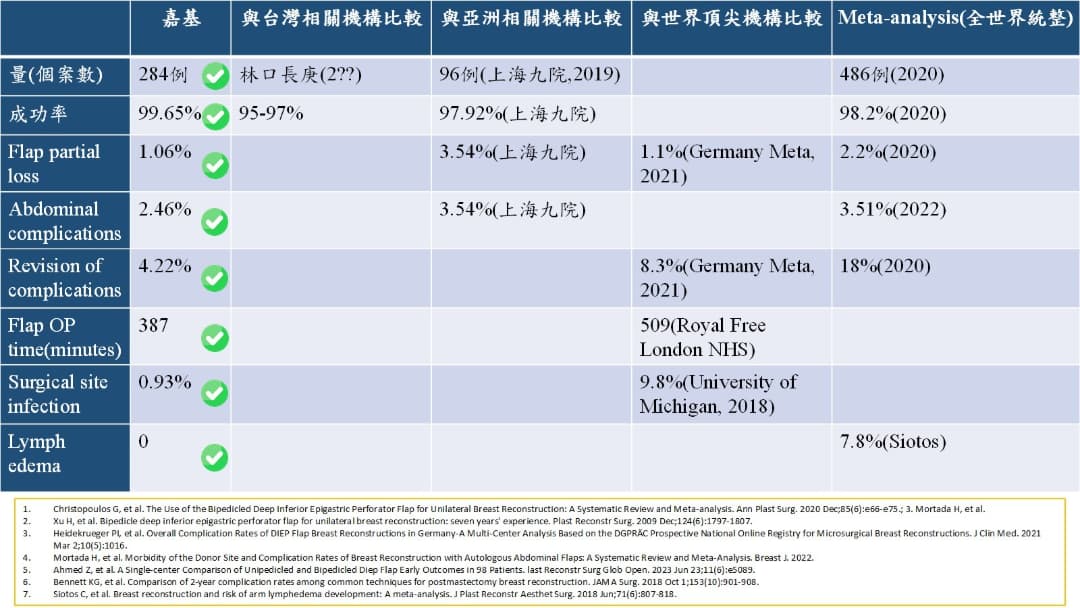
From September 2012 to June 2025, a total of 284 patients underwent breast reconstruction surgery, including 252 unilateral and 32 bilateral cases. Between 2020 and 2024, the reconstruction rate (including both autologous and implant-based) among total mastectomy patients at our hospital reached 27% (169/623), which is significantly higher than the national average.
The total flap success rate for bi-pedicled DIEP flaps is 99.65% (283/284).
The reoperation rate is 1.76% (5/284), with only three cases eventually resulting in partial flap necrosis.
The incidence rate of Stage II and III Lymphedema (per the International Society of Lymphology, ISL) is 0% at one year post-operation.
The incidence of abdominal bulge or hernia was 20% (2/20) in the first 20 cases, which subsequently decreased to 0.4% (1/264).
The prevalence of limited shoulder range of motion significantly decreased to only 3% at one year post-operation.
The average operative time is 387 minutes, which is approximately 2 hours shorter than the 509 minutes reported by world-leading institutions, such as the Royal Free London NHS.
Our surgical site infection (SSI) rate is 0.93%, significantly lower than the 9.8% reported by the University of Michigan, a top-tier global medical center.
Post-assessment surveys regarding our Shared Decision-Making (SDM) tools showed a high satisfaction score of 4.12 toward the medical team.
Following the implementation of decision aid tools, patient anxiety scores significantly decreased from 3.89 to 2.68.
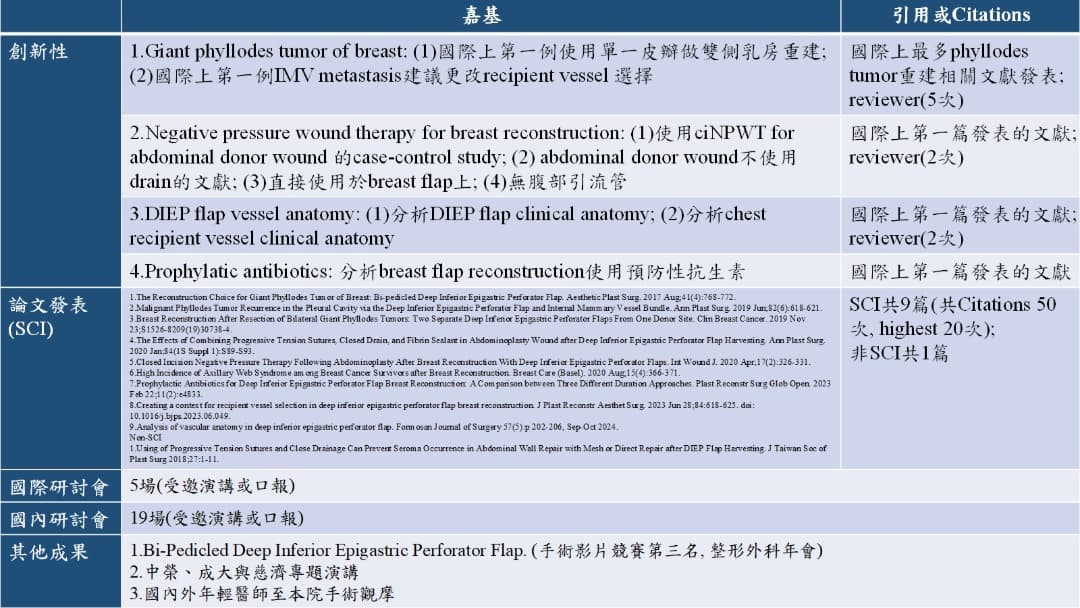
Over the past eight years, our team has published nine papers in SCI-indexed journals, accumulating over 50 citations. This underscores our significant academic impact and the practical value of our research.
Our members have served as expert peer reviewers for international journals in the field of breast reconstruction a total of eight times.
We were the first in the international medical community to publish literature on the clinical anatomy of the DIEP flap and the clinical anatomy of chest wall recipient vessels.
Our team published the world's first literature regarding the use of prophylactic antibiotics in breast flap reconstruction, which has since become a standard clinical guideline.
We authored the first international publication on the use of closed-incision Negative Pressure Wound Therapy (ciNPWT) for abdominal donor site wounds, establishing it as a standard protocol.
In the specialized field of Giant Phyllodes Tumors of the breast, our team holds the record for the most reconstruction-related publications and acts as the leading reviewer internationally.
In 2017 and 2020, our team published the world’s first case reports on bilateral breast reconstruction using a single abdominal flap in the prestigious journals Aesthetic Plastic Surgery and Clinical Breast Cancer.
We have established a high-success-rate model for autologous breast reconstruction with outcomes published in prestigious international journals, significantly enhancing Taiwan's global visibility in the field of reconstructive medicine.
Our team has developed standardized protocols integrating the DIEP flap with ERAS, serving as a benchmark for breast reconstruction care within the domestic medical community.
Through Shared Decision-Making (SDM) and holistic care, we have successfully improved patient satisfaction and quality of life while minimizing reoperation rates.
By integrating multidisciplinary expertise and optimizing clinical efficiency, we have shortened hospital stays and reduced resource consumption, fostering a high-quality and sustainable healthcare system.