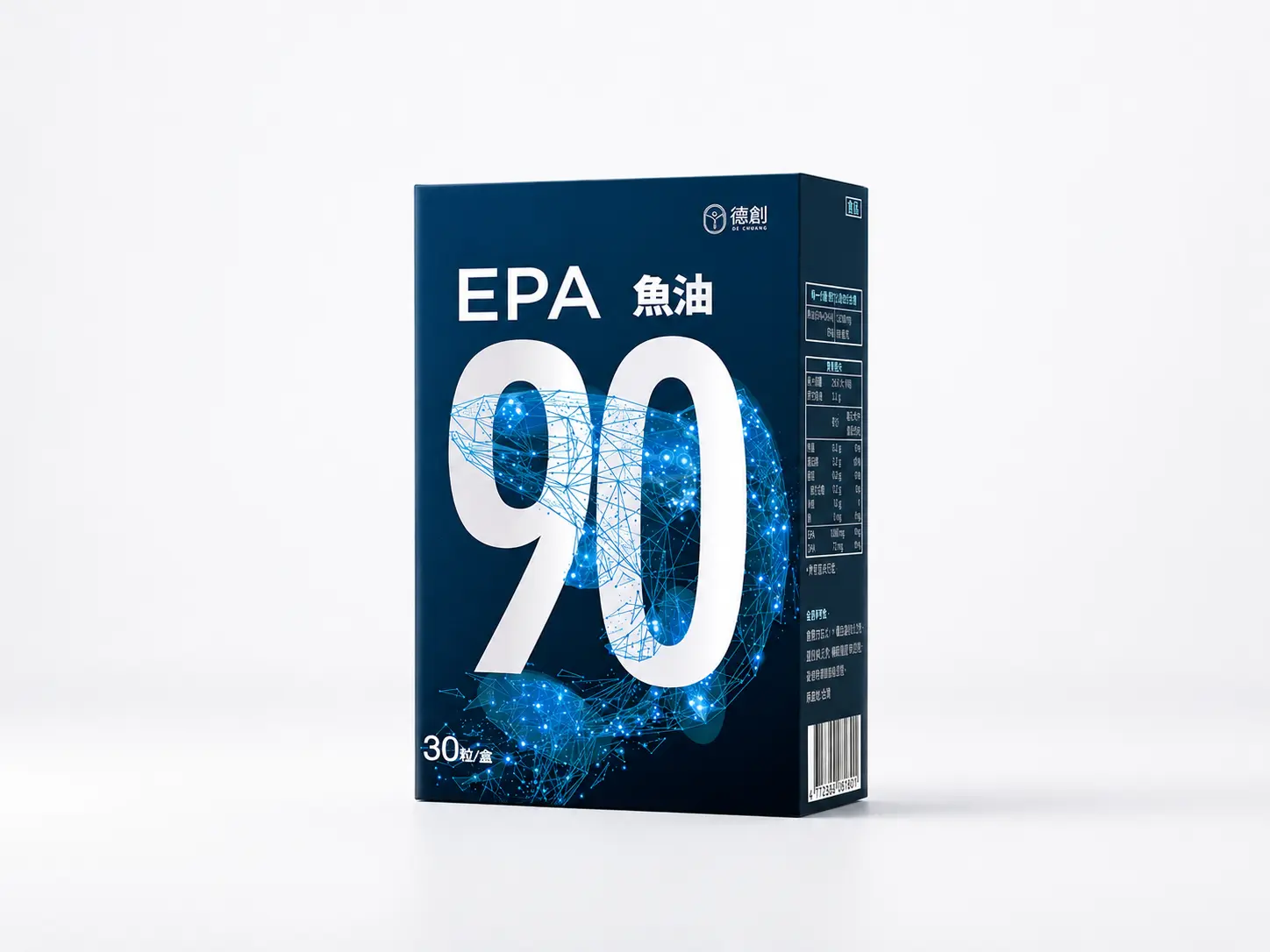
Design: Most fish oils label by total weight, forcing 2-3 softgels for a meaningful EPA dose and obscuring real purity. Taiwan's FDA caps daily EPA+DHA at 2,000 mg, so low-purity products can drive accidental overdose. Dechuang EPA90 follows one rule—single softgel, high purity, transparent labeling—delivering 900 mg pure EPA per softgel.
Formula: Each softgel = 1,000 mg fish oil (≥90% EPA, i.e. 900 mg EPA) + 4 mg vitamin E (natural antioxidant). Shell: food-grade gelatin, glycerin, water; no flavors or colorants. PTP blister-packed individually to block light, oxygen and re-opened exposure.
Process: Oil is purified by Supercritical Fluid Simulated Moving Bed (SF-SMB) chromatography using supercritical CO2 and food-grade ethanol—one of the few systems in Taiwan producing ultra-high-purity fish oil under food regulations, with no residual organic solvents. The plant holds ISO 22000, HACCP and Taiwan Tier-2 quality certifications. Stability data (24-month long-term + 6-month accelerated) support a 3-year shelf life. Every batch is SGS-tested for EPA, acid value, peroxide value, plasticizers, heavy metals and fatty acids, plus radionuclide screening rarely seen on consumer fish oils; acid value can reach 0.07, indicating exceptional freshness.
Use: A daily Omega-3 EPA supplement for adults with insufficient dietary fish. Suggested use: 1 softgel daily, up to 2 with professional guidance. Distributed mainly via clinics and pharmacies.
Fish oil (containing ≥90% EPA)
Gelatin (capsule shell)
Glycerin (capsule shell plasticizer)
Purified water (capsule shell moisture).
Vitamin E (antioxidant)
Active ingredient: Eicosapentaenoic acid (EPA, C20:5 n-3).
EPA: ≥ 900 mg (≥ 90% purity)
Quality control is divided into four stages with documented hand-off and third-party testing:
Incoming: Fish oil is purified by Danuo Biotech; each batch is delivered with a COA and sampled by SGS for EPA purity, acid value, peroxide value, plasticizers, heavy metals and fatty-acid profile. Process aids (activated bleaching earth, food-grade nitrogen) also carry COA and inspection records.
In-process: After passing outbound inspection, the oil is shipped by direct truck to the encapsulation plant, where COAs are re-verified before filling; finished softgels are sent to Dechuang in small lots for visual, weight and seal-integrity checks.
Outbound: Before shelf release, Dechuang randomly samples sealed boxes and sends them to SGS for a full release test. Quantified KPIs: 1. EPA purity ≥ 90% (spec floor); 96% measured on the 2024 batch. 2. Acid value ≤ 3 (CNS method); as low as 0.07 measured. 3. Peroxide value ≤ 5 meq/kg. 4. 9-item plasticizer panel compliant. 5. Heavy metals (As, Pb, Hg) not detected. 6. Stability: 24-month long-term + 6-month accelerated; EPA coefficient of variation < 5%, supporting a 3-year shelf life. 7. Fill weight tolerance held within ±5%.
All safety and hygiene testing is performed by independent third-party SGS Taiwan Ltd., following Taiwan FDA-published methods:
Microbiology (mandatory):
Salmonella (MOHWM0025.01) — negative.
Staphylococcus aureus (MOHWM0002.02) — negative, <10 CFU/g.
Listeria monocytogenes (MOHWM0029.00) — negative, <10 CFU/g.
Heavy metals (mandatory): arsenic, lead, mercury, cadmium — all "not detected", within Taiwan FDA limits for edible oils.
Chemical residues and oxidation indicators: 1. Plasticizers — 9-item panel (DEHP, DBP, DINP, etc.) — all compliant. 2. Acid value — 0.07 measured, well below the ≤3 ceiling. 3. Peroxide value — ≤5 meq/kg, compliant. 4. Erucic acid, iodine value, tin — all compliant.
Efficacy markers: fatty-acid profile (GC-FID, MOHWO0014.00) — EPA 96%, total Omega-3 99%.
International certification: raw material is IFOS (International Fish Oil Standards) 5-star certified for purity, freshness, potency and stability.
A four-stage "Source–Process–Finished Goods–Post-market" risk system, supervised by the CEO and run by a cross-functional team (Service, R&D, QA, Brand):
Incoming: Upstream supplier Danuo Biotech is ISO 22000 / HACCP / Tier-2 certified. Each batch's COA is checked against spec and re-tested by SGS; process aids (activated bleaching earth, food-grade N2, gelatin, glycerin) also require COAs. Suppliers are audited at least annually.
Process: A QC flow chart defines CCPs—purification pressure, temperature, solvent ratio, fill weight and seal pressure. Direct truck transfer prevents transshipment contamination; filled softgels are sampled back to Dechuang. Retain samples are kept per batch.
Finished goods: Before release, sealed boxes are randomly sampled and sent to SGS for heavy metals, plasticizers, peroxide value, microbiology and active-ingredient tests. Retains are held for one year past expiry.
Post-market:
Daily customer-feedback intake; unresolved issues escalate to the CEO.
Medical advisors support professional interpretation.
Quality complaints trigger immediate plant-QA root-cause analysis.
Each case is logged and tracked.
Continuous monitoring of global supply, literature and regulations; voluntary withdrawal or recall when needed. Monthly QA walks inspect warehouse conditions (temperature, humidity, storage); a quarterly cross-functional QA meeting reviews deviations and corrective actions.