Enhancing the efficiency of nuclear medicine physicians in interpreting images of cancer patients with bone metastases.
Applicable to adult cancer patients aged 20 and above, excluding cases of primary bone cancer and malignancies of lymphatic or hematopoietic cells.
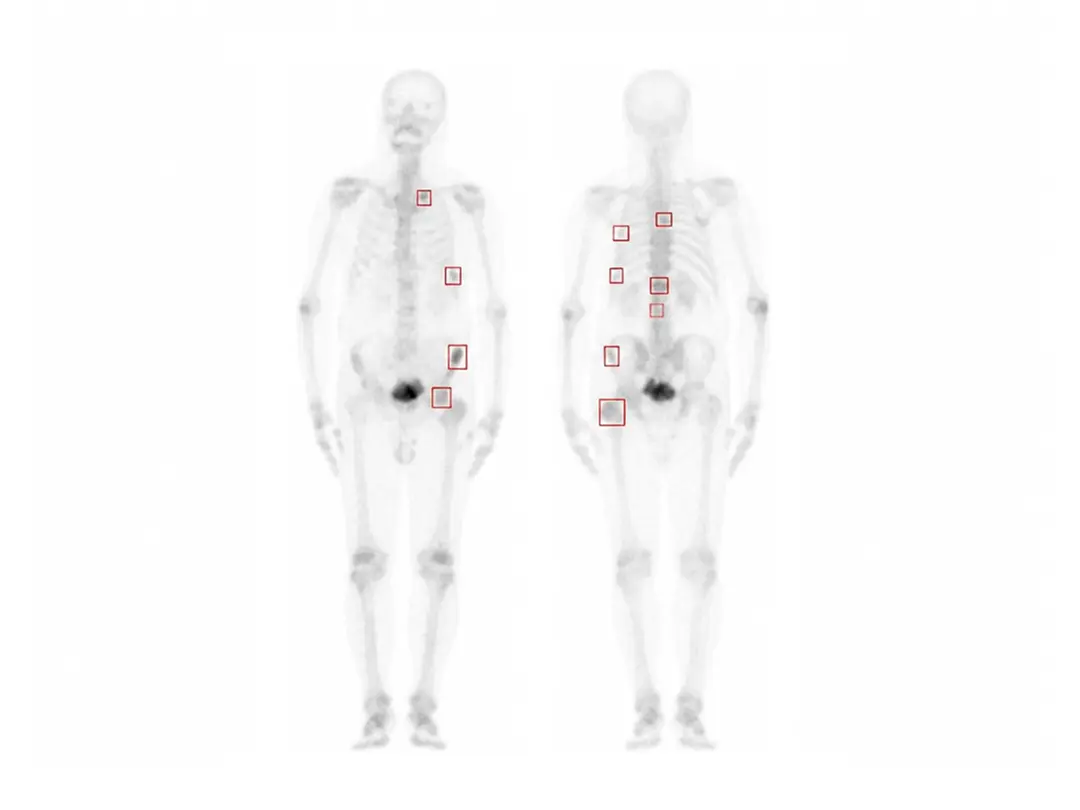
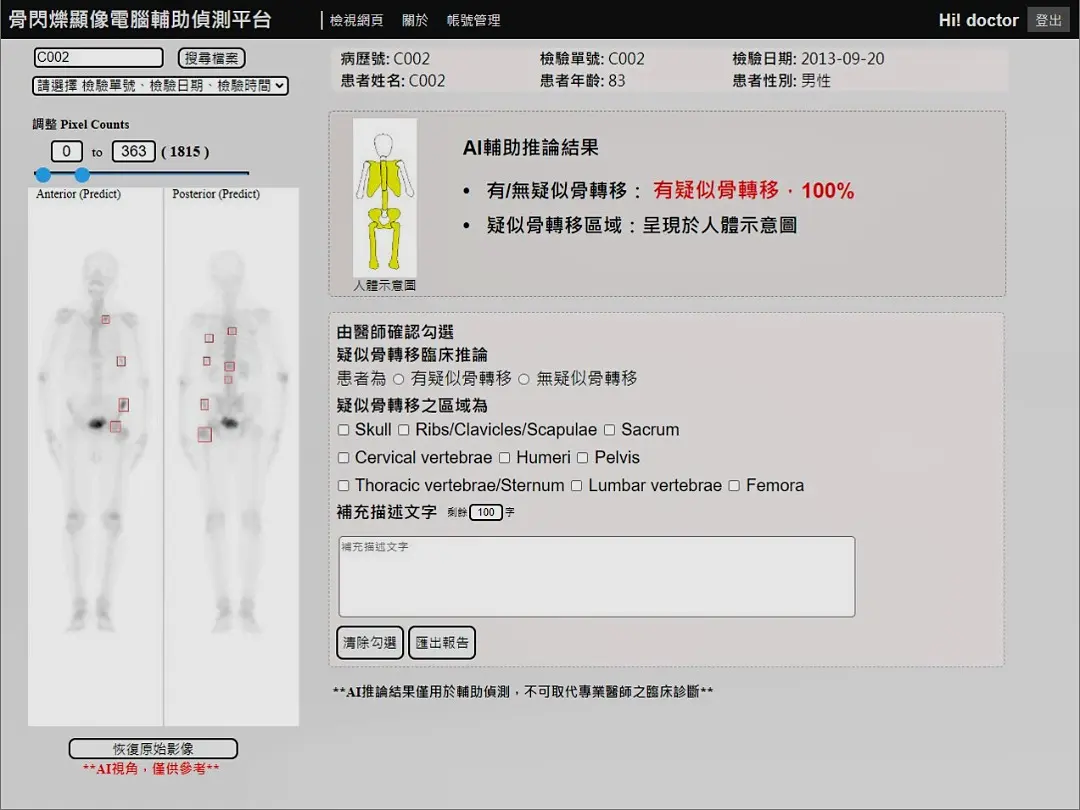
Whole-body Tc-99m MDP bone scintigraphy is particularly significant in the clinical diagnosis of metastatic cancer. With the increasing number of cancer patients globally and in Taiwan, the demand for such examinations has risen accordingly. To effectively reduce diagnosis time, reduce medical workloads, and improve physician accuracy and healthcare quality, our team has developed a "Computer-assisted detection platform for Bone Scintigraphy" This platform utilizes artificial intelligence algorithms to analyze whole-body Tc-99m MDP bone scintigraphy, quickly screening for the presence or absence of bone metastases and highlighting metastatic areas. Through an intuitive and structured reporting system, we aim to establish a one-stop service platform to support clinical nuclear medicine specialists. For patients, this ensures faster medical procedures, shorter waiting times, swift diagnosis, and timely treatment, significantly enhancing healthcare outcomes.
Traditionally, it takes a nuclear medicine physician approximately 20 to 30 minutes to diagnose a patient undergoing bone scintigraphy. However, the "Computer-assisted detection platform for Bone Scintigraphy," the world's first AI-powered software for analyzing bone scan images, can identify suspected lesions in just 30 seconds. The platform achieves 90% accuracy, ensuring high reliability in correctly identifying non-metastatic cases.
Currently, the "Computer-assisted detection platform for Bone Scintigraphy" has been certified by the Taiwan Food and Drug Administration (TFDA) (Certificate No. 007971) and granted a patent in the Republic of China (Invention Patent No. I818813).
This product has been certified by the Taiwan Food and Drug Administration (TFDA), and the technology has been licensed to Ever Fortune AI Co., Ltd. Ever Fortune serves as the distributor and also licenses the platform to nuclear medicine hardware providers, including General Electric Company and Siemens, as well as pharmaceutical companies specializing in bone scintigraphy tracers. By forming strategic alliances with international industry leaders, the platform is poised to expand its global reach and promote its adoption worldwide.
This year, a five-year agency agreement for 200 units was signed with a China company. This milestone not only marks a significant step for Taiwan’s domestically developed medical software entering the international market but also highlights the innovative capabilities of this product and the international recognition it has achieved.
Post-Market Surveillance
Ensuring the software maintains its safety, effectiveness, and consistent performance in real-world applications helps protect patient health and the operational safety of medical institutions.
Continuous Monitoring and Updates: Based on clinical needs and feedback, functional updates to the software may be required. These updates must be evaluated to ensure they do not compromise existing functionality or introduce new safety risks.
Usage Patterns and Performance Monitoring:
Monitor the software's actual usage in different medical environments and analyze its impact on patients and healthcare professionals, including stability, performance, and user interface experience. Track the software's performance across various scenarios, including processing speed, accuracy, and reliability, and use this data for continuous improvement.
Adverse Event Reporting System:
Establish a system to collect and report adverse events and malfunctions related to software usage.
Regulatory Compliance:
Ensure adherence to medical device regulations, including ongoing monitoring and updates to the software.
Version Control and Traceability:
Maintain detailed records of changes for each software version to enable traceability and identification of specific versions and modifications in case of issues.
Draft Plan for Autonomous Modifications
The Taiwan Food and Drug Administration (TFDA) has proposed a draft for the management of autonomous changes in medical device software. This aims to regulate the processes and requirements for manufacturers making self-initiated changes to their products post-market. Such changes may involve software functionality, performance, safety, or compliance, balancing the need for software innovation with its safety and effectiveness.