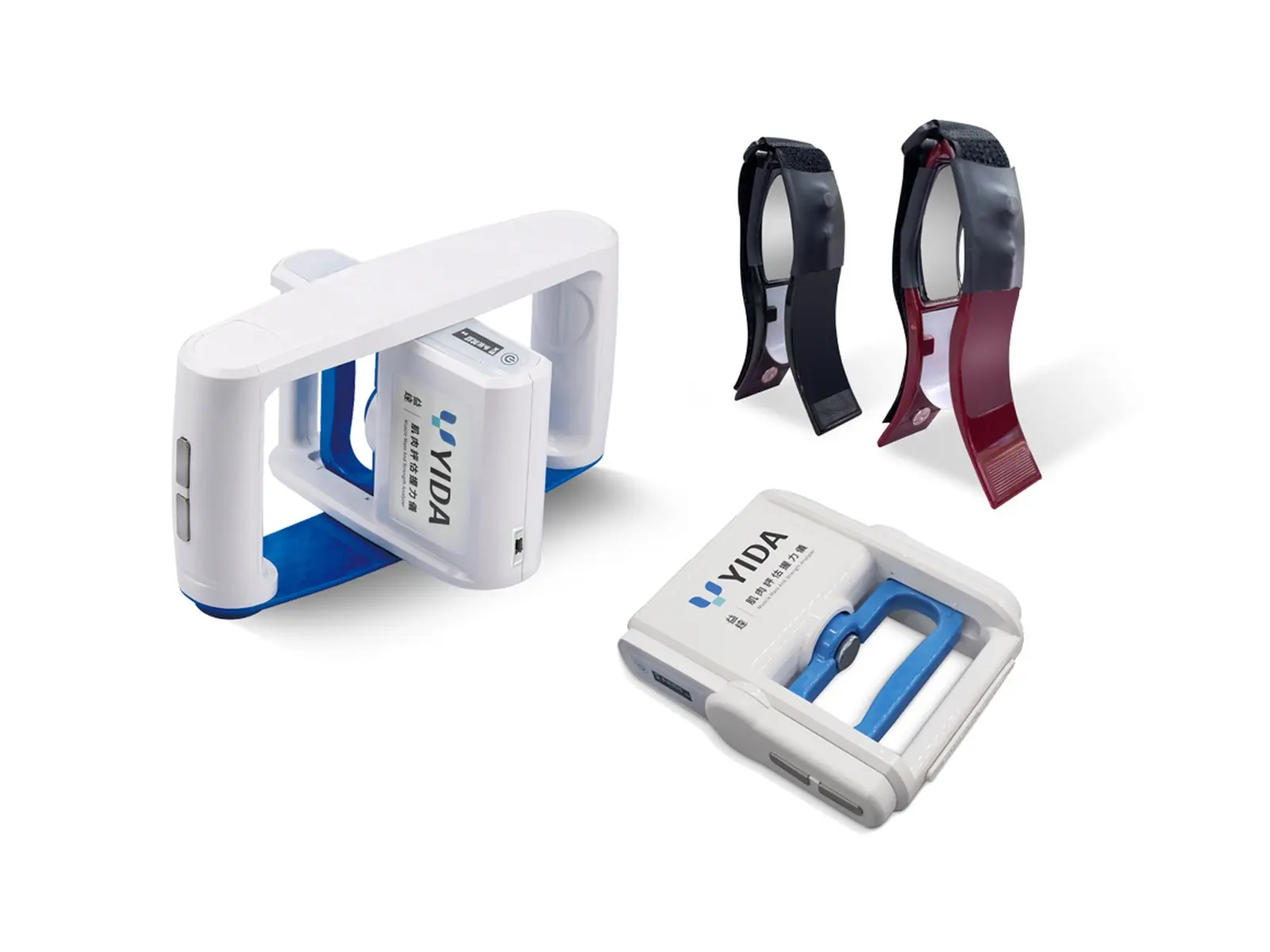
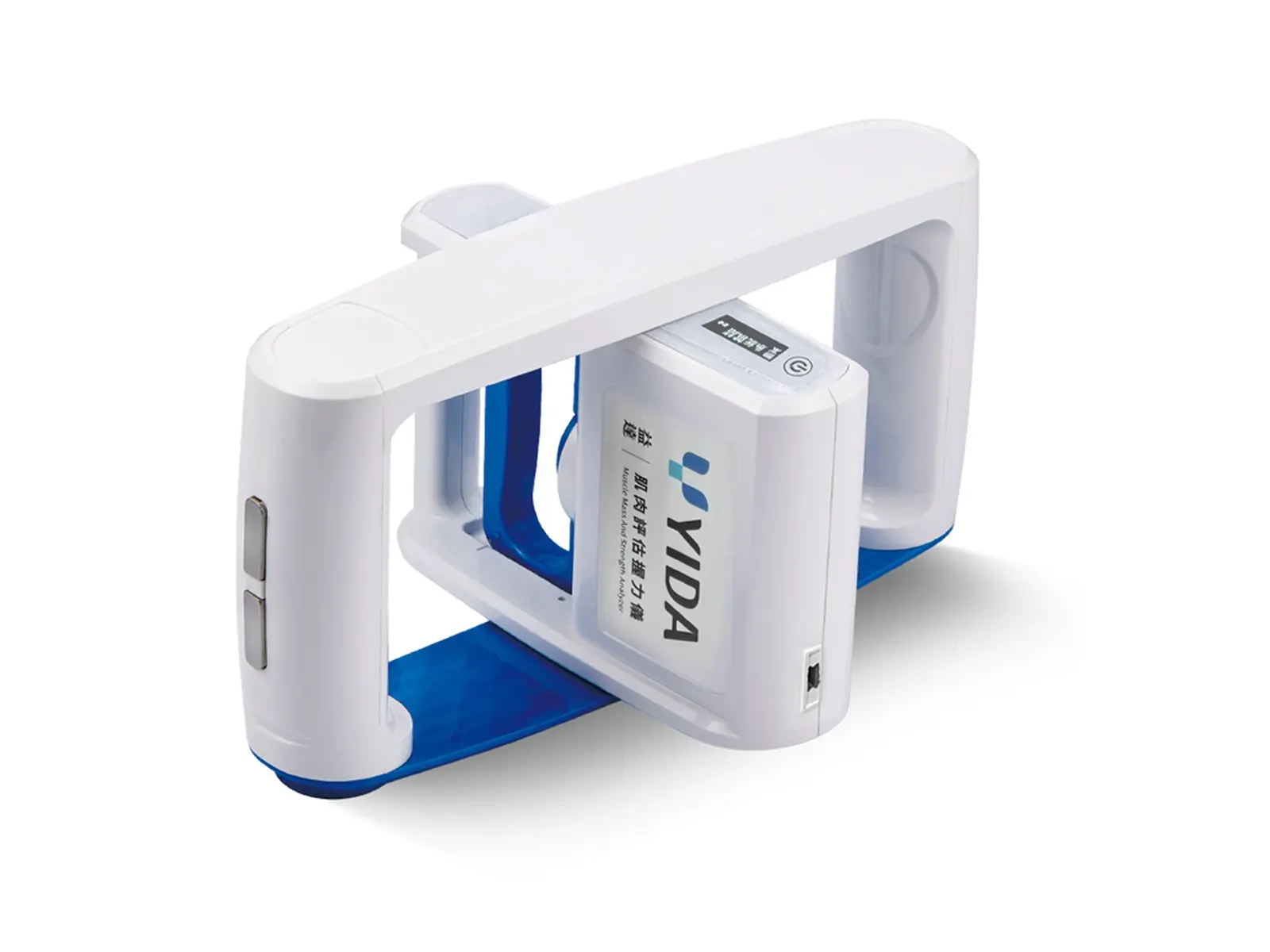
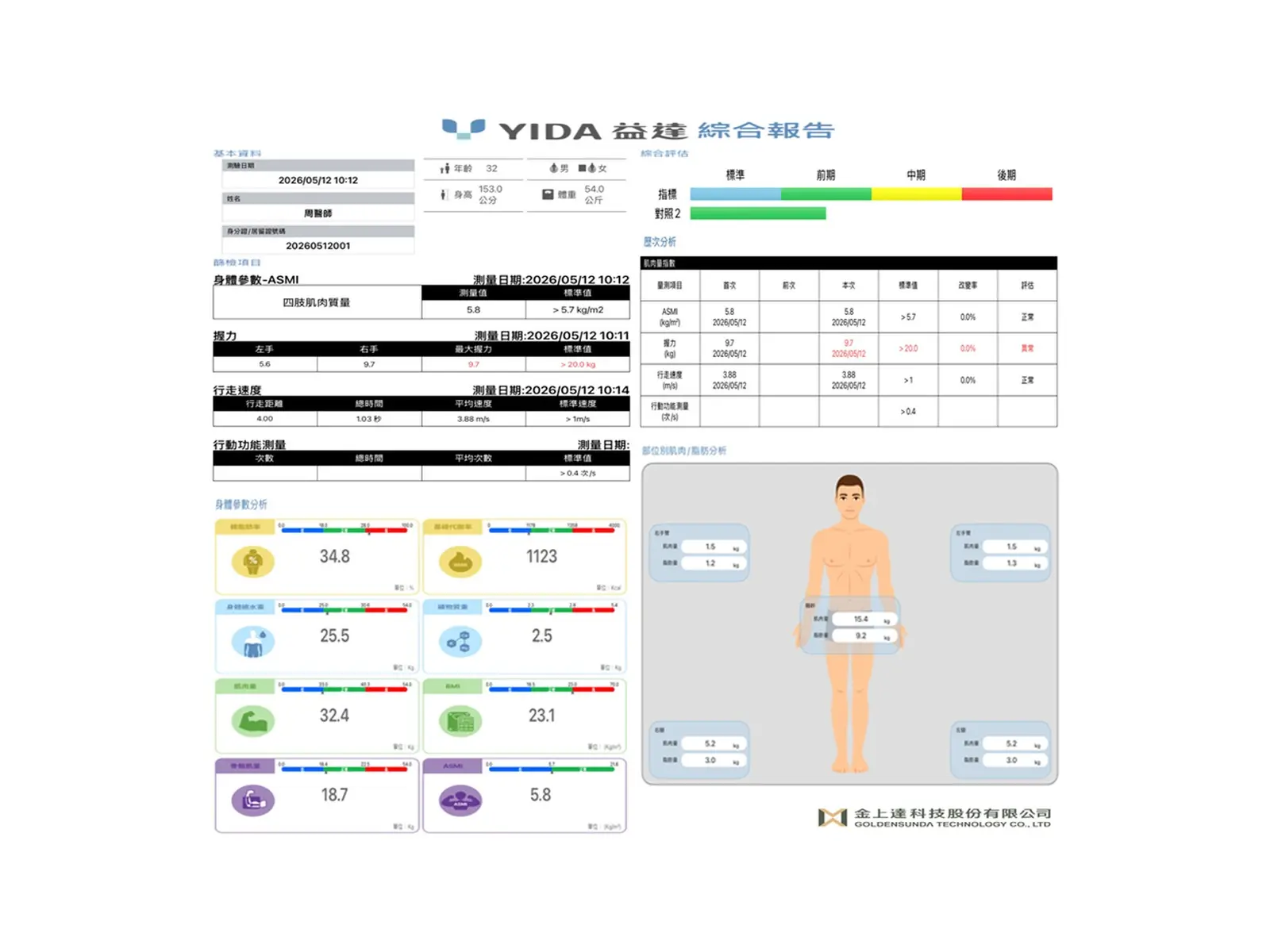
YIDA Muscle Mass and Strength Analyzer was designed to address the need for early screening of sarcopenia and functional decline in an aging society by integrating previously fragmented testing procedures into a fast, convenient, and longitudinally trackable all-in-one assessment tool. Its technical principle is based on bioelectrical impedance analysis (BIA) to estimate limb muscle mass, combined with handgrip strength and walking speed, corresponding to the key assessment indicators recommended by the Asian Working Group for Sarcopenia. It can also provide additional body parameters, including body fat percentage, basal metabolic rate, total body water, BMI, and skeletal muscle mass. Key product features include completing the assessment in about five minutes, requiring no change of clothes or removal of shoes, and enabling automatic data storage and report export. The product is available in both professional and home-use versions, suitable respectively for medical institutions, long-term care facilities, community sites, and everyday home health management. In clinical and wellness applications, it can be used for sarcopenia risk screening, health promotion, resident monitoring, evaluation of exercise and nutritional intervention outcomes, as well as outreach screening services in rural or community settings.
MOHW-MD-No.007158
Goldensunda Technology co., ltd.
Our company has established verification and validation mechanisms for the YIDA Muscle Mass and Strength Analyzer in compliance with ISO 13485, ISO 9001, and QMS requirements, covering development, pilot production, and mass production. Development activities include design input/output review, pilot production, pilot run review, design transfer, and final acceptance. Software and firmware are verified and managed throughout their life cycle in accordance with IEC 62304 to ensure the accuracy and stability of system functions, data processing, and operating procedures. Before mass production, first article inspection, incoming material control, in-process control, and final inspection are conducted to verify key components, manufacturing quality, and finished product functionality. Nonconforming products are isolated, recorded, and handled according to established procedures. The first-generation YD01A has obtained Medical Device Manufacturing License No. 007158 from the Ministry of Health and Welfare. New-generation models YD01F and YD01E have been submitted to MEDTech for Class II medical device testing, including IEC 60601-1, IEC 60601-1-2, IEC 60601-1-11, IEC 62366-1, and IEC 62304, LP0002 with additional environmental reliability validation planned. The product integrates BIA with handgrip strength and walking speed assessment, supported by risk management, complaint handling, and post-market surveillance mechanisms to ensure safety and quality stability.
Our company has established a full-process quality management system for the YIDA Muscle Mass and Strength Analyzer in accordance with ISO 13485, ISO 9001, and QMS requirements. For incoming materials, the Materials Department conducts supplier evaluation, annual assessment, and qualification maintenance in accordance with the supplier management procedure, while the Quality Assurance Department performs IQC in accordance with the incoming inspection control procedure to verify that the specifications, quantity, and appearance of raw materials, components, and outsourced items meet requirements. First article inspection is also implemented for new products, mold transfers, and outsourced products. During the manufacturing process, the Manufacturing Department carries out self-inspection of semi-finished products, inspection at critical process points, and equipment maintenance in accordance with standard operating procedures, while the Quality Assurance Department simultaneously conducts patrol inspection, measuring instrument calibration, and abnormality determination. If any nonconforming product is identified, it is handled according to procedures for isolation, labeling, root cause analysis, and corrective and preventive actions. Final inspection and functional verification are completed for finished products before warehousing and shipment, and only qualified products are released. To maintain quality stability, the company adopts data-driven management indicators such as supplier evaluation results, IQC/IPQC/FQC pass rates, defect rate, number of customer complaints, calibration completion rate, on-time delivery rate, and customer satisfaction. Through regular statistical analysis, internal audits, and management review, continuous improvement is implemented to ensure product quality consistency and stable shipment performance.
Our company has established a comprehensive risk management system for the YIDA Muscle Mass and Strength Analyzer in accordance with ISO 13485, ISO 9001, and QMS requirements, implementing systematic controls over all stages including incoming materials, manufacturing processes, finished products, and post-market activities. For incoming materials, supplier evaluation, qualification review, annual assessment, and IQC incoming inspection are conducted to ensure stable quality of raw materials and components. During the manufacturing process, self-inspection, first article verification, and quality assurance巡檢 are carried out in accordance with standard operating procedures, while isolation, root cause analysis, and corrective and preventive actions are initiated for any abnormal batches. For finished products, final inspection and functional verification are performed prior to warehousing and shipment, and only qualified products are released. After market launch, customer complaints handling, satisfaction surveys, adverse event monitoring, and cross-functional task force mechanisms are used to continuously collect market information, conduct risk assessments, and track improvements, in order to ensure product quality consistency, safety, and protection of user rights and interests.
Our company has established a comprehensive post-market management mechanism for the YIDA Muscle Mass and Strength Analyzer in accordance with ISO 13485, ISO 9001, and QMS requirements. We continuously carry out post-market safety monitoring, complaint handling, customer satisfaction surveys, adverse event management, and risk assessment. For software and app functions, version control, verification testing, and update release are conducted under the quality management system, while cybersecurity management for medical devices is strengthened in compliance with TFDA requirements. In the event of major quality abnormalities, use-related risks, or cybersecurity incidents, a cross-functional task force is immediately activated to conduct reporting, investigation, root cause analysis, and corrective and preventive actions. Product improvement, shipment suspension, or recall evaluation will be implemented when necessary. Through continuous monitoring and improvement tracking, we ensure post-market product quality stability, safety, and the protection of user rights and interests.
Title:Predict Sarcopenia Risk in the Elderly by Cardiovascular Function and Heart Rate Variability
Authors:Hsu, Po-Wen,Hsu, Wei-Hsun,Wang, Yu-Ling,Lee, Su-Shiang,Huang, Chun-Feng,Mao, Tso-Yen
Source:American Journal of Health Behavior, Volume 48, Number 1, January 2024, pp. 261-268(8)
Publisher: PNG Publications and Scientific Research Limited
Publication date:2024.01.01
DOI: https://doi.org/10.5993/AJHB.48.1.25
The patent portfolio is primarily focused on the product’s testing methods, system design, structural design, and biosignal detection device technologies.
One of the key granted patents is the Taiwan invention patent “Simple Detection Method and System for Sarcopenia” (Invention Patent No. I652039), which serves as an important foundation for the core sarcopenia assessment technology of this product.
The company has also obtained multiple international patents for “Grip Device with Detection Function” and “Biological Information Detection Device and Method / Biological Information Detection Device,” covering Taiwan, the United States, Japan, France, Germany, South Korea, China, and Singapore. These patents provide intellectual property protection for the product’s applications in grip strength measurement, bioelectrical impedance analysis, and integrated system design.