Hemodialysis patients
Through interdisciplinary collaboration, we provide safe, compassionate, and high-quality care, creating a second home for dialysis patients and helping them return to normal lives. Our vision is to become Taiwan’s leading hemodialysis care center, recognized for excellence in patient-centered care and clinical quality.
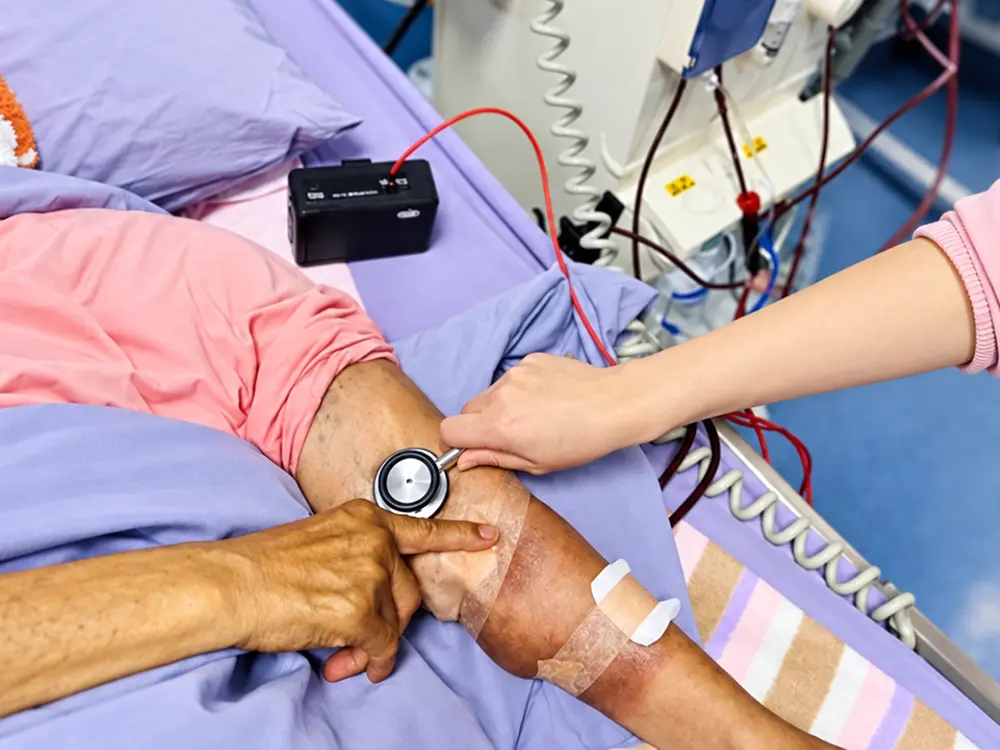
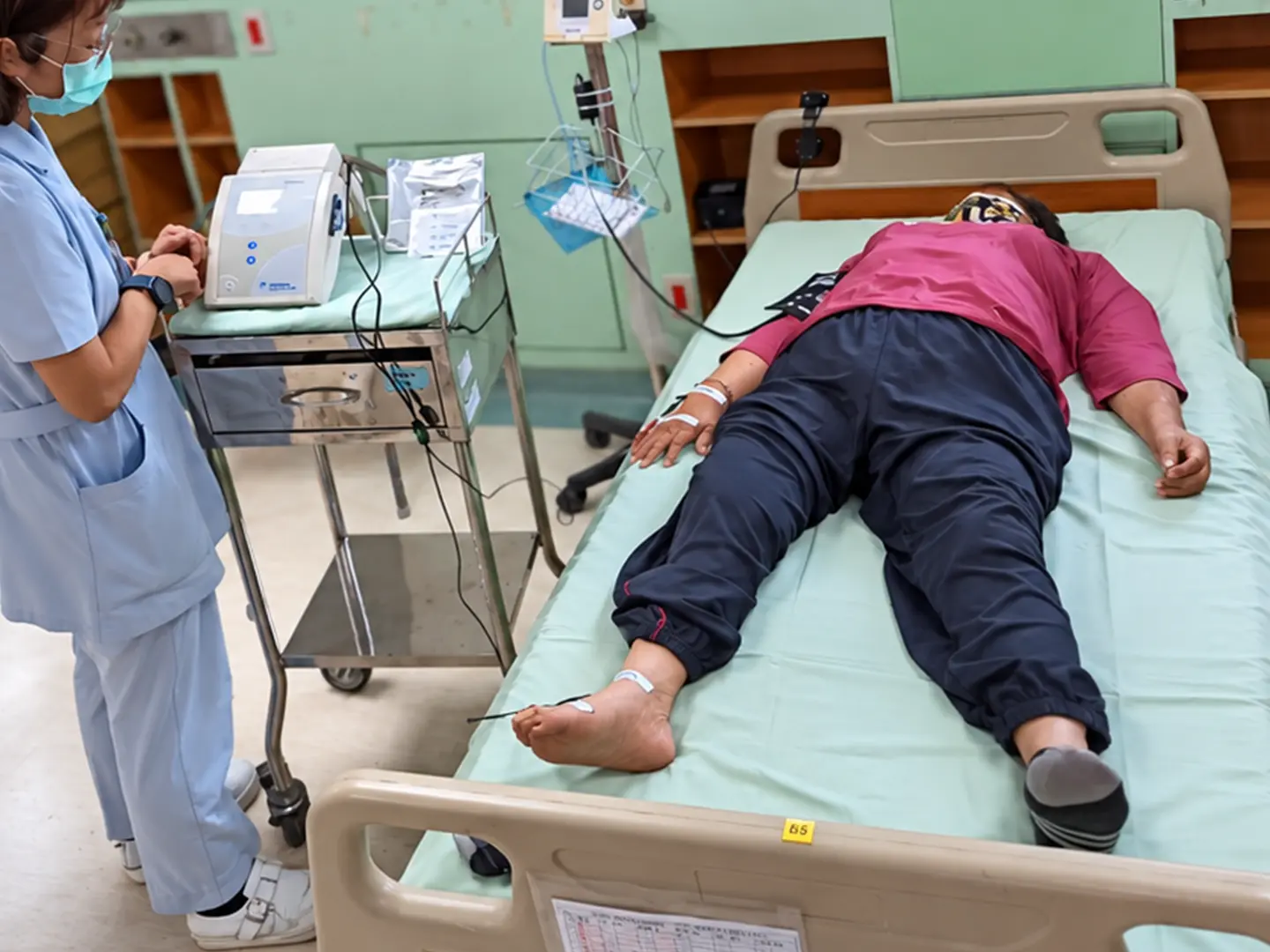
Our hemodialysis team is dedicated to innovative, patient-centered care. We are the first hospital in Taiwan to integrate digitalized diabetic foot screening into routine dialysis care, achieving a 100% screening rate. We also routinely use Body Composition Monitoring (BCM) for dry-weight assessment, with an implementation rate of 94–95%. To support seamless care, we developed the “Feng-Shen Life Learning Program,” which includes LINE-based communication, vascular access self-care training, health promotion activities, home care education, dietary guidance, and rehabilitation programs to enhance patients’ self-management and quality of life. The team has innovated a vascular access blood-flow amplifier (patent pending) to improve compression and hemostasis effectiveness, and designed an interactive meal-plate game to promote nutrition education. We also implemented the Golden Five-Color Stool Card for early detection of gastrointestinal bleeding and timely referral. Our center provides high-volume hemodiafiltration (HDF) therapy, maintains dialysis water quality that meets ISO standards, and uses dedicated treatment areas for hepatitis B and C patients to reduce cross-infection risks and ensure safe, high-quality dialysis care.
Long-term Hemodialysis Patient Statistics and Quality Indicators The total number of long-term dialysis patients was 565 in 2024, 544 in 2025
Compression Hemostasis Completion Rate: Target: 65% Achievement Rate: 90% Foot Examination Checklist Completion Rate: Target: 95% Achievement Rate: 100% Primary Nurse Care Completion Rate: Target: 95% Achievement Rate: 100%
The diabetic foot amputation rate decreased progressively from 4.6% in 2021 to 3.0% in 2025. The pulmonary edema-related emergency department visit rate declined gradually from 2.9% in 2021 to 0.2% in 2025. Serum Albumin Testing Rate: 100% Compliance Rate: ≥90% Annual compliance rates (2019–2025): 93.32%, 90.33%, 92.96%, 90.07%, 92.87%, 95.4%, and 95.3%, respectively. Hemoglobin Testing Rate: 100% Compliance Rate: ≥90% Annual compliance rates (2019–2025 Q2): 93.44%, 92.00%, 96.22%, 90.00%, 92.76%, 96.0%, and 96.5%, respectively. The arteriovenous fistula (AVF) occlusion rate decreased from 5.9% in 2022 to 4.8% in 2025. The vascular reconstruction rate remained below the National Health Insurance (NHI) benchmark (threshold: ≤1%). The hemodialysis mortality rate remained lower than the national average.
Dialysis Water Quality Management and Infection Control Measures RO (Reverse Osmosis) Water Quality Monitoring: Heavy metal testing: annually Endotoxin testing: monthly Bacterial culture testing: monthly Total chlorine and hardness testing: every shift HDF (Hemodiafiltration) Dialysate Monitoring: Endotoxin testing: monthly Bacterial culture testing: quarterly Comprehensive dialysate quality testing: semi-annually Dialysis water quality complies with international ISO standards. Spatial segregation and isolation design: Patients with Hepatitis B (HBV) and Hepatitis C (HCV) are treated in designated separate areas and use dedicated dialysis machines to minimize the risk of cross-infection. Emergency Disaster Drill – Four Steps for Self-Evacuation: Turn Off, Clamp, Disconnect, and Run (Open/Off, Clamp, Separate, Run). Note: If this is intended for a presentation or accreditation document, the wording can also be standardized as: Emergency Evacuation Drill – Four-Step Self-Rescue Procedure: Turn Off, Clamp, Disconnect, and Evacuate.
Nursing Staff Satisfaction Rate 2021: 92.0% 2022: 99.3% 2023: 98.7% 2024: 96.7% 2025: 97.8%
Awarded First Place in the Department of Nursing Service Satisfaction Competition (2023).
Clinical Outcomes and Quality of Care The average hemoglobin (Hb) level was higher than that reported in the United States. 2024–2025 average: 10.9 g/dL at our hospital vs. 10.73 g/dL in the United States. The proportion of patients with serum albumin ≥ 3.5 g/dL was higher than that reported in the United States. 2025 data: 95.3% at our hospital vs. 88.2% in the United States. The overall quality-of-life score of hemodialysis patients was 90.6, which was higher than the scores reported in the literature from Taiwan (81.3) and Iran (81.4).
Innovations and specialized features have been formalized into nursing care standards.
The application of the blood flow amplifier was horizontally expanded and implemented at the Shalu Campus.
The average percentage of patients maintaining serum albumin levels ≥ 3.5 g/dL reached 93.5% from 2024 to 2025 at our hospital.
The diabetic foot amputation rate remained significantly lower than the national average of 17.47% reported in the literature (Lin et al., 2019).