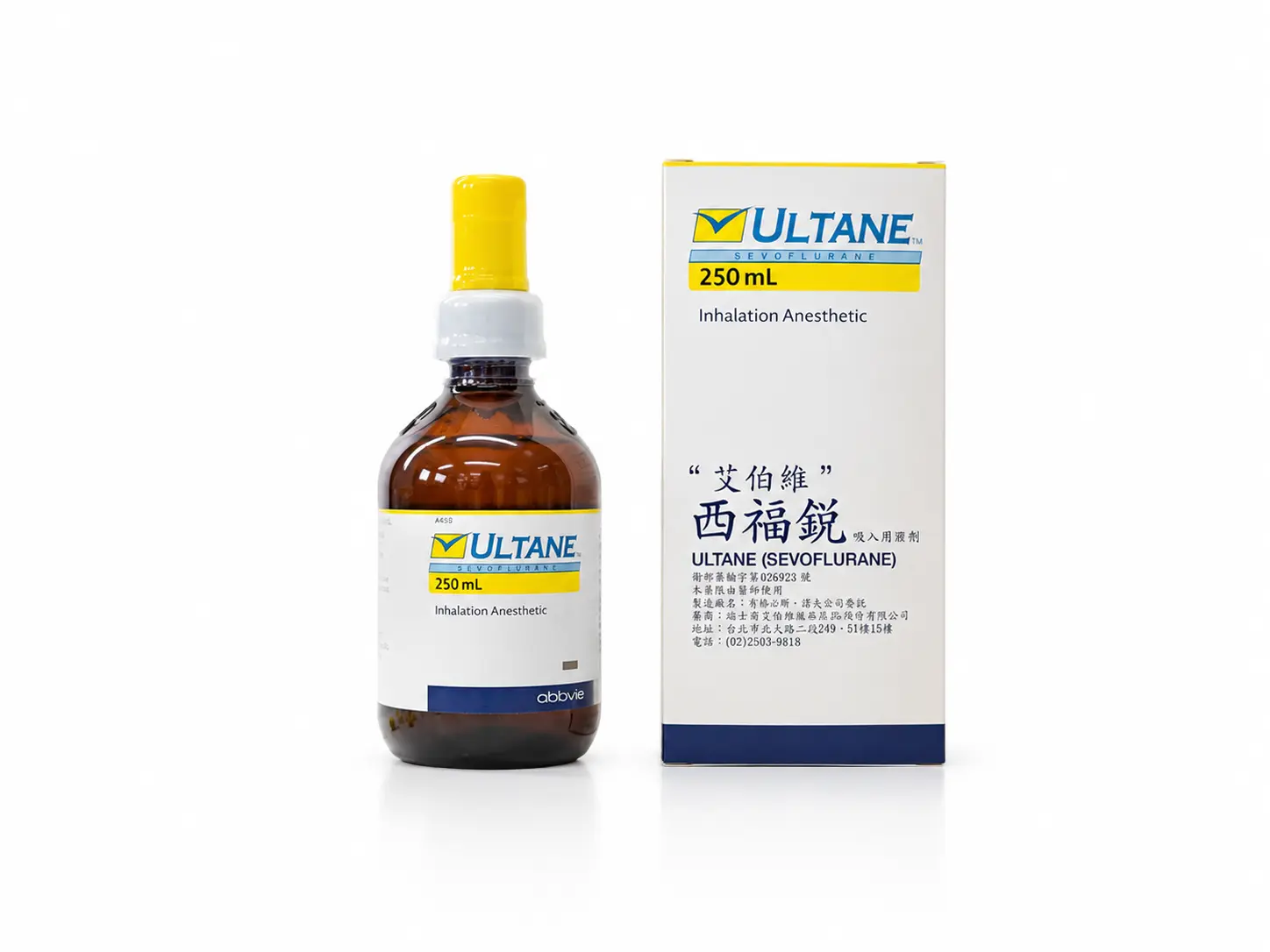
https://lmspiq.fda.gov.tw/web/DRPIQ/DRPIQ1000Result?licBaseId=ABD0D90F-EB60-47BD-91FF-273A8E02CF29
許可證字號:衛部藥輸字第026923號 有效日期:01150806
製造廠名稱: Aesica Queenborough Limited. 製造廠登記: 115-0285-1, 製造廠品管: GMP
Product verification focuses on formulation stability, pharmacopoeial specifications, container compatibility, clinical performance, and safety. Public prescribing information states that at least 300 ppm water is added as a Lewis acid inhibitor, with no other chemical stabilizers, to reduce the risk of Lewis acid–mediated degradation under relevant conditions. The product can be verified against the USP sevoflurane monograph, including identification by infrared absorption, refractive index, acidity/alkalinity, water content, fluoride limit, nonvolatile residue, peroxide limit, related substances, and assay. Clinical and safety information in the approved labeling supports its use for induction and maintenance of general anesthesia in adults and pediatric patients, and also describes risks related to hepatic/renal parameters, adverse reactions, desiccated CO₂ absorbents, and degradation products.
Quality control for Ultane is implemented through GxP-based controls and approved product specifications across incoming materials, in-process controls, finished product release, and pre-shipment verification. Incoming controls should cover the active ingredient, stabilizing water content, PEN container, closure system, and filling interface components. In-process controls focus on critical quality attributes such as sevoflurane assay, ≥300 ppm water target, acidity/alkalinity, fluoride limit, related substances, peroxide limit, nonvolatile residue, appearance, and container-closure integrity. Finished product release is performed against pharmacopoeial and approved specifications, including identification, purity, impurity profile, water content, and visual inspection. Batch records, deviations, changes, and CAPA status are reviewed by Quality prior to release. AbbVie’s public ESG disclosure describes systematic inspection, testing, and monitoring of incoming materials, manufacturing processes, and final product output, supported by expert teams, advanced equipment, quality management systems, and GxP training.
Risk management for Ultane covers incoming materials, manufacturing, finished product release, supply chain, and post-market use. Incoming risks are controlled through supplier qualification, material specifications, batch documentation, and testing. Manufacturing risks are controlled through validated processes, critical parameter monitoring, deviation investigation, change control, and contamination control. Finished product risks are managed through pharmacopoeial specifications, COA review, batch release, and stability monitoring. Product-specific risks for sevoflurane include Lewis acid degradation, desiccated CO₂ absorbents, degradation product formation, container-closure compatibility, storage of volatile liquid, and occupational exposure. AbbVie’s public quality system describes management responsibility, change management, CAPA, Quality Risk Management, Process Performance and Product Quality monitoring, and documentation control. These elements support a lifecycle-based risk management approach to maintain product quality, patient safety, and regulatory compliance.
Post-market surveillance for Ultane is based on pharmacovigilance, product quality complaint handling, signal detection, labeling updates, and CAPA. AbbVie’s public disclosure states that its Pharmacovigilance and Patient Safety team identifies potential safety issues and mitigates their impact throughout the product lifecycle, while its Epidemiology organization supports post-marketing safety studies required by health authorities and real-world evidence generation. Ultane labeling includes adverse events identified in clinical trials and post-approval use, such as seizures, delirium, cardiac events, diffuse alveolar hemorrhage, hepatic dysfunction, malignant hyperthermia, and hypersensitivity reactions. Quality complaints or abnormal findings should be documented, investigated, risk-assessed, reported where required, and addressed through corrective and preventive actions. Findings may lead to updates in training materials, labeling, or use precautions. As a pharmaceutical product without embedded software, software maintenance or software update control is not applicable.
Published literature directly supporting the differentiated advantages of Ultane® / original sevoflurane mainly focuses on manufacturing process, formulation stability, water content, and container design. Baker reported in Anesthesia & Analgesia that Ultane is manufactured by a single-step synthetic process, contains >300 ppm water, and is supplied in a polyethylene naphthalate (PEN) plastic bottle, whereas some generic sevoflurane products use multi-step processes, lower water content, and glass containers. Kharasch et al. reported in Anesthesia & Analgesia that lower-water sevoflurane underwent substantial degradation to hydrofluoric acid and other degradants during storage in the Penlon Sigma Delta vaporizer, while the higher-water Ultane formulation did not show the same degradation profile under comparable test conditions. This supports the value of the ≥300 ppm water-stabilized formulation in inhibiting Lewis acid–mediated degradation. Yamakage et al. reported in the British Journal of Anaesthesia that original and generic sevoflurane products differed in actual composition, with original sevoflurane showing higher water content and a distinct impurity profile. These publications support Ultane’s differentiated advantages in process consistency, formulation stability, and container design.
Public patent records show that Ultane® / sevoflurane-related technologies cover manufacturing process, formulation stabilization, filling interface, and container design. First, US6100434A, “Method for synthesizing sevoflurane and an intermediate thereof,” filed by Abbott Laboratories, relates to a method for synthesizing sevoflurane and an intermediate, supporting the product’s single-step / efficient manufacturing process positioning. Second, US5990176A, “Fluoroether compositions and methods for inhibiting their degradation in the presence of a Lewis acid,” relates to stabilization of fluoroether compositions with a Lewis acid inhibitor; the preferred fluoroether is sevoflurane and the preferred inhibitor is water, supporting Ultane’s ≥300 ppm water-stabilized formulation. Third, US5505236A, “Anesthetic vaporizer filling system,” filed by Abbott Laboratories and later assigned to AbbVie Inc., relates to a closed transfer system between an anesthetic container and vaporizer, corresponding to the Quik-Fil filling interface. Fourth, US6074668A, “Container for an inhalation anesthetic,” relates to storing sevoflurane in a polyethylene naphthalate (PEN) container, supporting the product’s shatter-resistant and low-reactivity container design. Patent validity and ownership should be confirmed by Legal/IP before formal submission.