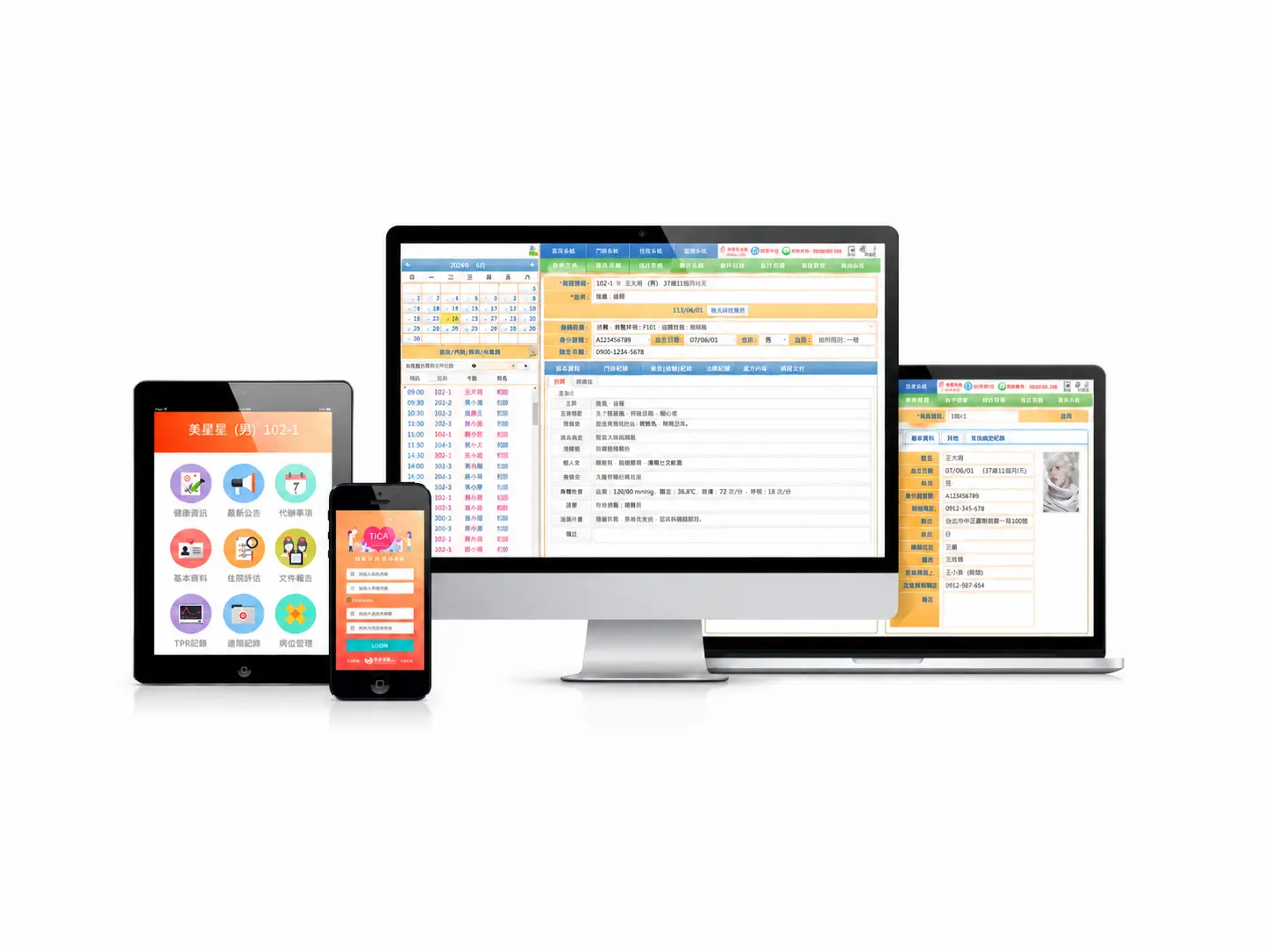
U-ark Technology delivers "one-stop cloud software services" driving digital transformation in Long-Term Care. Our integrated platform, uCare, supports residential care, home nursing, and daycare centers through three core strengths:
🚀 Key Innovative Features
All-in-One Integration: Unifies case management, payroll, finance, and NHI claims to eliminate multi-system hassle.
Smart IoT & AI: Embeds AI voice, facial recognition, and vital-sign monitoring into daily workflows.
Flexible Customization: Tailors forms and reports to meet diverse local regulatory standards.
💡 Service Functions & Application Scenarios
U-ark’s solutions have been widely adopted across various long-term care and healthcare service environments, including:
Residential Care Institutions: Supports automatic accreditation indicator statistics and cross-form data integration, helping institutions efficiently manage accreditation requirements and internal operations.
Home Nursing & Home Service Providers: Streamlines case management and National Health Insurance claim processes, improving the efficiency of daily documentation and monthly claim submissions.
Daycare Centers: Integrates a family communication app with IoT applications, enabling family members to monitor their loved ones' status in real time, thereby enhancing service transparency and trust.
Factory Registration Certificate No.: 53766524
U-ark adopts a cloud-based SaaS model, providing long-term care institutions with rapidly deployable and continuously updated systems. The platform reduces IT investment and maintenance costs while supporting third-party integrations, such as bank payment services and government review platforms, to ensure stable and scalable delivery.
Through modular design, U-ark offers continuous maintenance, feature updates, and customer support. Its solutions support residential care, home nursing, home services, and daycare services, integrating with Ministry of Health and Welfare systems to reduce duplicate work, streamline claims submission, import client data and service plans, and complete online reimbursement processing. All modules undergo integration testing, stress testing, and user acceptance testing.
With over 10 years of experience, U-ark holds around 50% of Taiwan’s long-term care market and has been adopted by more than 1,200 healthcare and long-term care institutions, including major healthcare systems, care groups, NPOs, and government smart care projects.
Manufacturing facility quality control standards comply with ISO27001:2022, ISO27701 Information Security Management System standards. Software testing processes include three major phases: design, development and construction, and acceptance, with each phase including unit testing, system integration testing, stress testing, and user acceptance testing. A comprehensive defect management process has been established, including four major operations: defect submission, assignment, repair, and closure, completed through collaboration between developers and testing personnel.
Uses Git distributed version control system to ensure that all developers save file states as update history records, allowing easy restoration to previous states and displaying differences in edited content. When someone attempts to upload an edited old file to the server and overwrite others' latest files, Git tools issue warnings to prevent developers and deployment personnel from inadvertently overwriting others' edited content, which could cause user operation issues.
uCare adopts a cloud-based SaaS architecture, providing long-term care institutions with stable and continuously updated services. During implementation, the Company supports data inventory, system setup, data migration, and user training. A dedicated LINE support group is established for timely issue tracking and resolution. The Company has clear Service Level Agreements (SLA) and provides telephone, online, and technical support.
uCare includes access control, login authentication, operation logs, data backup, abnormal activity monitoring, encrypted transmission, and regular cybersecurity checks to reduce risks of data leakage or service interruption.
System updates are regularly performed based on regulatory changes, customer needs, and system performance, and are tested before deployment.
For system incidents, the Company conducts issue classification, root cause analysis, and emergency recovery.
Quality issues are tracked, corrected, and incorporated into preventive improvements, training, and system optimization.