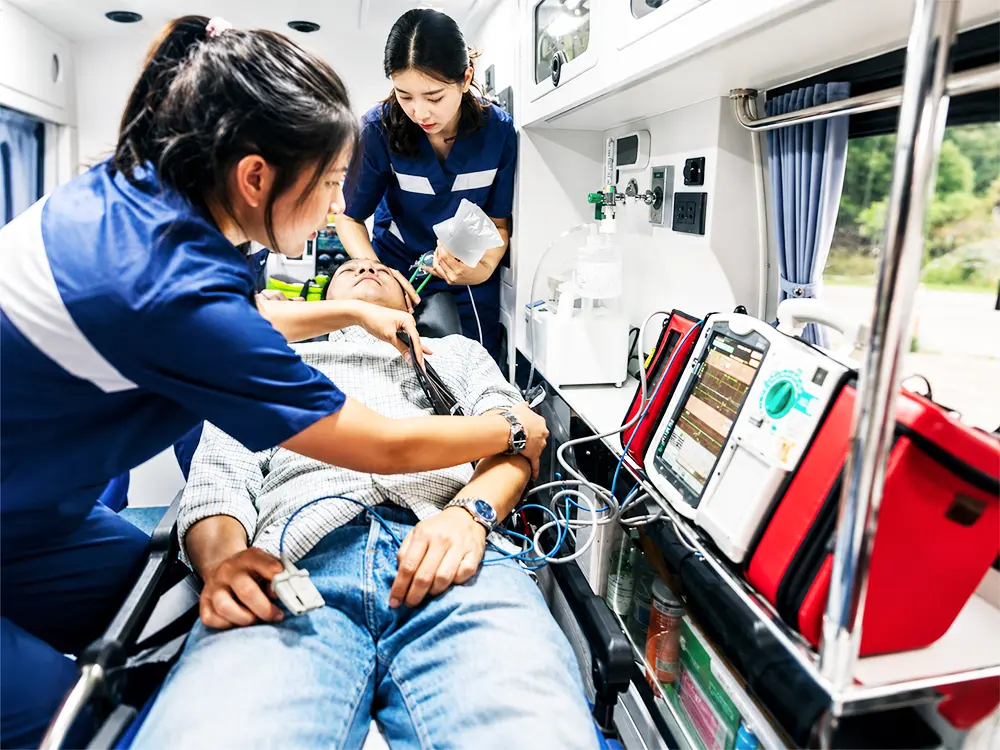
All patients, regardless of condition severity or type
Community members
Vulnerable patients
Everan Hospital was founded on February 21, 2016, with its name carrying the meaningful blessing of "peace for the elderly, and everlasting peace." Located in the Taiping District, the hospital sits adjacent to areas with limited medical resources and is situated right next to the Taichung Ring Line (Provincial Highway 74). With the "community" at its core, the emergency medicine team collaborates closely with private organizations to upgrade emergency medical services for local residents. Their goal is to build a safe, loving, and mutually supportive community, thereby creating the greatest possible medical well-being for the public.
Stepping out of the ivory tower to deeply cultivate community emergency medical care.
Real-time integration of nearby first-aid resources via the "Listen to AED" system.
Integrating pre-hospital emergency care with neighboring fire departments.
Five-year community first-aid cultivation plan (Awareness, Willingness, Capability, Opportunity).
Establishing fast-track "green channels" for four major acute conditions (Severe Trauma, Acute Stroke, Acute Myocardial Infarction, and OHCA).
Partnering with 150 local clinics to build a localized medical network.
Enhancing medical services for community groups (County Highway 136 Rescue Team, Huashan Foundation, and Hondao Senior Citizen's Welfare Foundation).
Emergency room visitor CAGR of 21.58%, ranking third nationwide among 179 emergency care hospitals over the past four years.
40 in-person exchange sessions with fire departments held between 2021 and 2025.
58 in-service emergency care training courses held, with a satisfaction rate exceeding 98%.
560 hours of external training related to emergency care.
11,843 downloads of the "Hear AED" app, achieving 100% coverage in 22 counties and cities.
33,063 emergency medical volunteers
"Hear the AED" Line@ activations: 2,171 emergency calls, 1,978 responses indicating willingness to respond, 690 successful arrivals
Taichung City has 1,094 AEDs, 109 equipped with smart alarms, a coverage rate of 10%
27 "Call the AED" volunteer promotion events held, reaching 1,697 people
21 complete CPR + AED first aid operation training sessions held, issuing certificates to 389 people
126 volunteers trained
From 2023 to April 2026, community health stations served 1,134 people
In 2025, community disadvantaged groups received a total of NT$1,752,353 in
community welfare subsidies and NT$1,987,288 in medical expense assistance
From 2018 to 2025, 411 disadvantaged emergency patients were referred to social
workers Invited to speak at 41 professional associations, institutions, and foundations
from 2020 to 2025
Three posters published for the International Conference on Emergency Medicine,
2023-2025
Emergency OHCA patient recovery ROSC rate: increased from 12.5% in 2019, to 29.41% year by year, and will remain at11.11%.
OHCA survival discharge rate: 21.88% in 2022, 22.08% in 2023, 21.62% in 2024, 18.18% in 2025,2026 (January-April) 11.11%, better than international standards.
Stroke arrival at the emergency room for 60 minutes (inclusive) and receiving intravenous thrombolytic agent (IV-tPA) treatment: 100% in 2023 (January-June),
Better than the whole country.
Acute ischemic stroke onset within 2 hours (inclusive) of an acute ischemic stroke onset and IV-tPA administered within 3 hours (inclusive) of the onset: 2022
100%, 77.78% in 2023, 100% in 2024, 100% in 2025, better than the national average.
The ratio of STEMI patients taking their first EKG test less than 10 minutes: 91.43% in 2022, 92.31% in 2023, 85.37% in 2024, 90.91% in 2025, and 66.67% in 2026 (January-April).
Acute myocardial infarction-STEMI administered direct percutaneous coronary intervention within 90 minutes of emergency visit: 100% in 2022, 85.7% in 2023, 81.8% in 2024, 66.6% in 2025, better than regional hospitals.
Emergency transfer rate: 1.10% in 2022, 1.26% in 2023, 1.43% in 2024, 1.76% in 2025, better than regional hospitals
The timeliness of referral patients arriving at another hospital within 30 minutes reaches 96%.
2055 pre-hospital initiation of disposal cases, 10 minutes in advance
The proportion of patients staying in the emergency room for more than 24 hours: 0.01% in 2021, 0.01% in 2022, 0.00% in 2023, 0.02% in 2024, and 0.04% in 2025 (threshold 0%)
Emergency patient referral AAD rates: 1.98% in 2021, 1.66% in 2022, 0.81% in 2023, 0.77% in 2024, and 0.86% in 2025 (threshold ≤ 1.35%)
Proportion of emergency major trauma surgeries entering the operating room within 30 minutes: 77.78% in 2021, 100.00% in 2022, 66.67% in 2023, and NA (threshold ≥ 60%) in 2024-2025
Mortality rates in hospital admissions for acute myocardial infarction: 0.0% in 2021, 7.14% in 2022, 0.0% in 2023, 0.0% in 2024, and 3.0% in 2025.
A total of 41 standard books have been formulated.
Satisfaction with emergency on-the-job education courses exceeds 98%
After promoting emergency medical services through community engagement courses, we provide positive feedback to our team via community software.
Patients and their families expressed gratitude in writing to the healthcare team.
The public thanked the rescue personnel for saving a life from the brink of death and specially went to the hospital in person to express their gratitude.
Three posters for the 2023 International Emergency Medicine Conference have been published.
Response rate to public call software emergency incidents - willingness to go rescue: 49% in 2023 (January-June), outperforming Taiwan at 7.3%, Singapore at 45.8%, the UK at 16%, the Netherlands at 27%, the US at 23%, and Denmark at 51%.
OHCA survival discharge rates: 11.1% in 2022, 21.62% in 2023, 18.18% in 2024, 11.11% in January-April 2025, outperforming 8% in Europe and 3% in Asia.
Collaborating with David Schwartz, a professor at Bar-Ilan University in Israel, Taiwan-Israel (MOST) bilateral cooperation is studying the "Add-on International Cooperation Research Program."
Benefiting Community Residents: There is no need for them to travel to the city center to enjoy high-quality medical services.
Regional Integration: Integrating hospitals to form a community medical network, collaborating with nearby medical centers on referral quality, and integrating with fire departments into pre-hospital emergency care systems.
This hospital is responsible for emergency care, providing 24/7 support for community patients.
Deepening Community Engagement: Establishing long-term partnerships with various community groups, moving from emergency care to the community
In the face of the severe COVID-19 pandemic, comprehensive epidemic prevention measures have been put in place to quickly respond and safeguard the health of community members.
Winning the MediaTek "Smart Homecoming" Social Innovation Excellence Award
From 2017 to 2021, we won the Regional Hospital Emergency Patient Progress Award under the Health Insurance Agency's Emergency Quality Impro...