Development of Three Platforms to Gradually Improve Critical Care Services
In addressing challenging critical care situations, healthcare professionals must perform regular monitoring and assessments to implement timely and appropriate interventions, thereby reducing patient risks and improving survival rates. However, a global shortage of healthcare personnel is significantly impacting the care of critical patients. Additionally, emergency medical staff face high workloads, requiring 24/7 operations to manage diverse acute cases of varying severity. To enhance emergency care and medical quality, it is crucial to provide tools that help healthcare professionals quickly and accurately assess patient conditions, enabling individualized treatment to improve outcomes and survival rates.
Three products have been developed focusing on three of the most critical acute conditions in medical care—sepsis, acute myocardial infarction, and acute respiratory distress syndrome (ARDS)—i. A.M.S, Smart Heart Platform, and ARDiTeX. During the digital transformation process, these platforms integrate seamlessly with hospital systems and clinical workflows, aiming to achieve the following objectives:
i.A.M.S:
Reduce sepsis mortality.
Improve decision-making efficiency and accuracy.
Accelerate the digital transformation of healthcare institutions.
Smart Heart Platform:
Minimize the time of myocardial reperfusion.
Reduce human errors and omissions.
Expand medical service coverage.
ARDiTeX:
Enable early detection by non-specialists.
Provide real-time monitoring to ensure lung-protective ventilation.
Enhance care quality while reducing medical resource costs.
i.A.M.S:
In November 2021, the sepsis risk prediction model was applied to approximately 1,800 patients, identifying over 1,400 non-sepsis cases and 70 sepsis cases with an accuracy rate exceeding 80%.
From January to June 2022, the platform successfully provided 15,000 predictions of antimicrobial resistance risk, achieving a 95% consistency rate with final microbiology reports.
Since the introduction of the "Antibiotic Therapy Decision-Support System" in 2019, near misses related to anti-infective medications have decreased from a monthly average of 35.25 cases to 3.33 cases in 2022. The hospital’s total reporting ratio dropped from 2.95% in 2019 to 0.79% in 2022.
With the system's support, the time required to prescribe antibiotics has been reduced by 75%. Inappropriate prescription rates (e.g., incorrect dosage, frequency, or infusion flow rate) dropped from 12.1% and 21.2% in February and October 2021, respectively, to 0% from March to December 2022.
Compared to traditional resistance detection methods, the "Comprehensive Smart Antibiotics Platform" reduced the time required for diagnosis by 1.4 days, enabling physicians to prescribe appropriate antibiotics sooner.
Intervention through the platform improved survival rates for Staphylococcus aureus infections by 11.7% and Klebsiella infections by 23.7%.
Smart Heart Platform:
Between June and October 2020, preliminary analysis revealed that the intervention of the Smart Heart Platform enabled STEMI patients to receive treatment within 10 minutes of symptom onset. The platform significantly reduced the "door-to-balloon time" (D2B time), which measures the time from hospital arrival to vascular reperfusion by the cardiac team.
ARDiTeX:
Before implementing standard-of-care (SOC) measures and ARDS lung protection monitoring, the diagnostic rate for ARDS was 52.2%. After integrating the AI alert system, the diagnostic rate increased to 91.67%.
With the implementation of the Smart Lung system, ICU mortality rates for ARDS dropped from 58.1% under SOC alone to 39.5%. This reduction was sustained over 18 months, with ICU mortality rates consistently lower than those under SOC alone.
Successfully partnered with the U.S. National Institutes of Health (NIH) for project implementation.
Pfizer and Merck have recognized the future potential of the Smart Antibiotics Platform and signed memorandums of understanding with CMUH.
Collaborated with HIMSS on the digital transformation of smart hospitals. The Smart Antibiotics Platform has received significant attention at international conferences and competitions. Additionally, ongoing clinical collaborations with Mayo Clinic have progressed with regular meetings to finalize project details.
The three platforms—i.A.M.S, Smart Heart Platform, and ARDiTeX—received the 2023 HIMSS Davies Award of Excellence in June 2023. CMUH became the only hospital in Taiwan and Asia to receive this prestigious award in 2023.
NA
NA
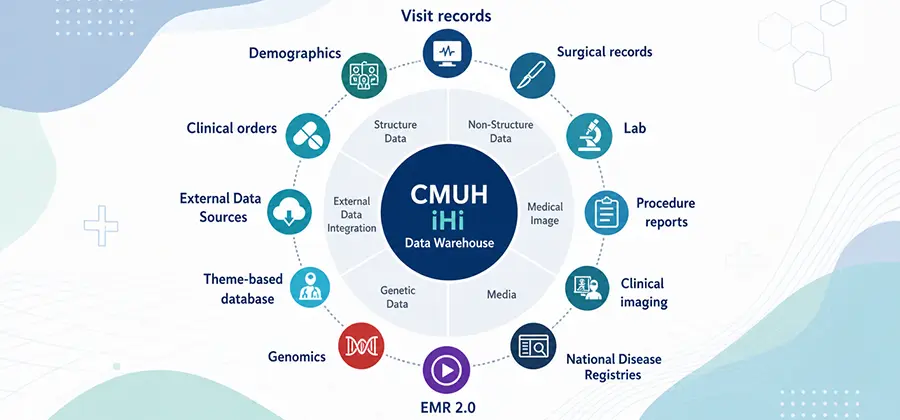
Applicants for medical data usage must be formal hospital staff. Data users and analysts must be registered and sign confidentiality agreements.
Applications for medical data usage must follow established procedures. Applicants must submit their requests to the data management department. Requests involving patient-identifiable or large-scale data require IRB approval and are reviewed by the Medical Data Application Management Committee before implementation.
Data intended for external use by collaborative institutions requires approval from the Medical Data Application Management Committee and must be documented.
If the purpose of data use changes, the original data must be destroyed, and a new application submitted for data usage aligned with the revised purpose.
The data management department may revoke data management privileges in cases of severe policy violations.
i.A.M.S: Establishes a precision antibiotic stewardship and early sepsis warning architecture, reducing hospital stays and optimizing survival metrics
Smart Heart Platform: Pushes AI triage straight to the pre-hospital frontline, building a seamless regional network that shortens reperfusion time to save lives *
ARDiTeX: Drives automated intensive care by enforcing international lung-protective ventilation guidelines (30% increase in adherence), optimizing ICU resource allocation, and achieving healthcare sustainability