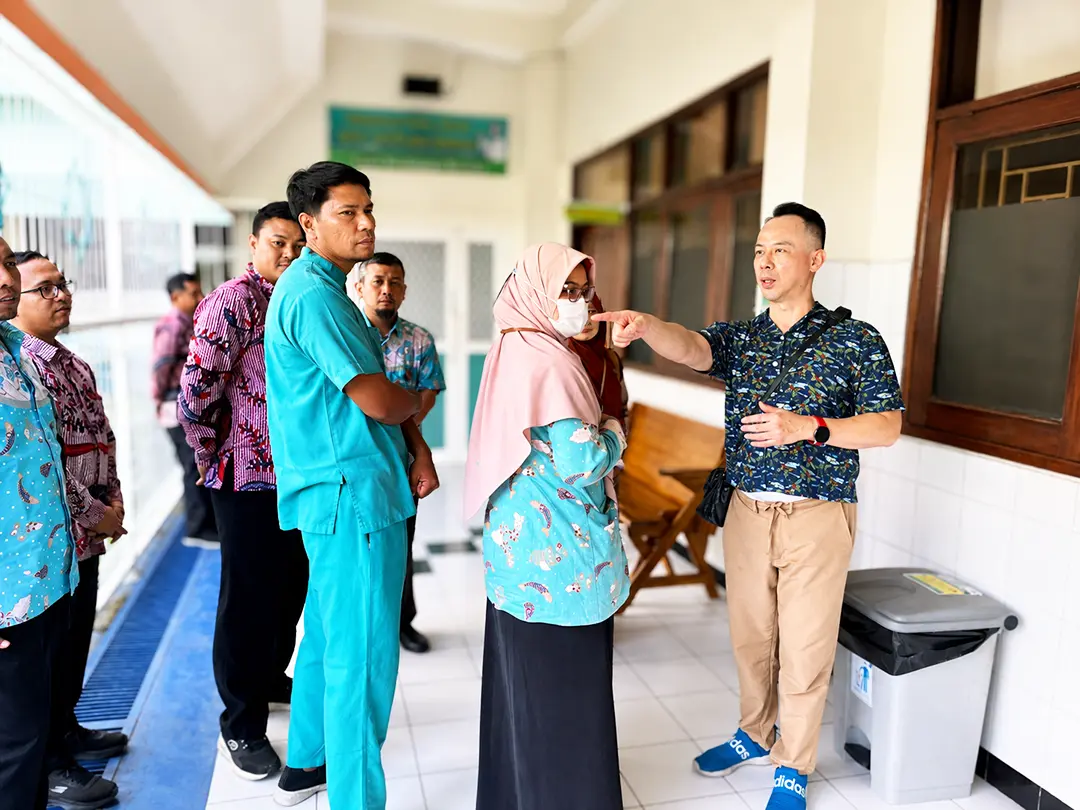
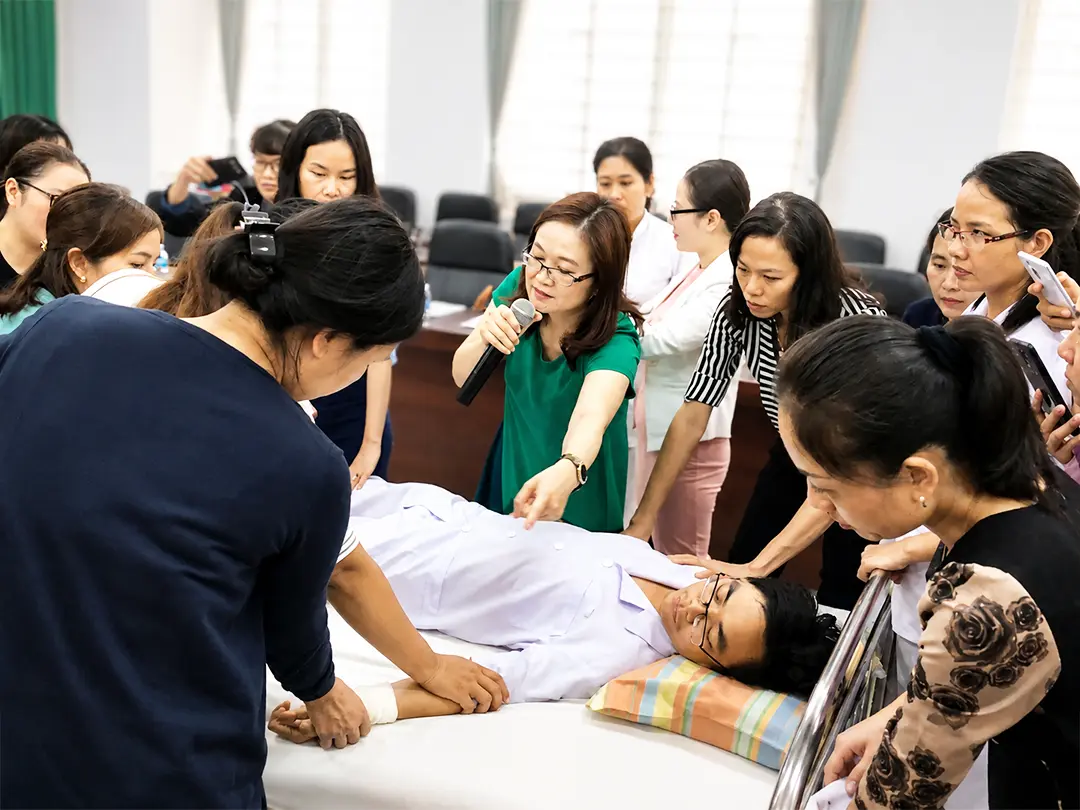
Southeast Asian psychiatric professionals and local patients
Our team's mission is to work closely with partners throughout Southeast Asia to promote Taiwan's mental health service model. Together with the support of our regional partners, we strive to build a global network for mental healthcare services, leveraging our collective expertise to enhance mental well-being and ensure that individuals in need receive timely and appropriate care. To continuously improve the quality of our training programs, we convene annual consultation meetings with experts and representatives from partner hospitals to review and refine the curriculum. While psychiatric care and psychiatric rehabilitation remain the foundation of our training, this year's program has been expanded to include Taiwan's distinctive healthcare system and quality management, social welfare service models, long-term care, mental health promotion, and public health. Our ultimate goal is to cultivate mental health professionals with cross-cultural competence who can contribute effectively to global mental healthcare development.
Through our country's practical experience in mental health care and the process of practice changes it has faced in the past 20 years, it can provide a reference for Southeast Asian countries to learn about mental health care and introduce our country's service model.
The training mechanism and professional course learning established by our team can combine theoretical and practical learning to allow students to acquire professional mental medical technology and knowledge that is more in line with local needs.
Signed MoUs with 2 Indonesian institutions on behalf of the Taiwan International Mental Health Professionals Training Center: Puri Nirmala Psychiatric Hospital and Yayasan SATUNAMA Yogyakarta.
Held an overseas training course in Indonesia (Apr 19–26, 2025) for 99 professionals (14 doctors, 37 nurses, 5 social workers, 36 psychologists, 3 OTs, 4 others). Tailored topics included employee mental health, psychosocial intervention & day care for dementia, Positive Behavior Support (PBS), caregiver education, occupational therapy, and emergency/ICU care.
Held an overseas course in Cagayan de Oro, Philippines (Jun 1–8, 2025) for 66 professionals (7 doctors, 30 nurses, 73 social workers, 18 psychologists, 4 others). Topics included guiding youth via psychology/neuroscience, supporting dementia patients, identifying mental illness warnings, domestic violence prevention (Taiwan's experience), and professional self-care.
Hosted "The 7th International Mental Health Cooperation and Training Center Conference" on Nov 6, 2024. Invited 16 experts from 8 New Southbound nations (Indonesia, Vietnam, Philippines, Singapore, Malaysia, Cambodia, Thailand, Australia; target: ≥10). Attracted 310 in-person and 20 online attendees, totaling 330 (target: ≥80).
This project integrates psychiatric hospitals, academic institutions, and research organizations to strengthen mental health diplomacy in Southeast Asia. Through interdisciplinary collaboration, partner institutions jointly develop and deliver professional, internationally oriented, and diversified training programs. 2023: Six collaborating institutions jointly organized training courses and provided rotational clinical training for international participants based on their learning needs and feedback. 2024: Three collaborating institutions participated in the program. 2025: Four collaborating institutions jointly organized training courses and continued the rotational training model to enhance participants' practical learning experiences.
Recognizing the importance of mental health and international cooperation, the Taiwanese government supported Kaohsiung Municipal Kai-Syuan Psychiatric Hospital in establishing the International Mental Health Cooperation Training Center (IMHCTC) in 2018. Supported by Taiwan's Ministry of Health and Welfare, IMHCTC integrates Taiwan's mental health resources and shares its community-based psychiatric rehabilitation model through online and onsite training for mental health professionals across Southeast Asia. By the end of 2025, IMHCTC had trained 890 professionals from 13 countries: Indonesia, Thailand, Cambodia, Vietnam, the Philippines, Malaysia, Myanmar, India, Bhutan, Nepal, Pakistan, Sri Lanka, and Laos. It also established five overseas training centers in Vietnam, Indonesia, and the Philippines, providing training to 965 local professionals through a train-the-trainer approach to strengthen local psychiatric care and rehabilitation services. IMHCTC is committed to promoting Taiwan's mental healthcare model through international partnerships, facilitating knowledge exchange, and strengthening regional collaboration. By integrating professional expertise and expanding cross-border cooperation, the Center aims to improve mental healthcare capacity, advance sustainable development, and promote joint academic research, contributing to better mental health outcomes worldwide.
This project targets healthcare professionals from participating countries and uses structured questionnaires to evaluate training outcomes in two dimensions: reaction (participant satisfaction)and learning(knowledge and competency enhancement)after participants return to their home countries. On a 7-point scale, the program achieved excellent evaluation results. Perceived personal benefit received the highest average score(6.51),followed by service quality(6.46), overall satisfaction(6.40),course design(6.30),and instructor performance(6.27),demonstrating the program's high-quality curriculum, effective teaching, and strong participant support. Qualitative feedback from participants from Indonesia, Thailand, the Philippines, Cambodia, and Vietnam highlighted four major outcomes. Participants gained a broader understanding of community-based rehabilitation and holistic mental healthcare, strengthened their clinical practice, healthcare management, and nursing education capabilities, and applied the acquired knowledge in their home institutions. In addition, the program promoted cross-national collaboration and established an international mental health network for continued knowledge exchange.
Establishing the International Mental Health Cooperation and Training Center (IMHCTC) for the New Southbound and South Asian Countries The project established the International Mental Health Cooperation and Training Center (IMHCTC) as the region's leading professional training hub. By the end of 2025, it had trained 890 mental health professionals from 13 countries—Indonesia, Thailand, Cambodia, Vietnam, the Philippines, Malaysia, Myanmar, India, Bhutan, Nepal, Pakistan, Sri Lanka, and Laos. Through customized clinical and academic programs, participants strengthened their professional competencies while fostering Taiwan's medical diplomacy and building a sustainable international mental health network. Expanding Local Capacity Through Overseas Teaching Centers To extend training beyond Taiwan, the project adopted a localization strategy by establishing permanent Overseas Teaching Centers in key partner countries. Five centers have been established across Vietnam, Indonesia, and the Philippines, providing systematic, locally delivered training for 965 mental health professionals. This initiative not only transferred Taiwan's successful mental healthcare model but also strengthened bilateral collaboration and promoted the long-term localization of professional mental health services.
Key achievements and impacts in major partner countries are summarized below:
Indonesia:
The project advanced collaboration from institutional exchange to national-level partnership by introducing diversified care and telemedicine. To address workforce shortages and the challenges of Indonesia's archipelagic geography, a multi-skilled healthcare workforce training model was developed to train local trainers, improve healthcare accessibility on remote islands, and reduce urban-rural disparities.
Philippines:
Following the enactment of the Mental Health Act in 2018, Taiwanese training experiences were promoted by Filipino participants, attracting government attention and leading senior officials from Cagayan de Oro (CDO) to visit Taiwan. In 2024, the Taiwan International Mental Health Training Center–Philippines Branch was established in CDO, marking Taiwan's first overseas training center and demonstrating a sustainable model for regional capacity building.
Vietnam:
Over 16 years of collaboration, overseas teaching centers were established at Da Nang and Khanh Hoa Psychiatric Hospitals and expanded to 13 institutions, including Hanoi Mental Hospital. The project developed a community-based psychiatric rehabilitation model tailored to local needs and introduced occupational rehabilitation practices, inspiring the development of a Vietnamese model of psychiatric occupational rehabilitation.