Children and adolescents with acute, critical, complex, and rare diseases
Children in remote areas, offshore islands, and medically underserved regions
Taipei Medical University Hospital is committed to the principles of “child-centered care” and “maximizing children’s rights.” By integrating in-hospital pediatric subspecialty teams with regional healthcare resources, the hospital has established Taiwan’s first institutionally operated Children-Friendly Healthcare Network. Through cross-hospital integration, a green-channel referral system, outreach services, and attending physician outpatient support, pediatric subspecialists regularly provide outpatient care and clinical consultations at partner institutions and in medically underserved areas. This model enhances healthcare accessibility for children with acute, critical, complex, and rare diseases, effectively reducing disparities between rural and urban regions.
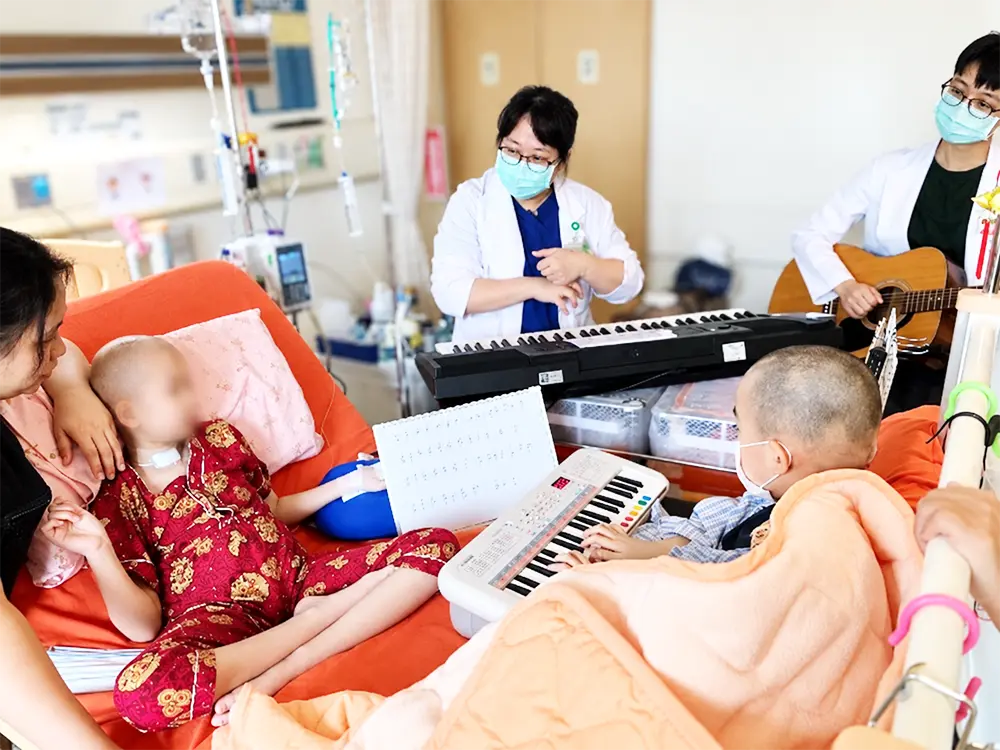
In clinical practice, the program incorporates micro-blood sampling, child-specific examination workflows, multimedia patient education, and non-pharmacological therapeutic interventions such as music and art therapy to reduce anxiety during medical care. Case managers further provide comprehensive medical navigation and cross-disciplinary coordination, ensuring holistic, family-centered integrated care.
Establish an institutionalized Children-Friendly Healthcare Network integrating in-hospital pediatric subspecialties with regional healthcare collaboration.
Provide attending physician outpatient support and cross-hospital clinical consultations to enhance accessibility in rural and medically underserved areas.
Implement a green-channel referral system and outreach SOPs to shorten care timelines for children with acute, critical, complex, and rare conditions.
Introduce micro-blood sampling, child-specific examination workflows, and multimedia education to reduce medical anxiety.
Incorporate music and art therapy with full-spectrum case management navigation to deliver holistic, family-centered care.
Apply SROI to quantify social impact and establish a scalable, sustainable pediatric care model.
Annual outpatient visits exceed 1.5 million
Attending physicians provide outpatient support to rural areas
Green-channel referrals implemented year-round
Music therapy averages 173 patient visits per year
Art therapy averages 412 patient visits per year
Green-channel implementation rate reached 100% year-round
Attending physicians support rural and partner hospitals
(Keelung, Yilan, Hualien, Taitung, Kinmen, etc.)
Outreach support averages 1–5 cases per month
Total fundraising exceeded NTD 21.78 million over the past three years
SROI (Social Return on Investment) ratio of 1:3.22
Standardized green-channel referral workflow
Continuous monitoring during outreach and patient transfer
Micro-blood sampling reduces invasive risks
Pre-examination education lowers procedure failure rates
Quality management processes reviewed and improved regularly
High overall satisfaction among pediatric patients and their families
Families provide positive feedback on care processes
Positive feedback on referral and outreach services
High retention rate for case management services
Strong acceptance of child-friendly care measures
Continuous publication of articles in international journals
Research findings presented at international conferences
Establish cross-hospital pediatric care and referral standards to enhance consistency of medical services
Improve accessibility for children with acute, critical, complex, and rare conditions, strengthening care outcomes
Introduce child-friendly and non-pharmacological therapeutic approaches to enhance the care experience
Promote regional and international medical exchange to disseminate care models
Integrate SROI and fundraising mechanisms to support sustainable pediatric healthcare development