Postoperative knee replacement patients
Degenerative arthritis is a common degenerative disease among individuals aged 70 and above, with a prevalence rate of c. 15% in Taiwan. Our team is dedicated to enhancing the quality of care for patients undergoing knee replacement, aiming to demonstrate nurses’ heartfelt care for patients that attends to their “kneeds”, and placing patients in an environment filled with compassion. We conduct evidence-based nursing research to optimize care services provided to patients. Key areas of focus include improving pain management, enhancing the comprehensiveness of health education, and using innovative teaching strategies to prevent falls in hospital wards. We also emphasize resource integration and utilization. By developing innovative assistive tools, we raise nursing efficiency and improve patient safety. To increase job satisfaction among nursing staff, we pay attention to improving the work environment and doing job satisfaction surveys. At the same time, we continue to put our expertise to use achieving overall nursing service goals.
Application of a Holistic Care Model to Establish a Standardized Care Pathway for Knee Surgery
Early intervention in pain management beginning in the preoperative stage
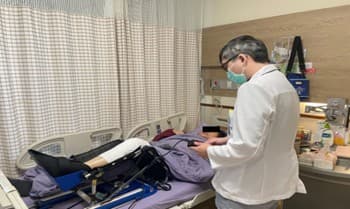
Initiation of CPM (Continuous Passive Motion) rehabilitation exercises starting on the first postoperative day
Prevention of inpatient fall incidents
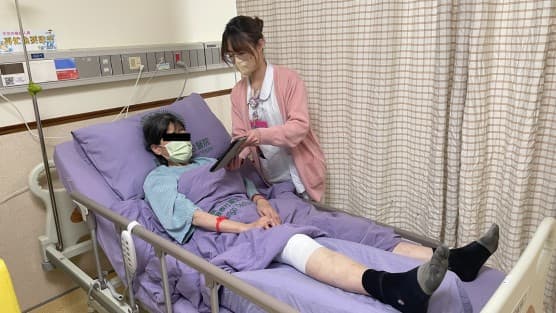
Integration of technology by using LINE to follow up postoperative wound conditions and care after knee surgery
Innovative products: tabletop drainage rack, multifunctional portable hot/cold therapy bag, and multifunctional walker
Case manager staffing: 3
Personnel Case enrollment volume: 10 patients per month Telephone follow-up
interviews: 10 patients per month Health education and consultation services: 30–40
patients per month Case management duration: cases closed after a 3-month follow-•up period
All indicators reached target thresholds in 2024.
Fall incidence rate reduced to 0.03%.
The average length of hospital stay was reduced to 4.5 days.
Emergency department revisit rate within 72 hours after discharge reduced to 0.6%.
Readmission rate within 14 days after discharge reduced to 0.5%.
The average knee joint range of motion reached 90 degrees.
Patient satisfaction score reached 96%.
Nursing staff satisfaction score reached 95%.
Postoperative mortality rate for knee surgery: 0%.
Compliance rate with the standardized knee surgery care protocol reached 100%.
Under continuous monitoring, zero adverse events have occurred among post-operative knee surgery patients from 2020 to the present.
The orthopedic ward has established 9 quality indicators to review nursing quality regularly.
Inpatient fall rate threshold: ≤ 0.03%.
Post-operative knee surgery mortality rate threshold: 0%.
Patient satisfaction with the "Multifunctional Portable Hot/Cold Compression Wrap" (n = 30) showed a statistically significant difference before and after the intervention (p < 0.001).
Inpatient service satisfaction threshold: 80 points.
Nursing staff satisfaction threshold: 90 points.
Patient satisfaction reached 92 points in 2022.
Nursing staff satisfaction reached 95 points in 2024.
2010: "Desktop Hot/Cold Pack Drying and Draining Rack" – Award of Merit, Nursing Innovation Competition, Taiwan Nurses Association (TWNA). Project Leader: Rui-Lan Kang.
2014: "Portable Adjustable Limb Ice Wrap" – Excellence Award, Nursing Innovation Competition, Taiwan Nurses Association (TWNA). Project Leader: Rui-Lan Kang.
2016: "Multifunctional Walker" – Outstanding Award, Nursing Innovation Competition, Taiwan Nurses Association (TWNA). Project Leader: Rui-Lan Kang.
Published a total of 5 professional articles from 2019 to 2025.
Comprehensive integration of case information via the "Knee Surgery Case Management System" facilitates smooth post-discharge recovery and return to daily life for patients.
While the demand for knee surgery continues to grow, the average length of hospital stay (LOS) exhibits a downward trend.
Wound care nurses were trained to conduct knowledge-sharing sessions focusing on challenging and complex cases.
Education methods were reformed by introducing QR codes to promote autonomous patient learning.
In collaboration with the orthopedic medical and nursing team, post-operative education videos for knee surgery were developed.
Interdisciplinary team collaboration successfully enhanced nursing staff work satisfaction.