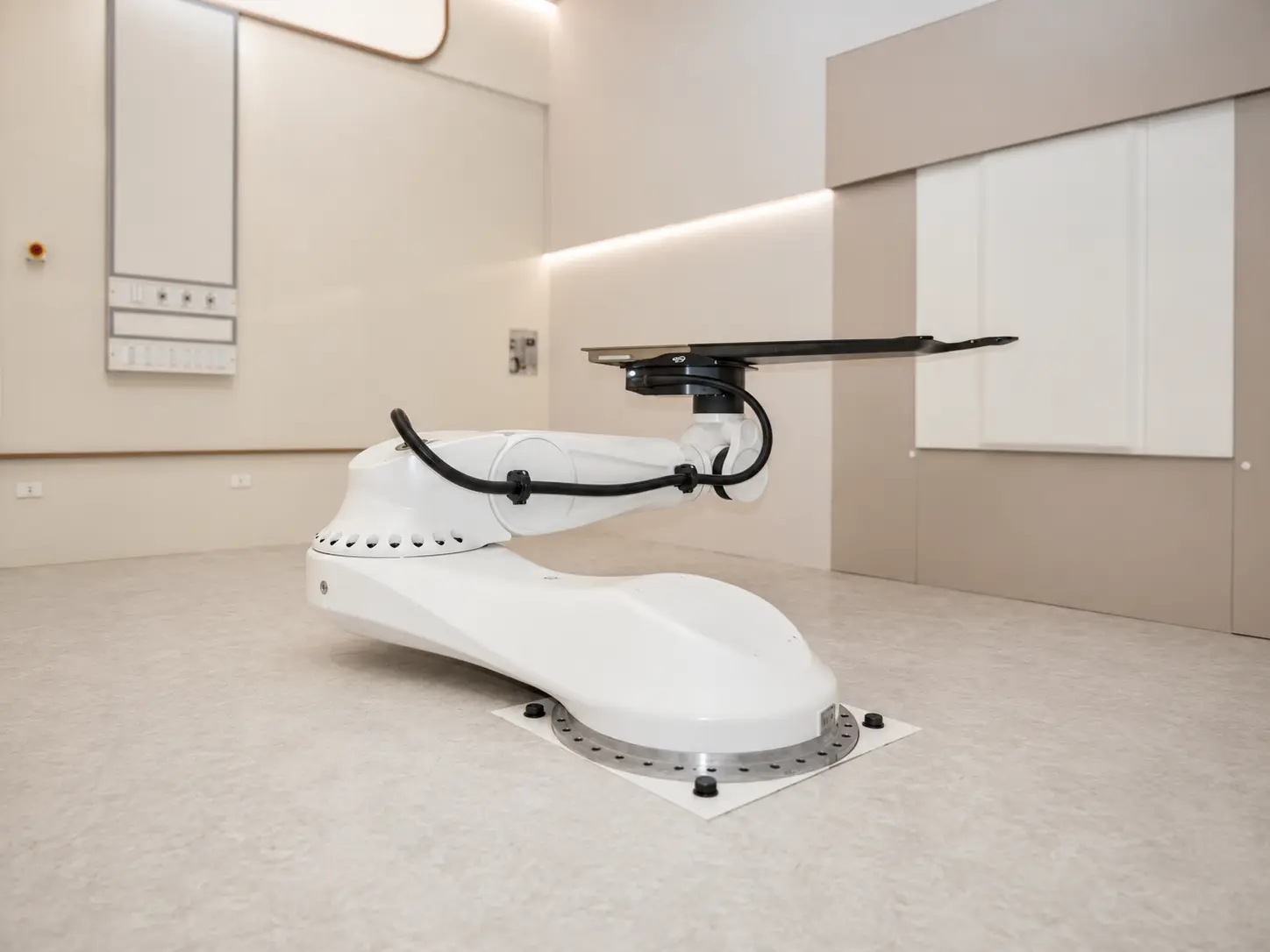
The “BENNU” Neutron Irradiation System is an accelerator-based boron neutron capture therapy (AB-BNCT) system. Its design concept integrates particle radiation with the selective accumulation of boron-containing drugs in tumor cells, offering an innovative cancer treatment modality with tumor selectivity and potential protection of normal tissues. A boron-containing drug is infused to allow boron-10 to selectively accumulate in tumor cells. The system then generates a high-quality neutron beam to precisely irradiate the lesion. When epithermal neutrons interact with boron-10, a nuclear capture reaction occurs, releasing energy within approximately one cell diameter to destroy tumor cells while minimizing damage to surrounding normal tissues. The system features stable neutron beam generation, real-time dose monitoring, a treatment planning system, and patient positioning equipment. It is applicable to refractory or recurrent cancers, or cases with limited options under conventional surgery, radiotherapy, or chemotherapy. The system obtained medical device approval in June 2024 and has completed an investigator-initiated clinical trial for meningioma. A registrational trial for recurrent head and neck cancer is currently recruiting, and an investigator-initiated trial application for an 18F-labeled boron-containing imaging diagnostic drug has also been submitted. The “BENNU” system is an innovative cancer treatment that advances personalized and precision cancer therapy.
TFDA Medical Device License No. 008196
Heron Neutron Medical Corp.
The product quality inspection and monitoring system covers materials, key modules, semi-finished products, and finished products. At incoming inspection, acceptance criteria are set for all materials, components, and key modules to confirm compliance with design specifications, quality requirements, and assembly needs. Key modules, such as the proton accelerator, neutron target system, and Beam Shaping Assembly (BSA), must complete verification and quality checks before assembly or integration.
For semi-finished products, functional and integration tests are performed to confirm module operation, subsystem interactions, control logic, and coordination.
For finished products, performance, usability, and safety tests are conducted. Performance testing evaluates dose output, accuracy, stability, and reliability. Usability testing involves actual users, such as radiologic technologists and radiation oncologists, to assess the interface, workflow, and human-machine design.
Safety testing follows ISO 13485 and applicable IEC standards, covering electrical safety, electromagnetic compatibility, radiation safety, and fail-safe functions, to verify protection against electrical hazards, interference, radiation exposure, and abnormal conditions.
All results are documented in design verification reports, validation reports, and the Design History File, ensuring the product meets its intended use, safety, effectiveness, regulatory requirements, and traceability before market release.
The medical quality control covers design, process control, supplier management, inspection, and regulatory compliance.
Hardware design includes key components such as the proton accelerator, target system, Beam Shaping Assembly (BSA), chiller, robotic treatment arm, laser system, and Treatment Control System (TCS), ensuring stable neutron beam generation and overall system reliability. The TCS controls and monitors treatment parameters, including accelerator status, neutron detector readings, beam-on settings, real-time monitoring, and data recording. Software deployment, maintenance, and updates are performed by qualified personnel, with validation and approval required before release.
For process control, the neutron target chamber is assembled and inspected in-house, while other modules are CNC-machined and assembled by qualified suppliers.
Supplier management is risk-based, including audits, incoming inspection, nonconforming product control, and corrective and preventive actions.
Before market release, verification and validation include functional, integration, performance, usability, electrical safety, EMC, radiation safety, and fail-safe tests. All results are documented in the Design History File (DHF) to ensure safety, effectiveness, traceability, and regulatory compliance.
The system establishes a risk analysis and control mechanism based on ISO 14971, covering potential risks such as equipment failure, operator error, environmental factors, system abnormalities, and use-related safety. During design, development, and process control, risks are systematically identified through a risk matrix and ranked by severity, occurrence, and detectability.
Risk evaluation includes qualitative and quantitative methods, such as FMEA and FTA, to identify potential failure modes, causes, and impacts on patients, operators, and system functions. For identified risks, a risk management plan defines control measures, responsible parties, timelines, and follow-up actions, with regular review and updates.
Risk controls include design optimization, redundancy, failure prevention, and emergency response measures. Key functions may include backup or redundant designs to maintain a safe state during system abnormalities.
Preventive controls include routine inspection, maintenance, calibration, and functional checks. Emergency measures include emergency shutdown, alarms, data backup, and recovery procedures. All controls are verified through testing, simulation, or drills.
Risk assessments, control records, and verification reports are documented in the risk management file to ensure product safety, effectiveness, and regulatory compliance.
We have established post-market surveillance and recall control procedures to continuously collect information on product use, safety, effectiveness, and market feedback after launch. The results are fed back into design, process improvement, and the quality management system to ensure ongoing compliance. Collected data include adverse events, complaints, market feedback, similar product reports or recalls, design or manufacturing changes, and process or inspection nonconformities, which are regularly summarized in market surveillance reports.
If a serious adverse reaction occurs, the quality management representative will report it to the TFDA within 15 days of awareness and conduct follow-up actions as required.
For recalls, the company follows the Medical Device Recall Regulations, classifies recalls by risk level, and submits recall plans and completion reports within statutory timelines. Notification records, affected batch or serial numbers, reasons, and results are retained for at least five years.
If post-delivery issues involve regulatory noncompliance, safety concerns, labeling updates, design or manufacturing defects, complaints, or major risks, the company will assess whether to issue an advisory notice. Regulatory communications are handled by the Regulatory and Quality Department.
If designated for safety monitoring by the authority, periodic safety reports will be submitted as required. Currently, approved Heron products are not subject to such monitoring.
Compassionate boron neutron capture therapy for locally recurrent nasopharyngeal cancer: A retrospective study
Results: Ten patients (eight men and two women) with a median age of 54 years and recurrent stage T2-T4N0-N1 disease were included. The median radiation dose before BNCT was 70 (range: 70-124) Gy. For the initial BNCT session, the median average tumor dose was 16.4 (range: 11.7-25.1) Gy-Eq delivered in a single fraction. Two patients underwent a second BNCT session for residual or recurrent disease at 3 and 12 months after the first, respectively. The median follow-up period was 10.7 (range: 2.2-50.9) months. Overall, one complete response and one partial response were observed after one or two BNCT sessions among eight evaluable cases. The most common acute toxicities were low-grade mucositis and dermatitis. No cases of carotid blowout syndrome were reported. Temporal lobe necrosis occurred in one patient who received two BNCT sessions. The 1-year overall survival rate was 44.4%, and the 1-year progression-free survival rate was 33%. One patient survived for more than 4 years.
Conclusion: In this small cohort of patients with recurrent NPC, compassionate BNCT with moderate doses yielded a 25% response rate and one long-term survivor (4 years). Protocol modifications involving adjusted dose-fractionation schedules and combination with other treatment modalities in future prospective trials may improve the outcomes for recurrent NPC.
As of 2025, Heron Neutron Medical Corp. has filed a total of 171 patent applications, of which 54 have been granted. Its core patent portfolio focuses on key technologies related to accelerator-based boron neutron capture therapy (AB-BNCT), including neutron generation target station, neutron beam shaping assembly, neutron moderation material, treatment control system, treatment planning system, patient positioning system, and FBPA boron drug production technology.
The patent strategy centers on the core technologies of AB-BNCT equipment, with particular emphasis on the neutron generation system and overall treatment system. Patent applications have been filed in major jurisdictions including Taiwan, Mainland China, the United States, Japan, Korea, and Europe, which are also key target markets and potential competitive regions for future AB-BNCT development. Through this patent portfolio, Heron Neutron Medical aims to strengthen its technological barriers, enhance market entry advantages, and support future product commercialization and international expansion.