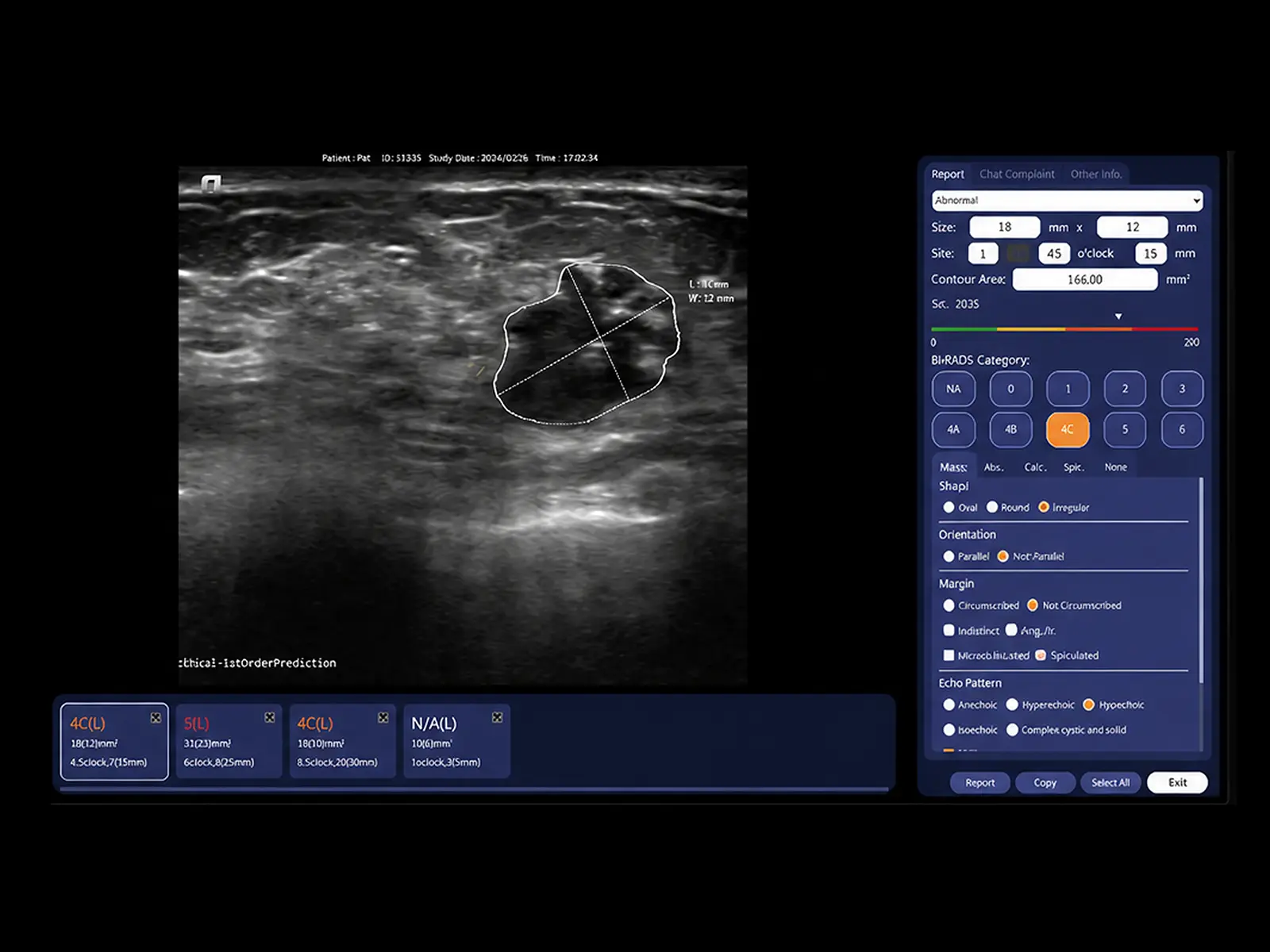
BU-CAD is a software application indicated to assist physicians in diagnosing and analyzing breast ultrasound images of patients with soft tissue lesions suspicious for breast cancer. The compatible input images of this product apply to mammography and breast ultrasound, including hand-held breast ultrasound (HHUS) and automated breast ultrasound system (ABUS) images. Output of the device includes regions of interest (ROIs) and lesion contours placed on breast ultrasound images assisting physicians to identify suspicious soft tissue lesions from up to two orthogonal views of a single lesion, and region-based analysis of lesion malignancy upon the physician’s query. The region-based analysis indicates the score of lesion characteristics (SLC), and corresponding BI-RADS categories in user-selected ROIs or ROIs automatically identified by the software. In addition, BU-CAD also automatically classifies lesion shape, orientation, margin, echo pattern, and posterior features according to BI-RADS descriptors. BU-CAD may also be used as an image viewer of multi-modality digital images, including ultrasound and mammography. The software includes tools that allow users to adjust, measure and document images, and output into a structured report.
TFDA - MOHW-MD No. 007651
US FDA - 510(K) K210670
Malaysia - No. Pendaftaran GB7687825-205156
Thai FDA - ใบรับแจ้งรายการละเอียด 68-2-2-2-0004031
Vietnam MoH - 250001570/PCBB-HCM
Indonesia - PB UMKU 912030012101400010111
TaiHao Medical Inc.
Our SaMD product undergoes strict verification and qualification. For development and deployment, IQ ensures installation complies with design and cloud/hardware configurations; OQ verifies stable software operation under various conditions through functional testing; PQ conducts stress and load testing in simulated or production environments to ensure consistent performance. Regarding product release and outgoing inspection, our company strictly enforces FQC and OQC procedures. For FQC (System Testing), prior to official software release, the testing team conducts comprehensive system testing based on the SRS to ensure core functionality, performance, and security meet specifications. For OQC (Validation Batch Release), prior to official delivery, we implement process validation and finished product inspection by continuously compiling/deploying three validation batches and performing 100% full-functional testing and final version reviews on them, thereby validating the reproducibility of software replication, packaging, and deployment to ensure the final package fully satisfies regulatory and customer requirements.
All products are classified as Software as a Medical Device (SaMD). Based on product characteristics and risk attributes, the design and development processes comply with relevant domestic and international regulations and standards. For instance, the workflows adhere to international standards including ISO 13485:2016 (Medical devices — Quality management systems), ISO 14971:2019 (Medical devices — Application of risk management to medical devices), and IEC 62304:2006+AMD1:2015 (Medical device software — Software life cycle processes), while also satisfying Taiwan's Medical Device Quality Management System Regulations and related product guidelines. Through this robust R&D and quality management framework, the safety, effectiveness, and quality consistency of the product development process are ensured, aligning with international regulatory requirements to enhance regulatory compliance and global market competitiveness.
Our company's products are classified as Software as a Medical Device (SaMD), with quality control focusing on each stage of the software development lifecycle. In terms of Incoming Quality Control (IQC), since all core software and algorithms are fully self-developed, the quality focus is placed on the version control of development environments and compilation tools, as well as the security confirmation of dependent packages. For In-Process Quality Control (IPQC), during the software development phase, quality is controlled primarily through code reviews and phase-based functional verification to ensure each individual module aligns with technical specifications. For Outgoing Quality Control (OQC), prior to official delivery, a strict process validation and 100% finished product inspection are implemented across three validation batches by performing a 100% full-functional system testing and final release review. A 100% pass rate on the final system testing report is utilized as the quantitative indicator to maintain quality stability, ensuring that the delivered software package is consistent and fully satisfies regulatory and customer requirements.
Upon product launch, our company has established a comprehensive post-market surveillance and management system to ensure continuous compliance with safety and effectiveness requirements. This system encompasses the collection, evaluation, and reporting processes for adverse events, maintaining seamless communication channels with regulatory authorities and medical institutions to captured potential safety risks in real time. Concurrently, in accordance with the regulations for medical device traceability, our products implement a Unique Device Identification (UDI) system to establish robust traceability; this ensures that in the event of any anomaly, recalls or software correction measures can be executed swiftly to mitigate risks. Furthermore, our company continuously conducts post-market risk management, integrating user feedback and suggestions into our quality system to drive iterative product optimization, while providing educational training and user guidance to ensure the software operates safely and reliably throughout its entire lifecycle.
Tsuyuzaki S, Fujioka T, Yamaga E, Katsuta L, Mori M, Yashima Y, Hara M, Sato A, Onishi I, Tsukada J, Aruga T, Kubota K, Tateishi U. Evaluation of AI diagnostic systems for breast ultrasound: comparative analysis with radiologists and the effect of AI assistance. Jpn J Radiol. 2025 Oct;43(10):1643-1651. doi: 10.1007/s11604-025-01809-2. Epub 2025 Jun 9. PMID: 40488816; PMCID: PMC12479558.
Baek J, Kim J, Kim HJ, Yoon JH, Park HY, Lee J, Kang B, Zakiryarov I, Kultaev A, Saktashev B, Kim WH. Clinical Application of Artificial Intelligence in Breast Ultrasound. J Korean Soc Radiol. 2025 Mar;86(2):216-226. doi: 10.3348/jksr.2025.0019. Epub 2025 Mar 26. PMID: 40201609; PMCID: PMC11973104.
Lai YC, Chen HH, Hsu JF, Hong YJ, Chiu TT, Chiou HJ. Evaluation of physician performance using a concurrent-read artificial intelligence system to support breast ultrasound interpretation. Breast. 2022 Oct;65:124-135. doi: 10.1016/j.breast.2022.07.009. Epub 2022 Jul 18. PMID: 35944352; PMCID: PMC9379669.