In a hospital that sees large numbers of patients every day, the front line is never short of ideas for improvement. The real questions are who has the time to carry an idea forward, who supplies the technical skills it needs, and how a successful pilot spreads to other departments.
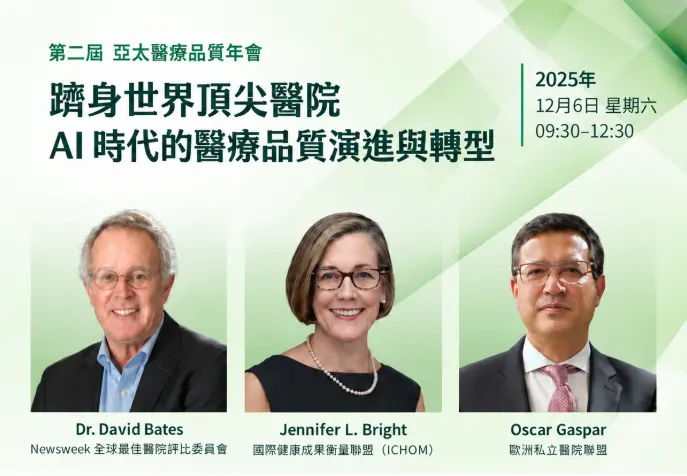
At the second Asia-Pacific Healthcare Quality Forum in December 2025, Clinical Associate Professor Tan Hiang Khoon, chief executive officer of Singapore General Hospital (SGH), described how the hospital supports clinical innovation and turns front-line observations into real improvement.
SGH ranked 9th in the world in the 2025 World's Best Hospitals list from Newsweek and Statista. Tan's account showed how a large public hospital uses talent, cross-disciplinary collaboration and organisational design to keep innovation moving inside a busy clinical service.
Tan used the image of a pebble in the shoe for the irritations of daily work: problems that look minor but recur, steadily consuming clinicians' time and attention.
SGH starts from those front-line experiences, inviting physicians and other health professionals to take part, and prioritising problems that recur, matter and can realistically be solved. Design thinking and user journey mapping then help teams pin down where in the process the problem appears and what users actually need.
Asking clinicians to take part in innovation also means giving them the conditions to do it. The hospital invests in training, builds career pathways for clinical innovators, and protects dedicated time for the work. Taking it on, Tan stressed, should not leave colleagues behind their peers in career progression.
That arrangement makes innovation institutionally supported work rather than something clinicians squeeze in around a full clinical load.
Clinicians understand care needs, but design thinking training does not make them engineers. SGH therefore brings engineers and data scientists into clinical areas to work alongside care teams.
Tan described a head and neck surgery project he took part in: after two weeks observing the team, an engineer compiled some 85 clinical observations, among them how often the lighting had to be repositioned during surgery and the strain on assistants bending over for long periods.
Some problems look minor but recur, steadily consuming clinicians' time and attention.
Tan Hiang Khoon - chief executive officer, Singapore General Hospital
To surgeons concentrating on the operation, these motions may long since have become habit; the engineer, looking from a different angle, saw room to improve and proposed ideas such as a flexible lighting device.
The case shows what cross-disciplinary collaboration looks like in practice: the engineer first enters the setting to understand it, the clinicians explain their needs and experience of using the tools, and together they shape the solution.
Once there is an idea, the clinical team faces funding applications, prototyping, validation and finding partners. SGH's innovation support centre helps busy clinicians reach those resources and connects them with universities, research institutes and industry.
A solution can be tested at SGH first, then extended where appropriate to other institutions in the SingHealth cluster to explore wider adoption.
Tan also argued that industry partners should be involved early. Beyond technology and investment, an industry view helps a team judge whether there is real demand for the solution, and whether anyone is prepared to commit resources to take it further.
Innovation support therefore spans the whole distance from clinical problem to wider adoption. At each step the team has to confirm that the solution still works, and what capabilities and resources the next stage is missing.
Hospitals, Tan observed, have pronounced hierarchies, and a traditional vertical chain of command does not necessarily keep pace with a fast-moving technology environment.
SGH favours cross-functional teams assembled around a problem, bringing in clinical, operations, finance or human resources people as the task requires. Teams stay connected to one another so that knowledge and resources can follow the problem.
Quality improvement teams that perform well, he noted, tend to share these characteristics. Leaders, in turn, need to help members secure resources, analyse problems together, and live with the uncertainty along the way.
Tan cited NVIDIA's organisational experience in his talk, particularly its emphasis on fast information sharing and on leaders using information to help others succeed. For a hospital, the question that raises is whether the organisation can bring people with different skills to a problem quickly enough.
Facing fast-moving technology, Tan argued, hospitals also need the ability to learn quickly and scale up what works.
Robotic process automation (RPA) is an example of SGH adopting an existing tool. Front-line staff raised the burden of repetitive tasks, workshops shaped the solutions, and implementation science methods helped spread them department by department. Internal figures Tan cited put the cumulative saving at 84,000 working hours over roughly two years.
Another effort is an AI clinical documentation tool adapted to Singapore's multilingual consultations. A consultation room may hold the physician, the patient and family members all speaking, sometimes switching between languages, so the team built multi-speaker audio and local language use into development. One piece of positive feedback during the pilot was that physicians could spend more time looking at the patient and less time staring at a screen.
When tools change how work is done, staff roles may change with them. SGH therefore invests in change management, capability training and job redesign so that colleagues can take on more meaningful work. From fixing front-line irritations to helping people adapt to new work, it is all part of keeping innovation in use.