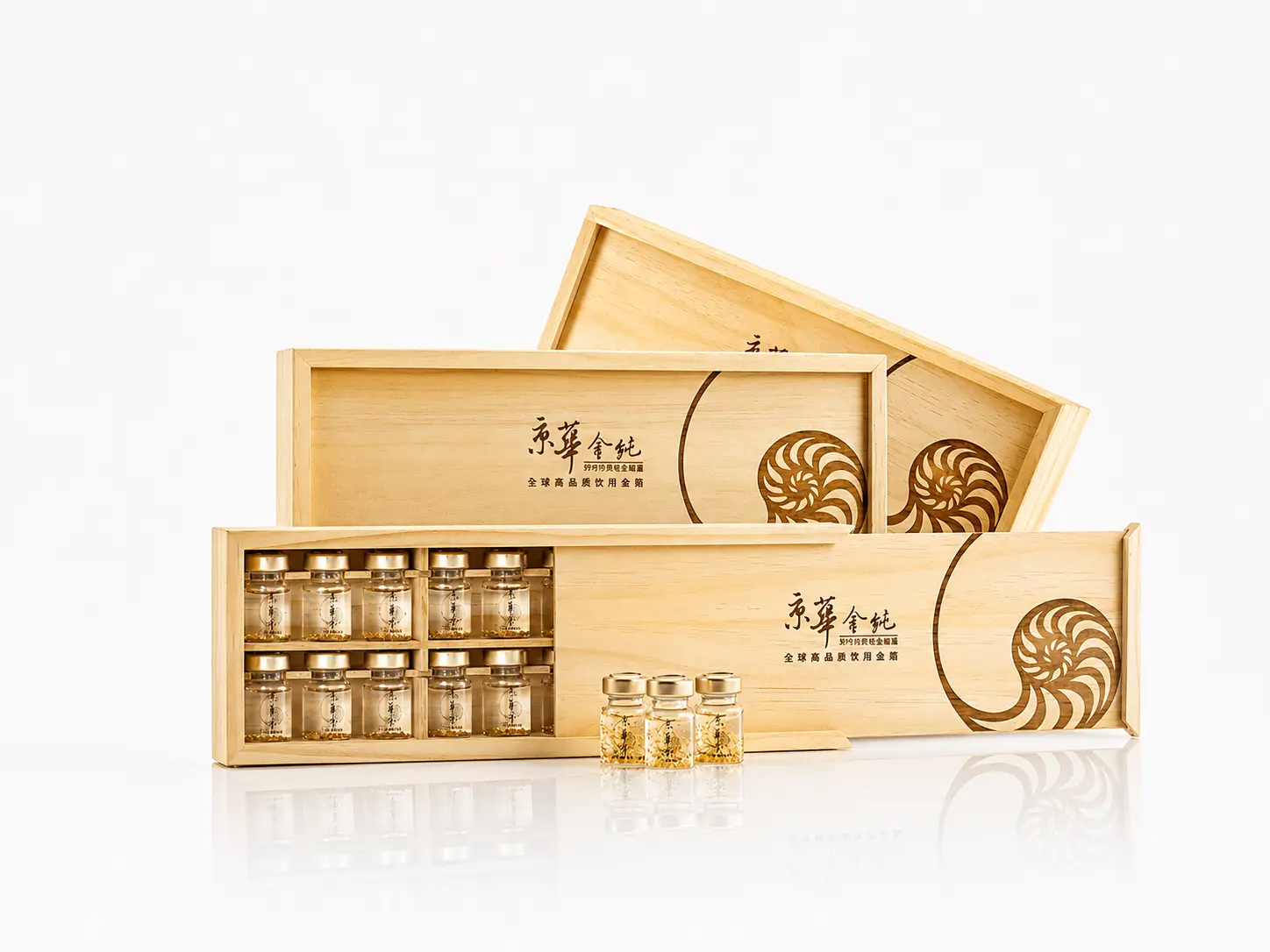
Special Process: Utilizes Physical Vapor Deposition (PVD) in a vacuum environment. This purely physical process requires no chemical additives or solvents, avoiding impurities common in traditional gold leaf . Health Applications: Its surface activity helps absorb free radicals, showing antioxidant and anti-inflammatory potential. In alcohol, it accelerates aging and converts aldehydes to esters. Research indicates potential in alleviating ethanol-induced liver injury and reducing hepatic triglyceride accumulation.
Obtained EU E175 certification for food additives and US FDA food facility registration
Water, Gold.
1 mg of vaporized gold flake per 5 mL
Gold NanoTech Inc
Incoming Quality Control (IQC)
Enforces strict inspections for all raw materials and containers (gold bars, carrier matrices, glass bottles, silicon stoppers, aluminum caps, outer boxes) using the MIL-STD-105E Single Sampling Plan (General Inspection Level II) with an Acceptable Quality Limit (AQL) of 0.4.
In-Process Quality Control (IPQC)
Parameter Monitoring: Real-time tracking of "vacuum setpoint" and "vaporization point" during gold wire processing and vacuum vaporization. Any "incomplete vaporization" triggers an immediate error-proofing loop for rework. Purity Control: Batch analysis ensures compliance with official food additive specifications (Digitized metrics: Gold ≥ 90%, Silver < 7%, Copper < 4%). Sterility Control: Following foreign matter prevention and pure water rinsing, products undergo high-temperature sterilization and UV sterilization inside an aseptic workbench to eliminate microbial risks.
Finished & Outgoing Quality Control (FQC/OQC)
Strictly controls filling volumes. Container integrity and sealing tightness are inspected batch-by-batch post-capping. Expiration dates are applied via a printing machine to ensure traceability, paired with routine microbiological monitoring prior to release.
Heavy Metals: Tested by Intertek, confirming 99.4% gold content (standard ≥90%) with no detectable silver or copper .
Microbiological: Tests are currently in progress and will be submitted later .
Safety Testing: Passed acute toxicity (LD₅₀ > 3600 mg/kg), Ames tests, and various feeding toxicity tests by third parties, showing no adverse effects.
Incoming & In-Process Risk Control
Defective materials are intercepted prior to storage via regular self-inspections and AQL 0.4 sampling to eliminate leakage or chemical leaching risks. QA personnel conduct scheduled process patrols, utilizing automated error-proofing loops to prevent non-conforming items from moving downstream.
Finished Goods & Pre-Market Risk Control
Mandates batch-by-batch chemical composition verification. For microbiological testing, a strict control chain of "simultaneous submission, dynamic tracking, and post-compliance sales authorization" ensures biological safety before official reports are finalized and appended.
Post-Market Risk & Crisis Management
Task Force: The Reporting/Sales Unit logs complaints via the Anomaly Handling Log and coordinates with QA; the QA Department performs technical root-cause analysis and compiles the Complaint Statistical Form; Technical/Production Units execute Corrective and Preventive Actions (CAPA) for closed-loop management. Market & Regulatory Monitoring: Storefront consumer questionnaires monitor satisfaction (maintained at 93%) as an early-warning risk indicator. For international expansion, data collection and legal consultations are underway to advance the New Dietary Ingredient (NDI) application with the US FDA, minimizing cross-border regulatory risks.
Animal studies (rats) indicate that feeding vaporized gold flakes significantly reduces oxidative stress-related enzyme activities (SOD, CAT, GPX) and inhibits TNF-α, alleviating ethanol-induced oxidative and inflammatory liver injury. It also reduces hepatic triglyceride accumulation.
Chen, Y. L., et al. (2013). Amelioration of ethanol-induced liver injury in rats by nanogold flakes. Alcohol, 47(6), 467-472.
Tsai, C. C., et al. (2003). Assessment of the effect of gold flakes on human liver cancer in an animal model. Taiwan Journal of Chinese Medicine, 2(1).
LIQUID CATALYZING SYSTEM
Collagen growth stimulating composition
Alcoholic drink composition having functionality to shorten drunkenness time
Metallic nano particles manufacturing system and method Metal Particle Manufacturing System
COMPOSITION CAPABLE OF REDUCING ALCOHOLIC FATTY LIVER