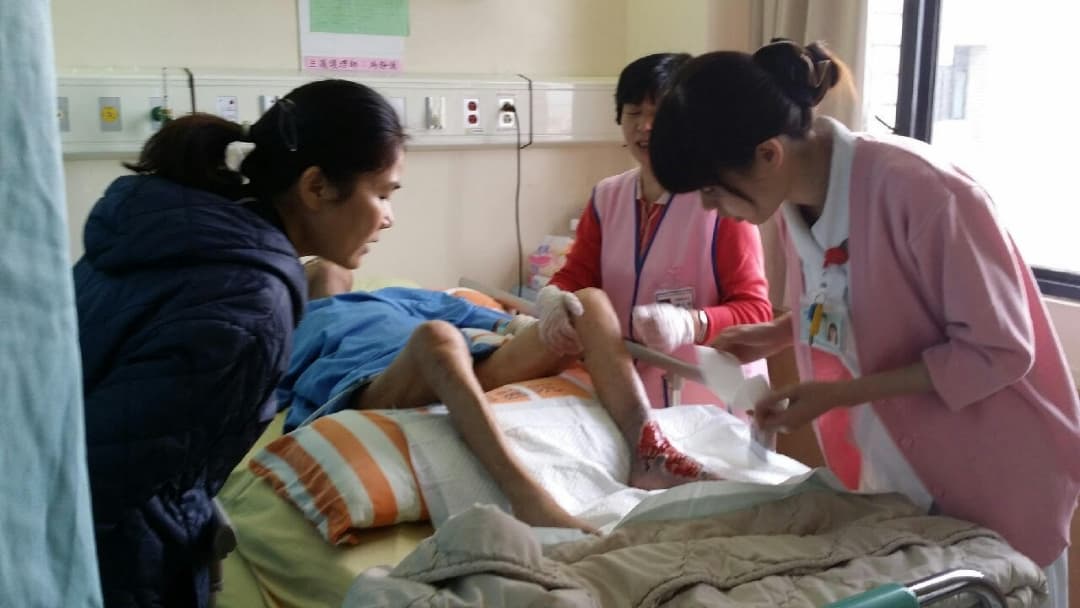
OT covers physical, mental health, pediatric, and acute bedside care: stroke, neurologic injury, orthopedics, developmental delay, mental health, plus PGY/UGY and interprofessional teaching.
The Department of Occupational Therapy has implemented competency-based medical education(CBME) as the core framework for training. An e-portfolio was developed for occupational therapy PGY and UGY programs to systematically capture and visualize learning trajectories, clinical performance, and assessment data. The training design is anchored in the Milestones Project aligned with core competencies in occupational therapy, integrating rubric-based scaled assessment and multisource, multi-occasion evaluation. Clinical assessments are completed efficiently through the e-portfolio, supported by an online workflow that pushes e-portfolio links via LINE notifications. On the backend, Power Query automatically consolidates data across modules and assessments to generate individualized competency analytics reports. In parallel, GPT is used to summarize key learning points, draft Clinical Competency Committee(CCC) agenda proposals, and flag items requiring attention. These outputs support CCC decision-making and enable iterative refinement of training modules, forming a continuous “assessment-feedback-improvement” educational cycle. Since 2024(ROC113), the paperless model has expanded to 11 allied health professions hospital-wide, saving more than 200,000 sheets of A4 paper annually while strengthening educational quality, administrative efficiency, and healthcare sustainability.
Full e-portfolio digitization, visualizing teaching and learning processes
CBME implementation: EPAs aligned with the Milestones Project and mapped to core competencies
Rubric-based scaled assessment with multisource, multi-occasion evaluation to enhance consistency
Online workflow integrated with LINE notifications to deliver assessment form links in real time
Power Query automation to consolidate data and generate individualized competency analytics reports
GPT/AI for automated summarization, CCC agenda drafting, and flagging items requiring attention
Regular CCC review of competency levels, with iterative refinement of training modules based on decisions
AI-enabled collaboration extended to clinical practice, education, and administrative management
Monthly e-portfolio usage increased from 502 to 64,855 user-sessions
OT Moodle adoption reached 100%
Hospital-wide allied health adoption reached 71.5%
Scaled to 11 professions and 3 units
Saved over 200,000 sheets of A4 paper annually
Reduced cognitive load; teaching administration time saved by over 80%
Lowered OT turnover rate from 36% to 8%
PGY e-portfolio completion increased from <50% to 85–100%
Significant improvement in PGY core competencies after training(p=.16)
UGY first-attempt licensure pass rate increased from 61% to 90%
Form access control reduces loss risk
Traceable assessment logs for auditability
LINE push and completion tracking prevents missed assessments
Data-driven CCC processes reduce bias
E-portfolio implementation strengthens privacy protection
PGY satisfaction averaged 4.7/5
UGY satisfaction averaged 4.8/5
Clinical instructor satisfaction reached 4.6/5
Retention improved; turnover decreased to 8%
High feedback adoption rate for continuous improvement
Published in BMC Medical Education, sharing OT EPA development
Built a Moodle-based OT e-portfolio training model with strong transferability
Established OT-specific EPAs integrated with Milestones to support competency mapping and level placement
Edited an OT association EPA book to disseminate CBME and assessment implementation
Standardized CBME and the Milestones Project to improve consistency in educational quality
Integrated EPAs with rubric-based assessment to build competency evidence and strengthen quality and safety of care
Used Power Query + GPT to support CCC decisions, improving transparency and traceability
Saved over 80% of teaching administration time; reduced OT turnover from 36% to 8%, stabilizing the workforce
Scaled a paperless model to 11 professions and 3 units, saving over 200,000 A4 sheets annually
Invited to share the implementation journey across teaching hospitals nationwide, helping peer hospitals improve medical education quality