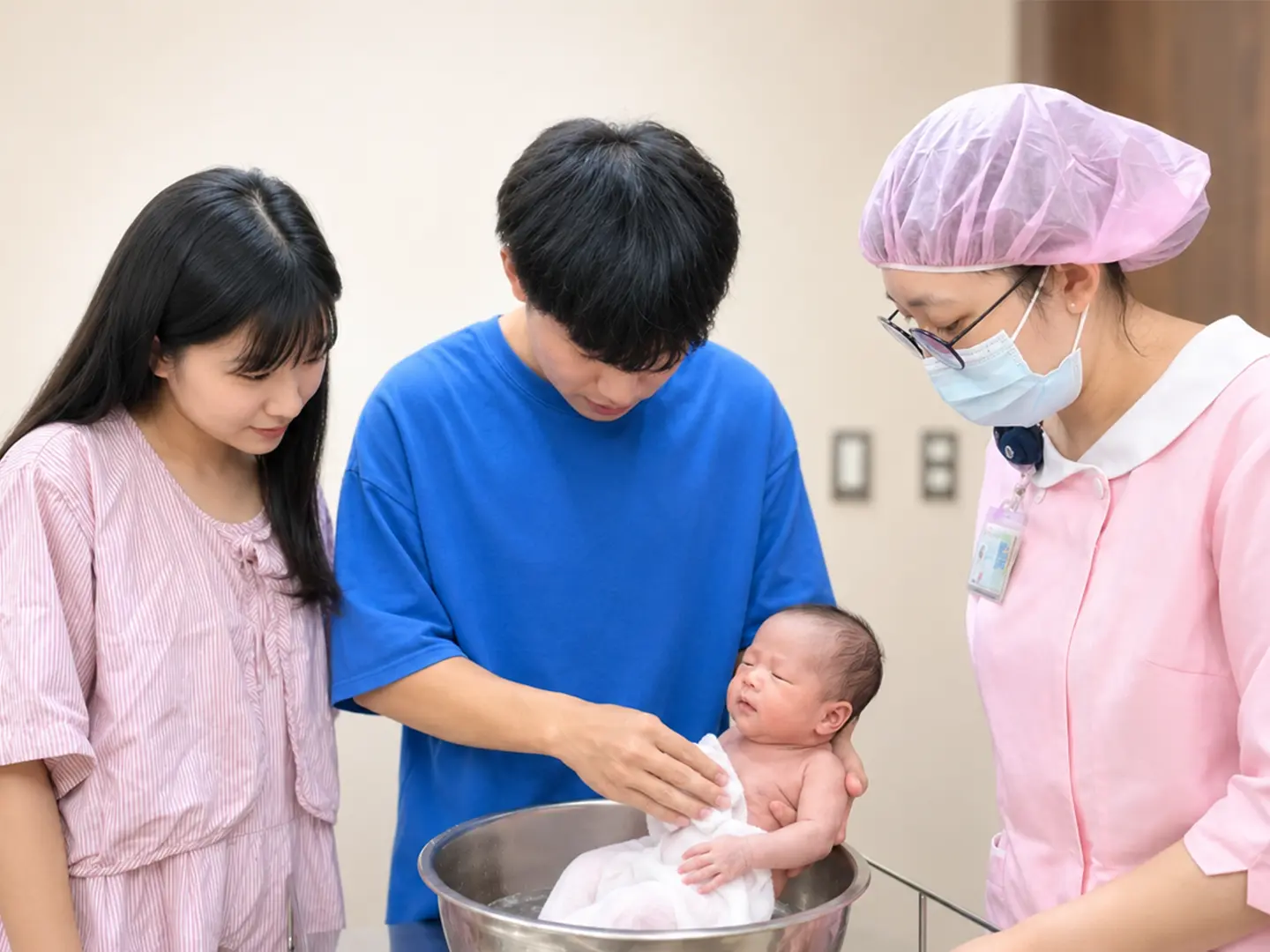
Postpartum women
Newborns, including high-risk infants
Individuals requiring postpartum care support
Families seeking breastfeeding support
Mothers with postpartum emotional support needs
Since its establishment in 2013, the Postpartum Care Center of Tainan Municipal An-Nan Hospital has been dedicated to providing comprehensive postpartum care under the mission of “Guarding the Beginning of New Life with Love and Professional Care.”
The center operates 20 maternal beds and 25 infant beds, offering 24-hour professional nursing services. Weekly rounds by specialists in obstetrics, pediatrics, and traditional Chinese medicine provide integrated healthcare tailored to the needs of mothers and newborns.
Services include breastfeeding support, newborn care education, nutritional counseling, and emotional support to promote maternal recovery and parenting confidence. A continuity-of-care model linking hospital, home, and community extends support through parenting education, post-discharge follow-up, and real-time consultation via LINE.
Committed to innovation and evidence-based practice, the center is conducting a randomized controlled trial on the effects of aromatherapy on postpartum stress, sleep quality, and mother–infant bonding. It also develops educational tools, promotes breastfeeding, and provides clinical training opportunities for future healthcare professionals.
Looking ahead, the center will continue to enhance care quality, research, and professional education, striving to become a leading and trusted postpartum care institution in Southern Taiwan.
GRACE-based holistic postpartum care model
Hospital-affiliated with immediate multidisciplinary support
Regular obstetric, pediatric, and TCM rounds
Individualized breastfeeding assessment and guidance
Post-discharge follow-up at 1, 7, and 30 days
Real-time consultation and follow-up via LINE
Innovative teaching aids supporting clinical education
20 maternal care beds
25 neonatal care beds
Average length of stay: 21–23 days
24-hour professional nursing staffing
Regular obstetrician rounds
Regular pediatrician rounds
Regular traditional Chinese medicine physician rounds
Regular dietitian rounds
Real-time breastfeeding assessment services
Family-centered rooming-in support
Post-discharge follow-up care system
Real-time consultation services via LINE
Neonatal diaper dermatitis rate reduced to zero
In-stay diaper dermatitis rate maintained at zero
Mastitis incidence maintained at zero
Infant identification accuracy consistently achieved
Breastfeeding guidance accuracy consistently achieved
Nursing documentation completeness consistently achieved
Maternal–infant discharge assessment completeness achieved
Continuous monitoring and improvement of core quality indicators
Significant reduction in neonatal diaper dermatitis incidence
Mastitis incidence maintained at a consistently low level
Stable accuracy in infant identification procedures
Breastfeeding guidance accuracy consistently meets standards
Nursing documentation completeness consistently meets standards
High completeness of discharge assessment and guidance
Regular monitoring of core quality indicators
Periodic review through quality management meetings
Infection control audits consistently passed
Regular disaster drills conducted to ensure safety
Overall satisfaction consistently maintained above 90%
Seven-day satisfaction reached a peak of 94.24%
Pre-discharge satisfaction reached a peak of 93.47%
Nursing service satisfaction consistently above 90%
Physician care satisfaction consistently above 90%
Aligned with WHO mother- and baby-friendly care principles
Promotion of breastfeeding support models aligned with international standards
Implementation of evidence-based postpartum care research
Research outcomes planned for submission to international journals
Promotion of culturally sensitive maternal–infant care practices
Care and education models aligned with global trends
Establishment of standardized maternal–infant care models to enhance clinical quality and safety
Long-term, stable monitoring of key quality indicators with a clear reduction in risk events
Improved effectiveness of breastfeeding support and family-centered rooming-in practices
Development of a continuity-of-care system extending from hospital to home
High satisfaction feedback fostering service improvement and trust
Implementation of evidence-based care models to support sustainable healthcare development