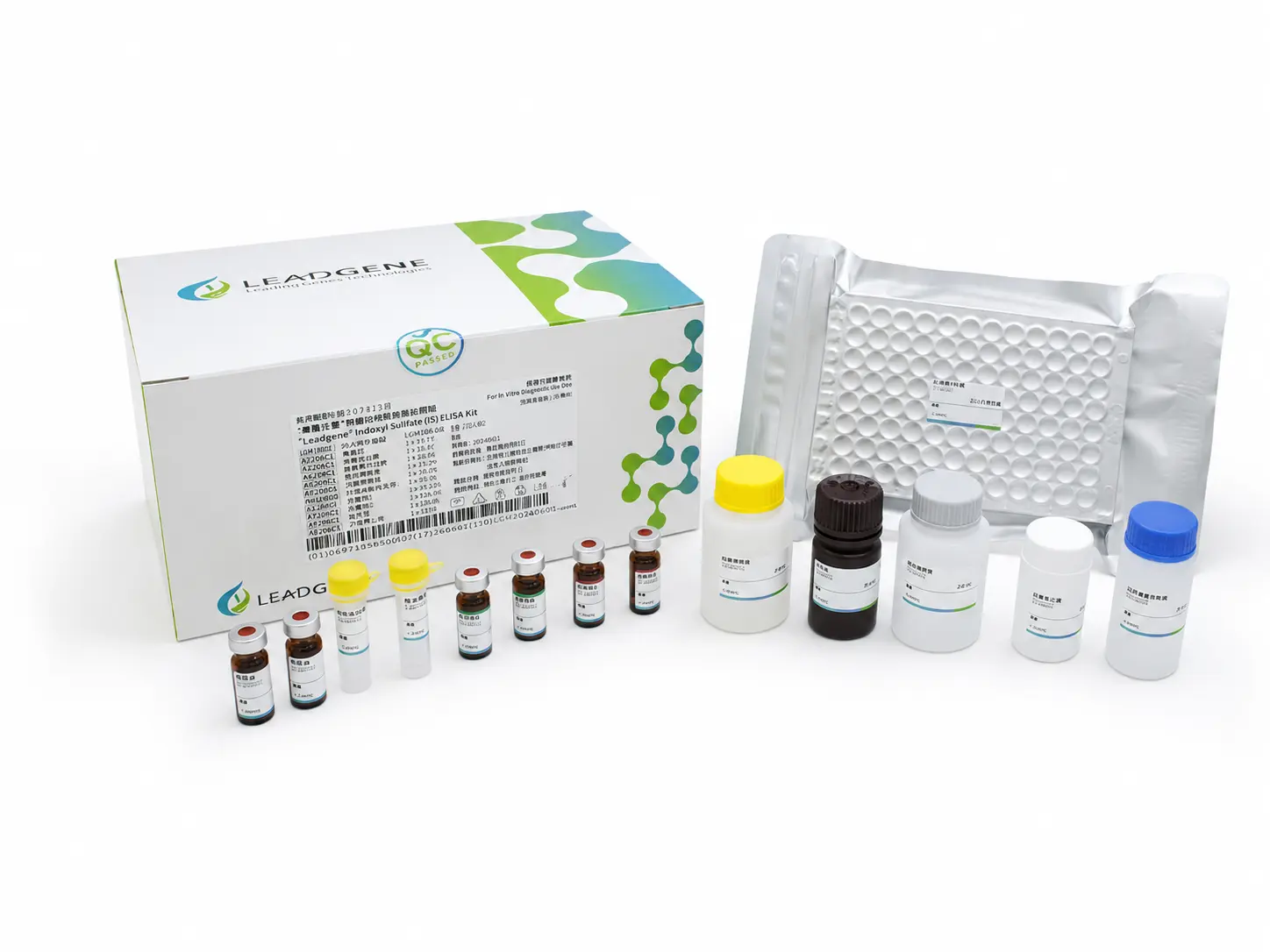
Leadgene Indoxyl Sulfate (IS) ELISA Kit represents the first CE-registered protein-bound uremic toxin (PBUT) detection IVD available globally. Chronic kidney disease (CKD) manifests as a gradual decline in kidney function. Among various uremic toxins, protein-bound uremic toxins (PBUTs) – including indoxyl sulfate (IS) – pose significant threats to CKD patients. As PBUTs accumulate, they further impair renal function and adversely affect the cardiovascular system. Regrettably, the standard PBUT detection, LC-MS/MS-based methods, necessitates sophisticated, expensive equipment, and can only be performed by certified technicians. Leadgene's pioneering work in antibody discovery has led to the development of antibodies targeting small molecules. These patented antibodies form the basis of the Leadgene Indoxyl Sulfate (IS) ELISA Kit. This kit has been approved by the Taiwan Food and Drug Administration (TFDA) as a Class III in vitro diagnostic device (MOHW-MD-No. 007625). As the first patented product of its kind globally, it aims to provide new clinical detection solutions. This innovation is expected to enhance the prevention and management of kidney disease worldwide, reduce healthcare costs, and improve social welfare.
Taiwan FDA (MOHW-MD-No. 007625)
CE-IVD
Singapore HSA (DE0510778)
Vietnam Marketing Authorization Code (MAC) (240001081/PCBB-HCM)
Leadgene Biomedical, Inc.
Precision (CLSI EP05-A3)
Protocol: 3 IS levels (low/mid/high), 20 days, 2 runs/day, 2 replicates/run.
Results: Within-lab precision was 9.284% (low), 7.516% (mid), and 7.540% (high). All met the <10% acceptance criteria.
Reproducibility (CLSI EP05-A3)
Protocol: 5 IS levels (1.6–80 µg/mL), 5 days, 1 run/day, 5 replicates/run.
Results: All met the <10% acceptance criteria:
Site-to-Site (3 sites): Total %CV 2.708%–8.339%
Lot-to-Lot (3 lots): Total %CV 3.465%–7.376%
Operator-to-Operator (3 operators): Total %CV 3.716%–9.770%
Linearity and Recovery (CLSI EP06-Ed2)
Protocol: 11 IS levels (0–100 µg/mL), 5 replicates in a single run.
Results: Linear range is 1.5–100 µg/mL. Recovery ranged from 97.583% to 101.949% (within the 90%–110% criteria).
High-Dose Hook Effect (FDA Sec II.A.4.e / CLSI EP06-Ed2) Protocol: 4 high-conc. groups (25–100 µg/mL) vs. controls (12–50 µg/mL) in human serum and DS18002; 3 replicates in a single run.
Results: At 100 µg/mL, %Deviation and linearity were acceptable. No hook effect up to 100 µg/mL.
Interference (CLSI EP07-Ed3E)
Protocol: 7 interferents spiked into IS samples (80 µg/mL and 1.9 µg/mL); 12 replicates per sample.
Results: No interference detected at the tested concentrations.
Raw material acceptance criteria must be determined based on product design requirements and the operating environment, and integrated into purchasing controls and receiving activities. These criteria must be clearly communicated to suppliers for compliance. The QA department inspects raw materials against these criteria and records the results. Upon review and approval by the QA manager as conforming, the materials may be moved to inventory. If raw materials are judged non-conforming upon inspection, a root cause analysis must be conducted, and the purchasing department will notify the supplier for corresponding disposition.
During production, semi-finished products at each stage must be inspected to ensure compliance with design specifications and safety requirements. This includes conducting process validation to ensure the manufacturing process stably produces products meeting quality requirements.
Finished products must undergo final inspections prior to release to verify design and regulatory compliance, including functional testing, safety checks, and labeling/IFU verification. Process validation follows production SOPs to ensure products meet their intended use and risk management criteria. If a finished product is judged non-conforming, the responsible department issues a "Scrap Disposition Form" for approval and sign-off by relevant managers to execute scrapping.
When investigating non-conformances, the quality impact, costs, benefits, and risks must be considered. Potential causes should be identified from causal relationships and process variables, avoiding superficial judgment. Upon receiving a "Quality Anomaly Disposal Form," departments must identify causes across product, process, and quality system levels, analyzing specifications, operations, quality records, service reports, and customer complaints if necessary. The responsible department must propose corrective actions for QA and manager review. Beyond corrective actions, solutions must be established to prevent future occurrences; preventive actions aim to detect, analyze, and eliminate potential causes of non-conformances.
Enviromental, Transport & Biochemical Hazards
Thermal & Preservative Issues: Bad transport/compounding degrades reagents.
Controls: Qualified logistics; cold-chain packaging; specify concentration in WIs; QC checks.
Contamination: Packaging defects cause microbes. Blood materials pose viral risks (HIV/HBV/HCV).
Controls: Negative blood test reports; sealer maintenance; IFU warnings; wear PPE.
Corrosivity & Leaks: Spills cause injury/pollution.
Controls: Pre-shipping QC; biohazard protocols in IFUs.
Process, Raw Material & Performance Controls
Inactivity: Antibody degradation biases results.
Controls: Incoming QC; temp-controlled storage; verify concentration before compounding.
Process Errors: Dispensing/capping failures cause invalid results.
Controls: Define parameters in WIs; routine calibration; strict final inspections.
Labeling, IFU & Operational Hazards
Label/Expiry Errors: Mislabeling leads to misuse.
Controls: Printer settings in WIs; verify IFU version and legibility during final QC.
User Error: Deviations cause test failure.
Controls: Detail procedures, limits, and warnings in IFUs.
Duan S, et al. Assessment of ELISA-based method for the routine examination of serum indoxyl sulfate in patients with chronic kidney disease. Heliyon. 2022.
Hou YC, et al. Indoxyl sulfate mediates low handgrip strength and is predictive of high hospitalization rates in patients with end-stage renal disease. Front Med (Lausanne). 2023;10:1023383. 2023.
Hou YC, et al. Indoxyl sulfate induced frailty in patients with end-stage renal disease by disrupting the PGC-1α-FNDC5 axis. Aging (Albany NY). 2023;15(20):11532-11545.
Hou YC, et al. Cerebral white matter damage in patients with end-stage kidney disease associates with cognitive impairment. Clin Kidney J. 2024;18(1):sfae283. 2024.
Hsieh CC, et al. Indoxyl sulfate is associated with cognitive impairment in ESRD patients by activating the extrinsic apoptosis in the neuronal cells during differentiating process. Int J Med Sci. 2025;22(8):1736-1749. 2025.
Hou YC, et al. The comparison of serum bone-turnover markers in different stage of chronic kidney disease and the associated impact of intradialytic cycling in patients with end-stage renal disease. Aging (Albany NY). 2025;17(1):217-231.
Wang YC, at al. Enhanced sleep quality and reduced indoxyl sulfate levels following probiotic supplementation were linked to gut microbiota modulation in hemodialysis patients. J Formos Med Assoc. 2025.
Guerrero F, et al. New biomarkers of inflammation associated with haemodialysis. Clin Kidney J. 2025;18(8):sfaf223. 2025.
United State Patent, COMPOSITIONS OF ISOLATED MONOCLONAL ANTIBODIES AND/OR ANTIGEN-BINDING FRAGMENTS THEREOF AGAINST INDOXYL SULFATE AND USES THEREOF (US 10,723,791 B2)
R. O. C. Patent, 單離抗硫酸吲哚酚之單株抗體及/或其抗原結合片段之組成物暨其使用 (I710577)
United State Patent, ISOLATED MONOCLONAL ANTIBODIES AND/OR ANTIGEN-BINDING FRAGMENTS THEREOF AGAINST INDOXYL SULFATE AND USES THEREOF (US 11,560,423 B2)
Japan Patent, 抗インドキシル硫酸の単離されたモノクローナル抗体及び/又はその抗原結合断片の組成物及びその用途 (7366353)
China Patent, 單離抗硫酸吲哚酚的單株抗體及/或其抗原結合片段的組成物及其使 用 (CN 111741974 B)