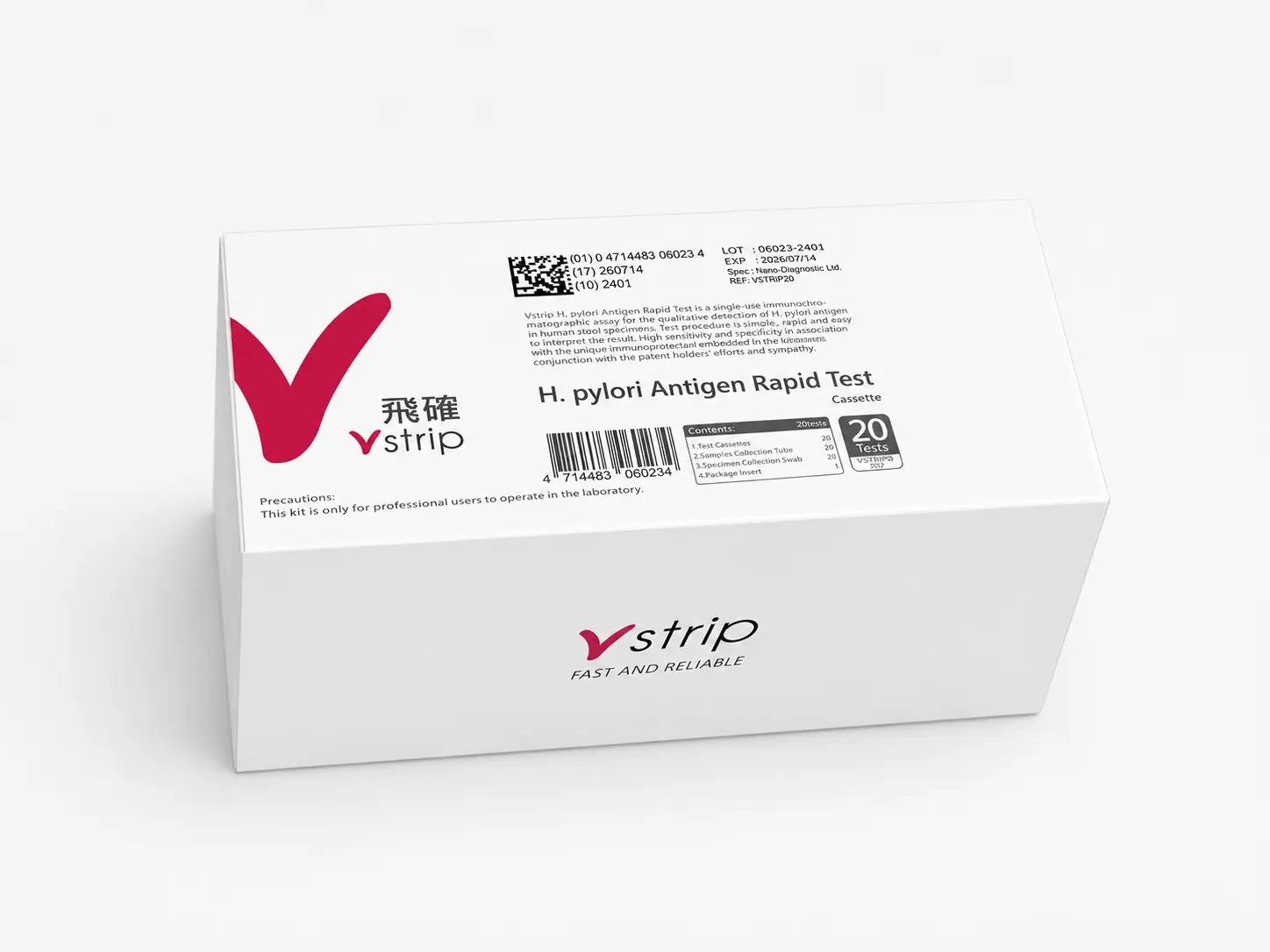
Vstrip H. pylori Antigen Rapid Test is a single use immunochromatographic assay for the qualitative detection of H. pylori antigen in unpreserved human stool specimens. Test results are intended to aid in the initial diagnosis and treatment of H. pylori infection. Test results should be taken into consideration by the physician in conjunction with the patient history and symptoms.
Taiwan-MOHW-MD-(I)-No. 006503(2016/12/02)
United States-K183573(2019/03/14)
Malaysia-IVDB2272919-27984(2019/04/18)
Singapore-DE0503624(2019/09/23)
Canada-111573(2024/07/24)
PANION & BF BIOTECH INC. XIZHI SECOND FACTORY
Performance characteristics of Vstrip H. pylori Antigen Rapid Test are comprised of the following seventeen parts:
Analytical sensitivity_ Inclusivity
Variability – inter & intra assay
Variability – sample volume variation study
Variability – temperature variation study
Variability – read time flex study
Variability – positive control volume variation
Accelerated stability
2-8 degree stool stability
Analytical specificity (Cross Reactivity)
Freeze-thaw cycle stool
Frozen stool stability
Hook effect
Interfering substances
Analytical sensitivity (LOD and Cut-Off value) in a stool matrix
Real-time stability
Shipping test
Clinical study
The data shows that the Vstrip H.pylori Antigen Rapid Test is safe, effective, and meets international standards.
A. Establish a risk-based approach to serve as the basis for company-wide implementation, and determine the processes needed for the quality management system and their application.
B. Determine the sequence and interaction of these processes.
C. Determine the criteria and methods needed to ensure that both the operation and control of these processes are effective.
D. Ensure the availability of resources and information necessary to support the operation and monitoring of these processes.
E. Ensure that monitoring, measurement, and analysis can be performed during the operation of these processes.
F. Ensure the implementation of actions necessary to achieve planned results of these processes, maintain the effectiveness of the processes, and drive continual improvement.
G. Establish and maintain the records required to demonstrate that the quality management system conforms to the ISO 13485 international standard and applicable regulatory requirements.
Procedure of Risk Management System
Identify hazards and medical device related hazard situations identify all foreseeable hazards.
Estimating and assessing the associated risks.
Controlling the risks.
Effectiveness of risk control measures for monitoring.
Risk management progress reports shall be approved by the General Manager and all relevant information shall be controlled. The review information of the risk management file shall include, but not limited to, the following : a. Risk Management Plan b. Risk Management Report c. Annual Risk Management Report d. Relevant test and inspection reports. (DHF) e. Other supporting information or documents. (External documents) f. Post-production and post-marketing, related risk management reports and quality abnormality documents related to risk management.
Systematically collecting and analyzing the usage data of shipped and retailed products in different application environments, including customer complaints, product returns, product recalls, and product usage information. These data are then re-incorporated into product design and management to ensure product safety and applicability, including,
a. Active Collection:The Company shall actively collect data on the usage conditions of its post-market products.
b. Passive Collection:When products have performance or safety concerns, or when an adverse event has already occurred, the Company shall collect data relevant to the aforementioned concerns or events.
If there are confirmed concerns about product performance or risk, or if an adverse event has occurred, the following actions should be taken: Advisory Notice, Adverse Event Notification, or Product Recall.
Regarding post-marketing feedback, the Quality Assurance Department will determine whether preventative and corrective measures should be initiated. The responsible department will then develop a corrective/preventative action plan and complete its contents within the specified timeframe.
Chen MJ, Bair MJ, Chen PY et al. Declining trends of prevalence of Helicobacter pylori infection and incidence of gastric cancer in Taiwan: an updated cross-sectional survey and meta-analysis. Helicobacter 2022; 27: e12914.
Fang Y-J, Chen M-J, Chen C-C, et al. Accuracy of rapid Helicobacter pylori antigen tests for the surveillance of the updated prevalence of H. pylori in Taiwan. J Formos Med Assoc. 2020 .