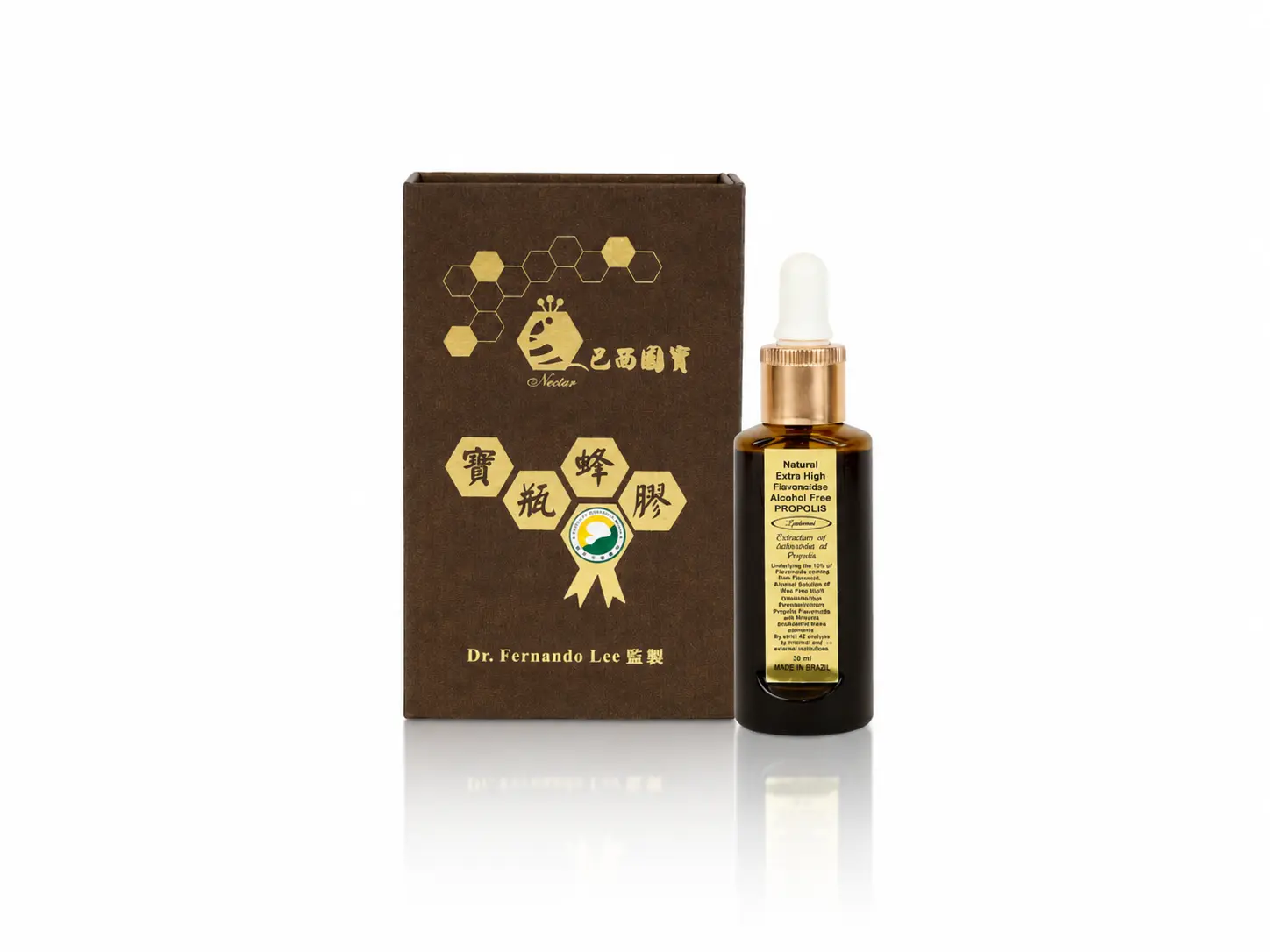
● Extremely high flavonoid content, comparable to medical grade,
Original manufacturer certification, batch-by-batch testing
● The only product developed and authorized by internationally renowned Dr.Fernando
● Imported from Brazil, selected pure and complete whole-plant propolis blocks from all four seasons,
Special blend ratio to preserve the characteristics of different tree species
● High-concentration propolis liquid, free of other compound ingredients
● S.I.F. certification
Brazilian court certification
Dr.Fernando's guarantee
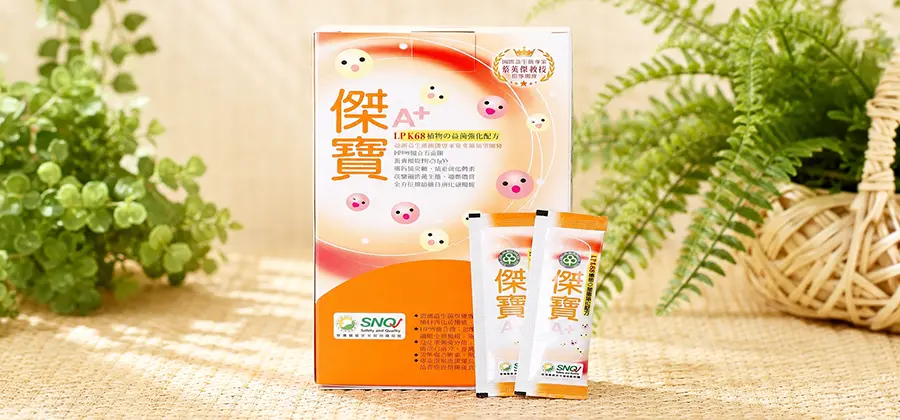
SNQ national mark
Four guarantees, fulfilled in one go
● Required annual inspection and review process,
Currently the only propolis liquid product in SNQ's product line
● High-cost, small-batch controlled production, supercritical extraction method,
Stable quality, free of impurities,
Alcohol-free, non-pungent and non-irritating
Brazilian top-grade propolis extract, USP food-grade propylene glycol
30ml/bottle
Specifications:
Colloid content (W/V %): >45%
Natural flavonoid content (mg/ml): >36%
Brix refractive index (°): >61%
Ingredients: Supervised by Dr. Femando, Faculty of Medicine, University of São Paulo, Brazil
CHANG CHING PAO BIOTECHNOLOGY CO,LTD
The raw materials used should have relevant information or records that can be traced to their sources.
The incoming raw materials should be subject to acceptance procedures to control the quality inspection of single incoming materials, including confirming whether the materials are as described in the above specifications to avoid defective materials from entering the production line and resulting in defective products.
Food additives should be stored in special counters, managed by dedicated personnel, and the types used, the food additive license number, purchase volume, usage volume and inventory should be registered in a special book.
If the temperature, humidity, pH value, water activity, pressure, flow rate or time need to be controlled during the food production process, relevant control methods and standards should be established and recorded. In the production and manufacturing process, ensure that the correct raw materials are used on the production line and confirm whether the operations on the line are carried out according to the standard operating instructions (SOP).
Each batch of finished products should be shipped after confirming its quality assurance; for those found to be unqualified, appropriate handling procedures should be established.
When there are abnormalities in the manufacturing process and quality control, measures to correct and prevent recurrence should be established and recorded.
◎ Staphylococcus aureus
Test Result: Negative
Unit: CFU/g
Test Method: Method of Test for Food Microorganisms - Test of Staphylococcus aureus, amended and announced by the Ministry of Health and Welfare on October 13, 2015 (Announcement No. 1041901818).
Limit of Quantification (LOQ) / Detection Limit: <10
◎ Salmonella spp.
Test Result: Negative
Unit: -
Test Method: Method of Test for Food Microorganisms - Test of Salmonella, amended and announced by the Ministry of Health and Welfare on December 23, 2013 (Announcement No. 1021951187).
Limit of Quantification (LOQ) / Detection Limit: -
◎ Listeria monocytogenes
Test Result: Negative
Unit: CFU/g
Test Method: Method of Test for Food Microorganisms - Test of Listeria monocytogenes in Foods, established and announced by the Ministry of Health and Welfare on August 18, 2022 (Announcement No. 1111901489).
Limit of Quantification (LOQ) / Detection Limit: <10
◎ Pesticide Residues: 410 Items of Pesticide Residues
Test Result: Not Detected (ND)
Unit: μg/g (ppm)
Test Method: Method of Test for Pesticide Residues in Food—Multiresidue Analysis (V) (410 items) (S-AN-PC-01)
◎ Heavy Metals and Elements:
Cu
As
Cd
Hg
Pb
Test Result: Not Detected (ND)
Unit: mg/kg (ppm)
Limit of Quantification (LOQ) / Detection Limit: 2.0
Test Method: General Council for Heavy Metals Test Methods (MOHWH0014.03), amended and announced by the Ministry of Health and Welfare on August 25, 2014; analyzed using Inductively Coupled Plasma Optical Emission Spectrometry (ICP-OES).
※Quality control commitments and responsibilities - Commitment to product quality and quality control responsibilities to meet internal and customer requirements for product quality specifications and continue to improve.
※Establishment of quality control procedures and specifications, formulation of quality control plans - establishment, implementation and maintenance of product quality control procedures and standards, and establishment of product quality specifications that meet internal and customer requirements.
※Establish integrated quality management and implement testing procedures - Integrated quality management is presented in quality control engineering drawings or HACCP plans. Key control points that affect quality specifications are analyzed with reference to HACCP principles, including raw material management, process control, resource capabilities, Technology, packaging, storage or transportation, etc.
※Improve the results and supervise the product manufacturing process - take appropriate measures to improve product quality, which may include changes in manufacturing processes, improvement of equipment maintenance, personnel retraining, etc.
※Product shipping quality, data analysis and evaluation - based on established or customer-specified inspection methods, product quality specifications are inspected and reviewed, and only qualified products can be shipped.