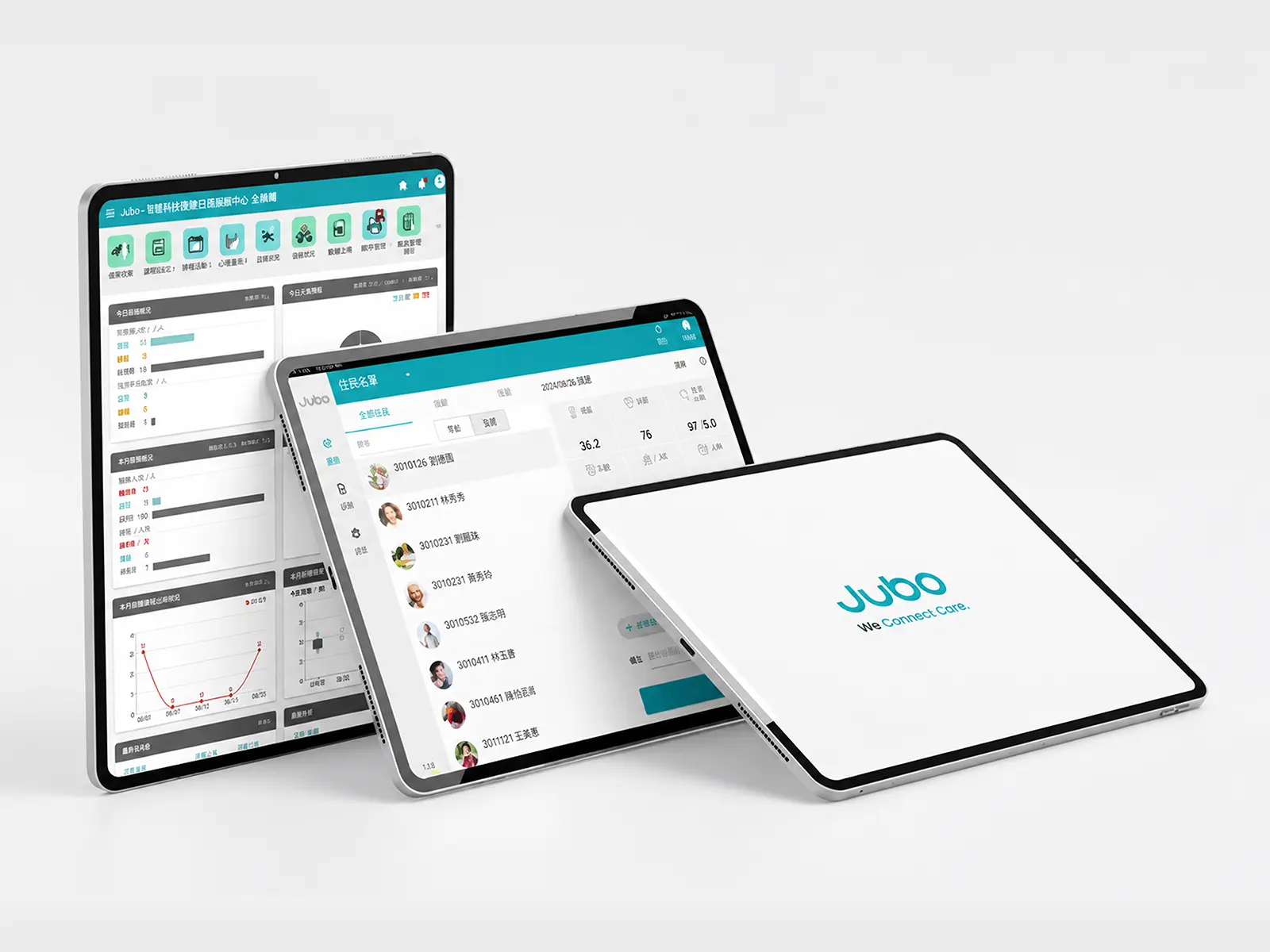
Jubo Longterm Care Solution is designed specifically for residential care institutions, day-care centers, and home-care service providers. Built on a modular and scalable SaaS architecture, the solution provides scenario-specific functions to improve workflow efficiency, reduce documentation errors, strengthen multidisciplinary communication, and reshape the care experience through technology.
1. Residential Care Settings:
To manage complex shift handovers and extensive daily documentation, Jubo leverages AI-assisted handover summaries, integrated digital vitals records, and visualized dashboards. This enables care teams to swiftly grasp historical status and receive real-time clinical risk alerts.
2. Day-Care Services:
Addressing the crucial need for activity transparency and family engagement, Jubo connects providers with families in real time via the ""Family Line 2.0,"" making care progress and elders' daily status highly visible, measurable, and trustworthy.
3. Home-Care Agencies:
To overcome challenges associated with a dispersed workforce and dynamic scheduling, Jubo delivers an integrated system combining mobile operations, smart scheduling management, and AI analytics, helping agencies sustain service quality while optimizing workforce allocation.
By breaking down information silos, Jubo fosters seamless collaboration among nurses, social workers, and caregivers. The collection of structured data is converted into actionable business intelligence, driving operational optimization and quality advancement across the senior care industry.
Jubo Longterm Care Solution is a smart care information system and cloud-based service used for care documentation, operational management, family communication and decision-support in long-term care institutions, day-care centers and home-care agencies. It is not positioned as a medical device requiring market approval.
The company has established management systems aligned with international standards, including ISO 27001 for information security management, ISO 27701 for privacy information management and ISO 13485 for medical device quality management systems. These standards serve as the foundation for product development, operation, maintenance and customer service.
Smart Ageing Tech Co., Ltd.
Product development and updates at Jubo follow a rigorous, iterative lifecycle covering deep user interviews, operational workflow review, prototype design, testing, and continuous field feedback.
1. Core Care Scenario Validation:
Prior to official release, core features—including care documentation, AI-powered shift handovers, smart scheduling, family communication (Family Line), access control, and real-time data synchronization—are subject to comprehensive validation. This process ensures absolute accuracy in data fields, seamless clinical workflows, responsive exception alerts, and rigid cross-device usability and UI consistency between web and mobile platforms.
2.Multi-Environment & Security Verification:
The entire infrastructure is verified through dedicated staging environments, standardized version control, automated issue tracking, and customer feedback databases, allowing continuous product optimization driven by real-world usage data. From an information security perspective, Jubo implements multi-role access control, encrypted transmission (HTTPS/TLS), comprehensive audit logs, and automated backup and disaster recovery mechanisms, successfully maintaining exceptional service stability and long-term care data integrity.
Jubo’s quality control framework focuses on software service quality throughout the entire life cycle, including requirements, development, testing, deployment, and maintenance:
1. Lifecycle Quality Control:
Requirements Phase: User scenarios and data-field logistics are deeply analyzed to ensure features align with actual clinical care workflows.
Development Phase: Standardized source control, peer reviews, and functional checks are strictly applied.
Testing Phase: Data accuracy, workflow completeness, role-based permission settings, and cross-device compatibility are comprehensively verified.
Post-Launch Phase: Dedicated customer success and product teams track reported anomalies, technical correction progress, and user feedback.
2. Maintenance & Data-Driven Improvement:
During long-term maintenance, continuous system infrastructure monitoring, issue risk classification, customer service case management, and meticulous version release notes are utilized to ensure stable cloud service delivery. Furthermore, Jubo leverages key quantifiable metrics—such as customer renewal rates, implementation progress, support response times, and issue resolution rates—as the objective basis for continuous service optimization and PDCA quality enhancement.
Jubo has established a comprehensive risk management mechanism covering platform development, implementation, maintenance, and post-market service:
1. Lifecycle Risk Control:
Development Phase: Potential risks related to requirement changes, functional defects, data consistency, and user operations are rigorously assessed.
Implementation Phase: Standardized training, meticulous permission settings, and data validation processes are utilized to minimize go-live risks.
Maintenance & Post-Market Phase: Continuous infrastructure monitoring, automated backups, proactive incident reporting, and tiered customer support ensure maximum service continuity and high availability.
2. Information Security & Privacy Management:
Jubo strictly applies Role-Based Access Control (RBAC), the principle of least privilege, encrypted data transmission, and comprehensive audit trails. Furthermore, regular off-site backups and disaster recovery protocols are enforced to prevent data loss. The entire risk assessment, improvement tracking, and internal governance framework are carried out in full compliance with international standards, including ISO 27001 (Information Security) and ISO 27701 (Privacy Information), ensuring a highly secure digital environment for long-term care data.
Jubo is certified in ISO 27001 (Information Security) and ISO 27701 (Privacy Information), embedding these international standards thoroughly into our surveillance and management ecosystem. Our governance framework covers proactive prevention, real-time monitoring, and incident response, which encompasses network intrusion prevention, unauthorized access controls, facility access security, and privacy risk management.
For post-market management, we implement a robust Customer Service Framework and a Corrective and Preventive Action system:
1. Proactive Surveillance & Updates:
A 24/7 automated cloud monitoring infrastructure captures system anomalies and triggers immediate developer alerts. Continuous seamless software updates are deployed to resolve bugs and optimize user workflows without service disruption.
2. Comprehensive Support & Incident Management:
Service Hours: Monday to Friday, 9:00 AM to 6:00 PM (Lunch break: 12:00 PM to 1:00 PM), handled by a professional customer success team.
Escalation Protocol: Customer feedback is classified and tracked systematically. Critical anomalies trigger an immediate response from the R&D and QA task force, guaranteeing timely technical mitigation and operational continuity for long-term care facilities.