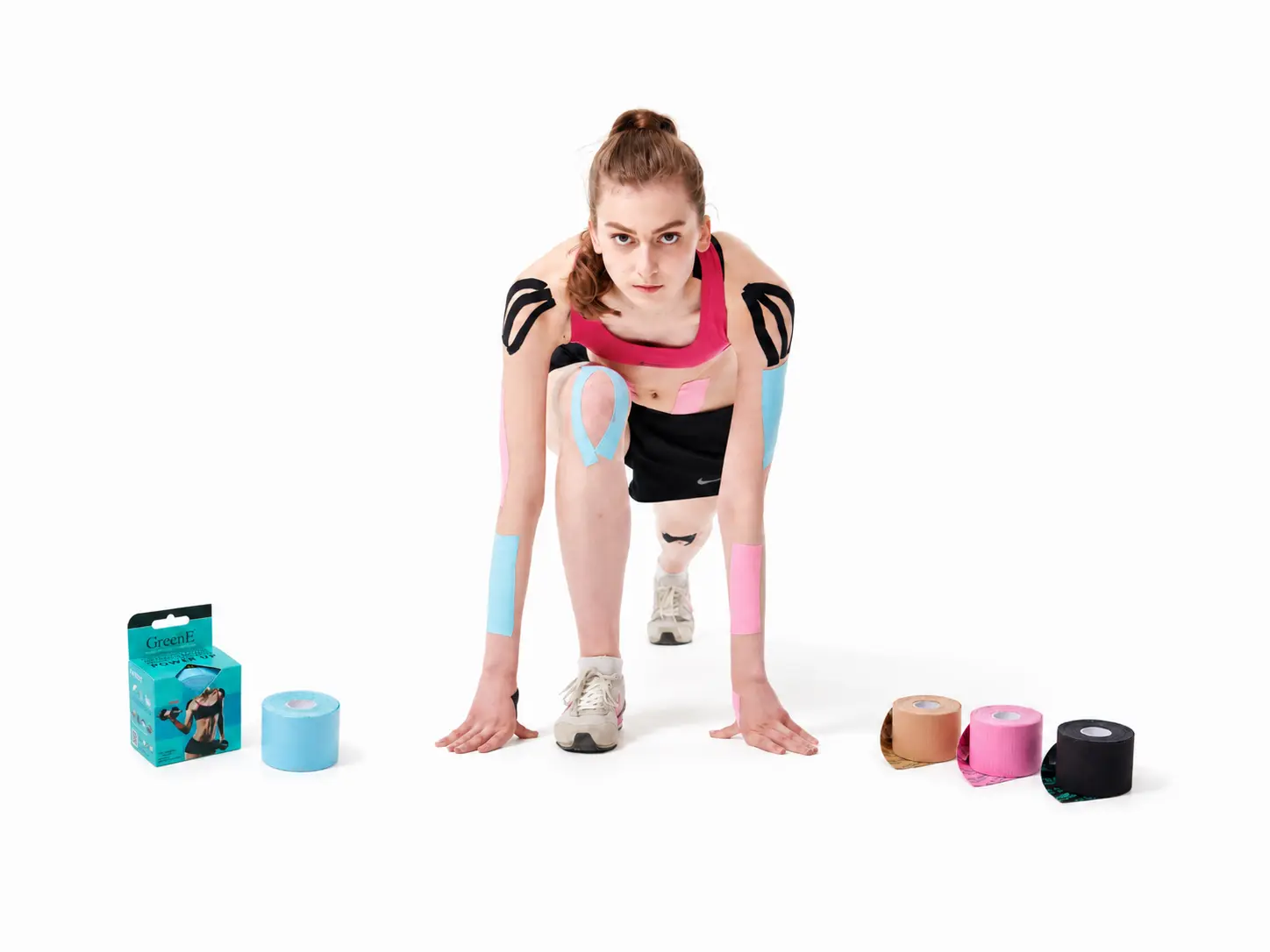
Green Energy Sport Tape is safe, wearable all day, and retains performance after repeated washing. Instead of surface coating, we weave the functional material into the fibers and use a drug-free, medical-grade adhesive that stays gentle and non-irritating. It suits long-term daily use, including by pregnant women (avoiding the abdomen), children, older adults, and athletes, and is everyday supportive care, not a replacement for medical care.
The fabric uses a patented non-powered energy-layer technology, embedding German reagent-grade precious metals (germanium, titanium) into fibers at the molecular level, emitting bio-grade far-infrared energy with an emissivity of 0.93. The composite formula has higher purity than natural minerals, with no radioactive-nuclide concern. Third-party testing showed only about 1% energy loss after 150 washes.
It uses four-way stretch breathable fabric, about 1.6x lengthwise and 2x widthwise, so muscles move freely with a good fit. No taping skills are needed; a small piece on a sore spot or joint is enough and stays in place up to 36 hours. Available in skin tone, black, blue, and pink.
It has undergone human clinical trials with Tri-Service General Hospital, research published in the U.S. National Library of Medicine (NLM), plus independent muscle testing. SGS testing found none of the 312 designated drugs, and skin tests returned zero. It is a far-infrared medical tape (Taiwan MOHW License No. 007713), certified by the US FDA and EU CE.
TFDA Medical Device License No. 007713
有效日期:20250520
Manufacturer Name: Green Energy Nano Technology Co., Ltd.
Manufacturer Registration No.: 65008180
Manufacturer Quality Management (Other): QMS; ISO 9001;ISO13485
During development and production, the product follows the ISO 13485 process for verification and validation. In the R&D phase, work is planned under the Design Development Planning Procedure (Form PFA73101) and the Document and Data Management Procedure (Form P-MA42301), and is released to production only after design verification review, document output, and technology transfer. Mass production runs under an ISO 13485 system, with a Device History Record (DHR) tracked per batch to ensure consistent quality.
Physical and performance test items and grades: the average far-infrared emissivity (wavelength 2-22 um, 25C), measured by the Tzu Chiang Foundation using a TSS-5X emissivity tester, is 0.93. The fabric has four-way stretch, about 1.6x lengthwise and 2x widthwise, and wash testing shows only about 1% energy loss after 150 washes. The product is classified as a Class 1 medical device.
Third-party safety results: for biocompatibility, skin irritation and sensitization tests to ISO 10993-10 both returned no irritation and no sensitization. For pharmaceutical screening, the SGS "312 common Western-drug ingredient analysis" (following the TFDA-recommended method, using TLC, LC/MS/MS, or GC/MS) detected none of the designated ingredients. For radionuclides, testing per standard IAEA-NDS-205, using minimum detectable activity (MDA) as the basis, covered the lead and uranium series and potassium-40, all below MDA (not detected), confirming no radioactive hazard.
ISO 9001 and ISO 13485 Compliance: Our quality management system is built upon ISO 9001 and ISO 13485 standards, ensuring all production and quality control processes meet internationally recognized best practices. We continuously maintain and improve our QMS to align with the latest regulatory requirements and industry standards.
Quality Objectives: We establish specific quality objectives aligned with our corporate strategy, focusing on defect rate reduction, production cycle optimization, and customer satisfaction enhancement. These objectives are communicated across all organizational levels to ensure company-wide understanding and support.
Standard Operating Procedures (SOP): Our SOPs, aligned with ISO 9001 and ISO 13485 requirements, cover product design, manufacturing, testing, and delivery. All employees strictly adhere to these procedures to maintain consistent product quality.
Total Quality Management: We foster a culture of total quality management, engaging all levels from senior management to frontline staff. Regular quality audits and performance assessments are conducted to identify and address potential quality issues.
Continuous Improvement and Training: We implement continuous improvement activities through the PDCA (Plan-Do-Check-Act) cycle to optimize quality management processes. Regular quality management training ensures our staff maintains the necessary expertise to uphold and enhance product quality.
Risk Identification and Assessment:
In accordance with ISO 13485 and QMS requirements, we systematically identify potential risks in our production and operational processes, with specific focus on medical device manufacturing.
We employ risk matrices and FMEA (Failure Mode and Effects Analysis) for risk assessment, classifying risks based on severity and probability.
Risk Control and Mitigation:
For identified high-risk items, we develop and implement specific control and mitigation measures, including enhanced testing, process improvements, and automation implementation.
All control measures are aligned with ISO 13485 risk management requirements to ensure patient and user safety.
Continuous Monitoring and Review:
We maintain ongoing monitoring mechanisms to track and evaluate the effectiveness of implemented risk control measures.
Risk management plans are regularly reviewed and updated to address emerging risks and environmental changes.
Emergency Response and Drills:
Emergency response plans are developed for critical risks, ensuring swift response to incidents while minimizing impact.
Regular emergency drills are conducted to verify plan effectiveness and practicality, with improvements made based on results.
Continuous Improvement: Following ISO 9001 and ISO 13485 continuous improvement principles, we regularly review our risk management processes and implement enhancement measures to further reduce risks and improve product quality.
At GreenE, we follow a thorough development process that goes beyond industry norms by strictly applying ISO 13485 protocols. Our professional teams run full safety and efficacy reviews, and the whole process is documented to keep production stable, consistent, and high in quality.
Our R&D process combines ISO 13485 and GMP standards through two key protocols: the Document and Data Management Procedure (Form P-MA42301) and Design Development Planning Procedure (Form PFA73101). Each product undergoes design verification, document review, and technology transfer before mass production approval.
The Document and Data Management Procedure sets up strong control systems for both internal and external records, ensuring traceability and compliance with quality goals. This system manages the full document lifecycle: creation, review, approval, distribution, revision, and archival of all quality and regulatory records.
The Design Development Planning Procedure gives structured guidelines for product design, addressing market needs and customer requirements across all categories – from new products to enhancements and customized solutions.
Our IP protection framework includes confidentiality agreements for all R&D staff, dedicated project management, and joint oversight by Management and Quality Assurance teams. A robust data system protects experimental data and technical records, maintaining our edge in advanced medical technology.